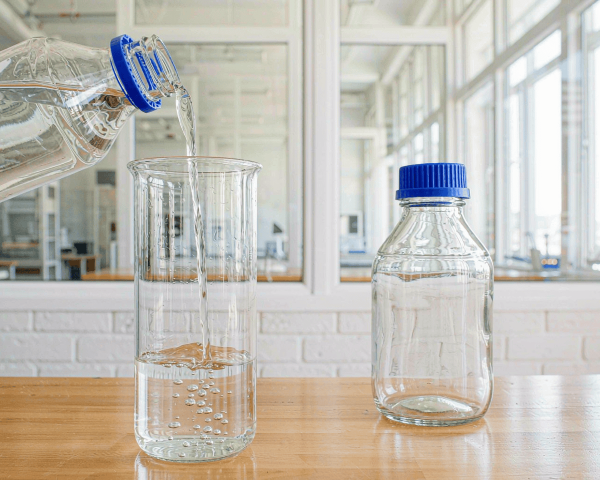

Walk up to any media-bottle shelf and you’ll see two almost identical-looking borosilicate bottles: one with a plain blue screw cap, one with a blue cap plus a soft blue ring sitting on the neck. Both are GL45. Both will hold 500 mL of buffer. But the second one is built for clean pouring, and that small ring is the difference between a tidy bench and a sticky mess. If you’ve ever wondered whether you actually need the pour ring, or what it does, this is for you.
The Short Answer
A “pour ring bottle” is a screw-cap bottle that ships with, or is designed to use, a polypropylene (or ETFE) pour ring fitted around the neck under the cap. The ring catches drips as you pour, so you get drip-free dispensing without removing the cap entirely. A plain screw-cap bottle is cheaper and seals identically for storage; the pour ring is an upgrade you add when you actually pour from the bottle often.
What “Pour Ring” Actually Means
The term trips people up because it’s used two ways in lab catalogs. In one sense, the pour ring is a separate accessory: a soft polypropylene or ETFE ring that slips over the neck of the bottle and sits between the glass and the cap. You pour with the cap on, and any liquid that runs down the outside of the bottle is caught by the ring. In another sense, the cap itself has an integrated spout or “drip-free” geometry that does the same job.
For standard GL45 media bottles (the kind made by DURAN, Schott, Pyrex, and most lab-supply vendors), the pour ring is a separate piece that ships with the bottle when you order the “with pouring ring” SKU. Per the DURAN GL45 amber bottle product page at DWK, the iconic blue polypropylene bottle ships complete with a blue PP cap and a drip-free pouring ring, both rated for use up to 140 °C and fully autoclavable at 121 or 134 °C. Plain cap versions exist too, and they cost slightly less.
Plain Screw Cap vs Screw Cap + Pour Ring
For storage, there’s no practical difference between the two; both seal liquid-tight and both survive repeated autoclaving. The ring matters only when you actually pour from the bottle.
With a plain screw cap, you have two choices. Unscrew the cap entirely, pour, then recap, which means exposed threads and a real risk of contaminating the inside of the bottle with whatever is on the bench. Or “pour through” the cap with the cap off-axis, which works until it doesn’t, and you’ll drip buffer down the side of the bottle every time.
With a screw cap plus a pour ring, you tilt the bottle with the cap still in place. Liquid follows the inner wall of the bottle, hits the rim, and runs down into the ring, which is shaped to channel the drip back into your receiving vessel rather than onto the bench. The cap stays on, the threads stay clean, and the bench stays dry. It’s a small thing, but if you pour from the same bottle fifty times a week, you stop noticing the mess.
Materials Matter: PP, PBT, and ETFE
Pour rings and caps come in three common material families, and the choice matters when you autoclave or work at temperature:
- Polypropylene (PP): the everyday standard. Good chemical resistance, autoclavable to about 140 °C, and cheap. The blue caps and rings on most bench-side media bottles are PP.
- Polybutylene terephthalate (PBT): the high-temp upgrade. PBT caps hold their shape through dry-heat sterilization up to about 180 °C, which makes them the right pick for sterilization ovens and depyrogenation cycles.
- ETFE: a fluoropolymer used for high-end pouring rings and cap liners when you need broad solvent compatibility or trace-metal cleanliness.
DURAN offers both. The high-temperature PBT cap with ETFE pouring ring version lists autoclavability at 121/134 °C and dry-heat sterilization up to 180 °C, a meaningful step up from the standard PP cap and ring combination. If you’re sterilizing in dry heat rather than steam, PBT is worth the small premium.
Sigma-Aldrich’s DURAN GL45 lab bottle listing confirms the bottles comply with ISO 4796-1:2016 for screw-neck laboratory bottles and are manufactured from Type I borosilicate glass per USP, EP, and JP. That’s the spec to look for if you’re storing buffers, media, or reagents under audit.
When You Need a Pour Ring
Pick a bottle with a pour ring if any of the following describe your daily routine:
- You pour from the bottle more than a few times a week.
- The contents are expensive, sticky, or hard to clean up (cell-culture media, glycerol solutions, viscous buffers).
- You want to keep the cap threads dry and clean to avoid cross-contamination.
- You color-code your reagents; pour rings and caps come in blue, green, yellow, red, and gray to match.
The color-coding angle is more useful than it sounds. DURAN ships its caps and rings in matched sets, so a blue ring always pairs with a blue cap. If you swap caps between bottles during a busy prep session, the matching colors catch the mistake before you contaminate a buffer with the wrong reagent.
When You Don’t Need a Pour Ring
There are real cases where a plain screw cap is the better call:
- The bottle is mainly storage; you pour once a month.
- You’re filling via tubing or a pump and not pouring at all.
- You need to minimize cost on a high bottle count (the ring adds a few dollars per bottle at scale).
- You’re working with a solvent that attacks PP or ETFE and need a specialty cap liner instead.
In those cases, skip the ring and put the savings toward a bottle caddy or a clear label system instead.
A Quick Decision Checklist
1. Will you pour from the bottle repeatedly? Yes → get the ring. 2. Are you autoclaving in steam (121 °C) or dry heat (180 °C)? Steam → PP is fine. Dry heat → step up to PBT. 3. Do you color-code reagents? Match the ring color to the cap color. 4. Is the contents expensive or viscous? Pour ring is cheap insurance. 5. Are you primarily storing, not pouring? Plain cap is fine.
Conclusion
A pour ring is one of those small lab accessories that pays for itself the first time you don’t have to wipe buffer off the bench. The screw cap seals identically with or without it; the ring’s job is to keep drips off the bench and contaminants off the threads. For storage-only bottles, skip it. For any bottle you actually pour from in a busy week, the few extra dollars are worth it. If you’re building a media-bottle setup from scratch, my GL45 media bottle guide walks through cap and ring combinations, and my borosilicate reagent bottle guide explains why the glass matters as much as the closure. For autoclave cycles and sterility validation, see how to sterilize reagent and media bottles.
Frequently Asked Questions
Is a pour ring autoclavable?
Yes; standard PP pour rings are autoclavable at 121 °C and most are rated to 140 °C for use. For dry-heat sterilization up to 180 °C, choose a PBT cap with an ETFE ring rather than PP.
Does the pour ring affect the seal?
No. The ring sits outside the cap-to-bottle interface; it has no role in pressure or leak integrity. The seal comes from the cap’s integral liner pressing against the bottle finish, with or without the ring in the stack.
Can I use a pour ring from one vendor with another vendor’s bottle?
For GL45-threaded bottles, yes; the ring geometry is standardized. For non-GL threads, only use the ring that ships with the bottle, since the ring diameter is matched to the bottle’s neck finish.
Do I need a pour ring for cell-culture media?
Strongly recommended. Cell-culture media are sticky, expensive, and easy to contaminate via wet threads. A pour ring keeps the bench clean and keeps the cap threads dry between pours.
What’s the difference between a pour ring and an integrated pour spout?
A pour ring is a separate piece that catches drips on the outside of the bottle. An integrated pour spout is molded into the bottle itself (you’ll see this on some 10 and 25 mL bottles) and lets you pour without a ring at all. Both achieve drip-free pouring; the ring is the dominant pattern for standard GL45 media bottles.