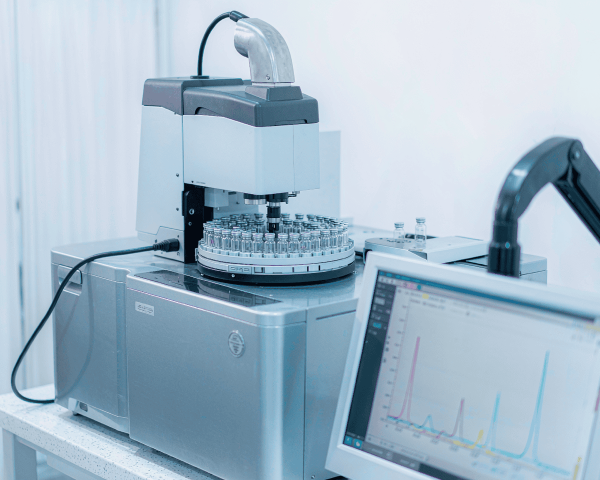

If you run a GC, you’ll eventually get asked “can headspace do this?” The answer is almost always yes, and the list of things headspace GC handles well is longer than most people think. Residual solvents in pills, VOCs in soil, alcohol in blood, off-flavors in juice: these are all everyday headspace applications, and once you’ve seen the method, you’ll start spotting new uses in your own work. Here’s the working list I share when labs ask what headspace is good for beyond the basics.
The Short Answer
Static headspace GC is the right tool whenever you need to measure volatiles in a difficult matrix without injecting the matrix itself. The four biggest application areas are pharmaceutical residual solvents, environmental VOCs, food and packaging volatiles, and forensic blood-alcohol analysis. Each area has well-established regulatory methods, vendor application notes, and reference columns you can lean on.
Why Headspace Works for So Many Things
Static headspace separates the volatile fraction from the sample matrix before the gas ever hits the column. Per the Sigma-Aldrich residual analysis technical document, this gives you three wins over direct liquid injection: minimal sample preparation, far less matrix contamination reaching the column, and cleaner baselines. The sample (solid, liquid, viscous, or even polymeric) sits in a sealed vial, equilibrates at a controlled temperature, and only the gas phase gets injected.
That same logic is what makes headspace useful across pharma, environmental, food, forensic, and industrial labs. The sample may be wildly different in each case, but the volatiles you’re after behave similarly in a closed vial.
Pharmaceutical Residual Solvents
This is the canonical headspace application and the easiest one to validate against published methods. Per the Shimadzu HS-10 headspace sampler brochure, the United States Pharmacopeia General Chapter <467> classifies residual solvents as Class 1 (high risk), Class 2 (moderate risk), and Class 3 (low risk), with prescribed signal-to-noise and resolution requirements for each. Headspace GC is the default technique for Class 1 and 2 methods, and instruments like the HS-10 routinely clear the spec with S/N > 200 for 1,1,1-trichloroethane and resolution > 1.0 for the acetonitrile/methylene chloride pair in Class 2A.
The Sigma-Aldrich article above confirms that headspace grade solvents, USP and Ph.Eur. residual-solvent standards, and ICH-aligned methodology all assume headspace GC as the workhorse. If you’re auditing residual solvents in an API, excipient, or finished drug product, headspace is almost always the answer. For a primer on the workflow itself, see my headspace analysis explainer.
Environmental VOCs
Environmental labs lean on headspace because soil, sediment, and solid-waste samples can’t go through a syringe. The U.S. EPA’s SW-846 Method 5021A covers equilibrium-based static headspace preparation of volatile organic compounds in exactly those matrices (soil, sediment, solid waste, aqueous, and water-miscible liquid samples) for determination by GC or GC/MS. Method 5021A is paired with determinative methods 8015, 8021, or 8260 depending on whether you’re looking at nonhalogenated organics, halogenated VOCs, or full-scan unknowns.
EPA 5021A is also explicitly useful for fuel oxygenates when both ethers and alcohols are target analytes; that’s the classic MTBE/ETBE/TAME problem in groundwater, where direct injection is hard because of the water matrix. For an even more sensitive alternative, EPA also publishes RSKSOP-175 for dissolved gases like methane, ethane, and ethylene in groundwater by static headspace, which is the standard method for landfill monitoring and stray-gas investigations.
Food, Beverage, and Packaging
Headspace is everywhere in food QC, often invisibly. The Sigma-Aldrich residual analysis article notes that headspace GC applications in food extend beyond pharma into residual solvents in foods, dietary supplements, and packaging materials. Beyond residual solvents, the same instrument handles:
- Flavor and aroma profiling: beer hop oils, wine off-flavors, fruit esters, dairy volatiles.
- Packaging migrants: solvents and monomers that migrate from plastic packaging into food.
- Spoilage indicators: biogenic amines, sulfur compounds, off-odor volatiles.
The Shimadzu HS-10 brochure demonstrates that headspace is sensitive enough to detect volatile contaminants in water at the 10 µg/L level when paired with an ECD. The same sensitivity carries over to food-matrix work where you need trace detection without the matrix loading down the column.
Forensic Blood Alcohol
Blood alcohol analysis is one of the oldest headspace applications, and it’s still the industry standard for forensic toxicology. A 2014 method paper indexed on PubMed (PMID 24648310) describes a headspace GC-MS method for ethanol in whole blood using n-propanol as the internal standard, with linearity from about 40 to 1,260 µg/mL, a limit of detection of 0.4 µg/mL, and a 5-minute isothermal GC run. The authors explicitly call out headspace GC as the forensic standard because of its selectivity and minimal sample prep.
A complementary UK-based method published in PMC describes a headspace GC-FID method validated to UK forensic toxicology specifications with dual columns and dual detectors for simultaneous ethanol quantitation. If you’ve ever wondered why DUI blood work goes through headspace, this is why — it’s fast, robust, and legally defensible.
Polymers, Materials, and Industrial QA
Headspace also shines when the sample isn’t a liquid at all. ASTM D4526 covers static headspace determination of volatiles in polymers, and ASTM D8028 covers dissolved gases in water by static headspace sampling. Common applications:
- Residual monomers in polymers: styrene in polystyrene, acrylonitrile in ABS, caprolactam in nylon.
- Volatiles in paints, adhesives, and inks.
- Photoresist solvents in the semiconductor industry.
- Volatile impurities in fuel cell catalysts and battery materials.
These are harder to find in vendor application notes but are very real in industrial QA. The same headspace workflow applies: weigh the sample, seal it, equilibrate at the right temperature, and inject the gas phase.
A Quick Application Checklist
1. Is your analyte volatile and present in a difficult matrix? Headspace probably works. 2. Is there a published regulatory method (USP, EPA, ASTM) for your analyte in this matrix? Use that method. 3. Is your detection limit in the ppm-to-ppb range? Static headspace handles it; switch to purge-and-trap only if you need ppt. 4. Is your matrix solid, viscous, or polymeric? Headspace will save your column. 5. Do you need legally defensible quantitation? Headspace is the forensic standard for a reason.
Conclusion
Headspace GC is one of those techniques that keeps finding new applications because the principle is so simple: keep the matrix out of the GC, measure only the gas. The five biggest application areas are pharmaceutical residual solvents, environmental VOCs, food and packaging volatiles, forensic blood alcohol, and polymer/materials analysis. Each has well-developed methods, vendor application notes, and regulatory references you can build on. If you’re new to the technique, my headspace analysis explainer covers the workflow from vial to chromatogram. For the consumables side, my headspace vial selection guide walks through vial volume, cap geometry, and septum choices, and my GC-MS vial primer covers the related GC workflow.
Frequently Asked Questions
What is headspace analysis most commonly used for?
The single largest application is pharmaceutical residual-solvent analysis under USP General Chapter <467>. Environmental VOC analysis (EPA 5021A and related methods), food and packaging volatiles, and forensic blood-alcohol analysis are the next three largest use cases.
Is headspace GC quantitative?
Yes, when run properly. Static headspace is a partition-based technique that follows Henry’s law, so the gas-phase concentration is proportional to the original sample concentration at equilibrium. Most regulatory methods (USP <467>, EPA 5021A) publish acceptance criteria for linearity, accuracy, and precision.
When should I use static headspace vs purge-and-trap?
Static headspace is simpler, faster, and works down to the low-ppb range for most volatiles. Purge-and-trap (dynamic headspace) is more sensitive (into the low-ppt range) but requires more maintenance and is more sensitive to foaming samples. Reach for purge-and-trap only when static headspace can’t reach your detection limit.
Can headspace GC analyze solid samples?
Yes. Static headspace is well suited to powders, soil, polymers, and other solids because only the gas phase is injected. EPA Method 5021A explicitly covers soil, sediment, and solid-waste matrices for exactly this reason.
How do I choose between headspace and SPME?
Solid-phase microextraction (SPME) is a fiber-based technique that concentrates volatiles onto a coated fiber before injection. It is more sensitive for some analytes and excellent for field work, but it is also more operator-dependent and slower. Static headspace is the right default for routine quantitative methods; SPME is the right choice for trace analysis or when minimal solvent use matters.