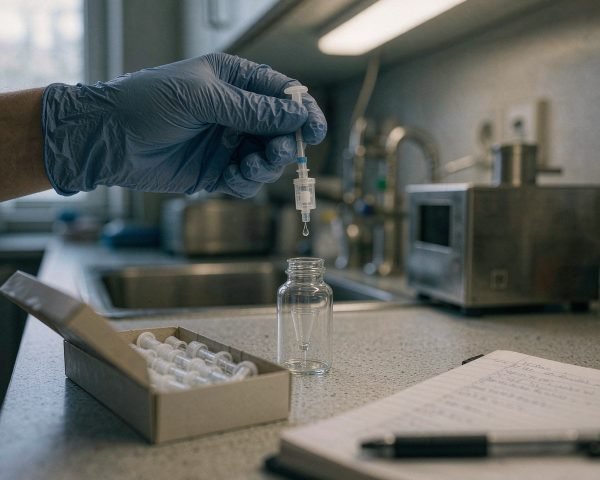

You push 200 µL of precious extract through a fresh 0.45 µm filter and recover 140 µL. The filter isn’t defective. Some of your sample is stuck inside it, and part of that loss is what manufacturers call wetting volume.
Answer: Minimum wetting volume is the amount of liquid required to fully wet a filter membrane and precondition it so sample flows through cleanly and reproducibly. Hydrophobic membranes like PTFE need the most; hydrophilic membranes need little. Whatever the membrane, the first portion of filtrate partly belongs to the filter, not to you.
Here’s what’s happening inside the device, where the numbers come from, and how to stop losing sample you can’t replace.
Wetting vs Hold-Up: Two Different Losses
These two get confused constantly, and both quietly shrink your recovery.
Wetting volume is the liquid absorbed by the dry membrane as it wets out. A hydrophilic membrane (PES, nylon, PVDF) wets instantly with water, so this loss is small. A hydrophobic PTFE membrane repels water until it’s pre-wetted with a miscible solvent like methanol or isopropanol, which is why PTFE filters “refuse” aqueous samples out of the package.
Hold-up volume is the liquid that stays physically trapped in the device after you finish pushing: in the membrane pores, the support layers, and below the outlet. On a 13 mm filter that can be under 25 µL; on a 25 mm device it can approach 100 µL or more.
Wetting loss is front-loaded and one-time. Hold-up loss is structural and every time. If you are fighting small recoveries, our breakdown of syringe filter hold-up volume covers the second half of the problem in detail.
Where You’ll Meet the Term
Vial-and-insert datasheets list it as a minimum fill volume. Filter datasheets list wetting volumes for hydrophobic membranes. Autosampler manuals discuss it as needle reach or bottom-sensing volume. Same physics, three vocabularies.
The practical convergence: whatever the document calls it, the question behind the number is identical. How much liquid has to be present before the hardware in front of you behaves like the drawing? When someone hands you a “minimum volume” without explaining which mechanism it covers, ask whether it is a wetting number, a hold-up number, or a needle-reach number. The fix for each is different.
Why the First Milliliter Behaves Badly
Even on a pre-wetted filter, the first portion of filtrate is the most “edited” portion of your sample. Surfaces inside the device are fresh, binding sites are empty, and adsorption is at its strongest.
Merck Millipore’s performance data on hard-to-filter samples shows the effect starkly: filters containing glass fiber prefilters bound 15-25% of a drug compound in the first milliliter filtered, while membrane-only filters showed no binding at all. Quantitative recovery only arrived by the third milliliter.
That finding is why validation protocols talk about discarding an initial filtrate fraction. The right discard volume is not folklore. It’s something you demonstrate for your analyte, your membrane, and your volume. Our article on filter lot validation walks through building exactly that experiment.
The Numbers That Matter for Your Bench
Rough expectations, assuming water-like samples and standard devices:
| Filter format | Typical wetting + hold-up loss | Practical minimum sample |
|---|---|---|
| 4 mm | ~5-10 µL | ~50 µL |
| 13 mm | ~15-30 µL | ~100-150 µL |
| 25 mm | ~50-125 µL | ~300-500 µL |
| 25 mm PTFE (aqueous, unprewetted) | can refuse or pass mostly air | pre-wet required |
Two consequences fall out of that table. One, if your sample volume sits below the practical minimum for your filter format, step down to a smaller diameter. Two, if you’re using PTFE for solvent compatibility but injecting aqueous mobile phase, pre-wet the membrane with methanol and push it through, or switch to a hydrophilic PTFE variant.
I learned the PTFE lesson the expensive way. A 250 µL derivatized extract, one 25 mm PTFE filter straight from the box, and twenty minutes of pushing that produced an air bubble and nothing else. The remaining sample went into the next method’s failure investigation. A 13 mm hydrophilic PTFE costs pennies more and would have saved the afternoon.
How to Stop Losing Precious Sample
Match the device to the volume and the losses mostly disappear.
- Shrink the diameter. A 13 mm filter has about four times the membrane area of a 4 mm one, and proportionally more wetting and hold-up. Small sample, small filter.
- Use low hold-up designs. Many 13 mm filters now specify hold-up below 25 µL. The spec sheet tells you.
- Pre-wet hydrophobic membranes with a small volume of methanol or isopropanol when your sample is aqueous, then flush with sample before collecting.
- Condition with sample. Push one small aliquot through and discard it, then collect. That saturates the adsorption sites that would otherwise eat your analyte.
- Consider centrifuge or filter vials for volumes under 100 µL, since they decant directly into the insert with minimal dead space.
If your volume problem is chronic, our article on low analyte recovery and whether the vial is to blame covers the adsorption side of the ledger, which sometimes dwarfs filtration losses.
For samples that genuinely cannot spare a drop, low-volume hardware exists for exactly this problem. Waters’ total recovery vial and insert options are built around pulling the needle reach close to the last 10 µL of liquid, and most suppliers now offer equivalent conical inserts. Pair the hardware choice with a validated discard: GenFollower’s filter validation guide shows how to collect sequential fractions and prove, rather than guess, how much filtrate to throw away.
Conclusion
Minimum wetting volume sounds like a spec-sheet footnote until it eats a fraction of an irreplaceable sample. Know your filter format’s typical loss, pre-wet PTFE before aqueous work, condition the membrane with a discard aliquot, and downsize the device when the volume is small. Do those four things and the filter stops being a hidden dilution step. For the adjacent problem of liquid trapped after filtration, read our hold-up volume guide, and for choosing inserts that stretch tiny volumes further, see our guide to recovery vials. Ten minutes of checking specs at order time beats losing a fraction of a sample you cannot re-collect.
Frequently Asked Questions
Is minimum wetting volume the same as hold-up volume?
No. Wetting volume is the liquid absorbed while the membrane first wets out; hold-up volume is liquid trapped in the device that never comes out. Both reduce recovery, but wetting loss is a one-time conditioning cost while hold-up is structural.
Do I need to pre-wet PTFE syringe filters?
Yes, if your sample is aqueous. Untreated PTFE repels water, so the filter will pass air, stall, or deliver erratic flow. Push a small volume of methanol or isopropanol through first, followed by sample or mobile phase.
How much filtrate should I discard before collecting?
There is no universal number. Validate it: collect sequential fractions, measure recovery in each, and pick the smallest discard that gives quantitative recovery for your analyte and membrane. Common practice ranges from a few drops to the first milliliter.
Which filter is best for samples under 100 µL?
A 4 mm low hold-up filter or a filter vial setup. Both minimize the wetted area and trapped volume so most of your sample reaches the vial instead of the membrane.