
A 0.5 mm gap at a column inlet sounds like nothing. It costs you about 23% of your column efficiency, and it happens every day on benches where somebody reused a swaged fitting from a different column brand.
Answer: Zero-dead-volume (ZDV) means a fitting design with no empty space in the flow path. Tubing butts directly against the seat, so sample flows without mixing pockets. Get it wrong and dead volume broadens peaks, kills resolution, and quietly wrecks UHPLC performance.
Here’s where that gap comes from, what it costs you, and how to make connections that stay void-free.
Where Dead Volume Actually Comes From
Every LC connection has two parts: the tubing and the fitting that holds it. Dead volume appears when those two parts don’t meet flush.
The common causes:
- Tubing not pushed fully home while the nut was tightened
- A ferrule swaged at the wrong depth for the new column
- Mixing fitting brands, so the stem length doesn’t match
- Worn PEEK ferrules that have deformed one too many times
That last one deserves a story. A colleague of mine reused the same PEEK nuts on a 2.1 mm column for a month of method development. Peaks got fatter week by week. Not drift, not temperature. The ferrule had deformed enough that the tubing sat 0.3 mm proud of the seat. Fresh nuts, and the plate count jumped back overnight.
Fittings Vocabulary in One Minute
Three terms get used loosely, so here is the bench version.
The fitting is the nut plus ferrule assembly that grips the tubing. The ferrule is the ring that deforms to make the seal; it is the part that “remembers” depth. The seat is the coned surface inside the column port that everything presses against.
Zero-dead-volume describes the goal of the assembly: tubing end flush with the seat, no pocket. Manufacturers also sell unions labeled ZDV, which simply means their internal geometry leaves no room for a gap when assembled correctly. The label does not protect you from a ferrule swaged at the wrong depth; careful assembly does.
Why Small Volumes Hurt Small Columns
The math is unforgiving. A void of 1 mm inside a standard fitting adds roughly 2 µL of volume. On a 150 × 4.6 mm column, that’s under 1% of the system volume and you’ll never see it. On a 50 × 2.1 mm UHPLC column with about 103 µL of interstitial volume, the same 2 µL is closer to 2% all by itself, stacked on top of the 10-20 µL your system already contributes.
Crawford Scientific’s guide to UHPLC connections walks through this scaling problem in detail, including how a fitting that’s fine on one system ruins a smaller column.
Extra-column volume doesn’t just spread the peak. It eats resolution between closely eluting pairs, which is exactly where quantitative methods live.
What “Zero-Dead-Volume” Actually Means in a Fitting
A ZDV fitting is designed so the tubing end seats flush against the mating surface, leaving no pocket where sample can sit, mix, and re-enter the flow late.
Three design features do the work:
1. A coned seat that lets tubing bottom out against the port 2. Ferrule geometry matched to the tubing OD and the port depth 3. Enough clamping force to keep everything seated under pressure
The tricky part is that “flush” depends on stem length, the distance tubing protrudes past the ferrule. Column manufacturers don’t agree on that distance. Avantor’s ACE knowledge note on UHPLC column connections shows measurable efficiency losses from a 0.5 mm installation gap and explains why reusable fittings that allow a “fresh connection” each time avoid the problem.
Practical Rules for Void-Free Connections
You don’t need new hardware for most of this. You need habits.
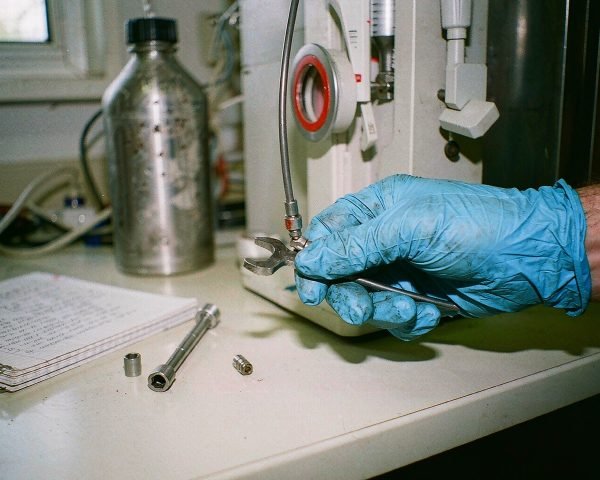
- Bottom the tubing out and hold it there while you tighten. Sounds obvious; watch a busy bench and count how many people skip it.
- Make a fresh ferrule seat for each new connection when depths might differ. PEEK deforms, and a deformed ferrule can’t re-seat.
- Don’t mix stainless and PEEK hardware across brands. The stem lengths disagree.
- Retighten once after the first pressure cycle. Everything relaxes a little under heat and pressure.
LabRulez’s summary of an LC connections webinar reports that switching from 0.17 mm to 0.12 mm ID capillaries cut dispersion by more than half and roughly doubled resolution, which tells you how much the small plumbing decisions add up.
One more habit worth stealing from instrument technicians: keep a short log per system of which fittings were used and when they were remade. When an efficiency mystery appears three weeks later, that log turns a day of guessing into a ten-minute answer.
A 10-Minute Dead Volume Audit
Run this once a quarter on any system that matters.
Replace the column with a union, inject your standard, and note the peak width. Then rebuild the column connection deliberately: bottom the tubing, finger-tight, wrench a quarter turn. Inject again and compare.
If the rebuilt connection gives narrower peaks, the old one was leaking volume into your chromatogram. If widths match, note the date and move on. Either way you have a baseline for the next quarter.
While you’re at it, check the two connectors people never touch: the one behind the injection valve and the one at the detector inlet. They age in silence, and they are exactly the kind of slow leak that gets blamed on the column.
When Suspect a Dead Volume Problem
The symptoms are consistent across labs:
- Peaks broader than the method’s history suggests
- Resolution loss on early-eluting pairs
- Efficiency that changes after column swaps but not after mobile phase changes
- Plate counts that differ between two “identical” systems
If you see these, check the connections before you blame the column. Replace the newest fitting first, and bottom every tubing end as you go. Ten minutes of plumbing beats a week of method revalidation.
It’s also worth separating this from the volume that lives inside your sample path before injection, like filter hold-up. We cover that cousin problem in our guide to syringe filter hold-up volume.
Conclusion
Zero-dead-volume is a small phrase for a big fraction of your chromatography quality. A fitting with no voids keeps extra-column volume where it belongs: near zero. Bottom your tubing, match your ferrule geometry to the port, make fresh connections when you change hardware, and treat any unexplained peak broadening as a plumbing question first. If you want to go deeper on protecting the column itself, read our guide to guard columns as cheap insurance, and if you’re moving methods between labs, our method transfer checklist covers the consumable details that usually get missed. Both take ten minutes to read and save hours of rework.
Frequently Asked Questions
What is the difference between dead volume and dwell volume?
Dead volume (extra-column volume) is empty space in the flow path after injection that broadens peaks. Dwell volume is the volume between the mixer and column head in a gradient system, which delays the gradient. Both hurt, but in different ways.
Can I fix dead volume by tightening the fitting harder?
No. Over-tightening deforms ferrules and can crack fittings, which creates new voids and leaks. Push the tubing fully home, tighten to spec, and remake the connection with a fresh ferrule if a gap persists.
Do PEEK fittings wear out?
Yes. PEEK ferrules deform each time they’re compressed, and after several remakes they no longer conform to the seat. If a connection starts leaking or broadening peaks after reuse, replace the nut and ferrule as a set.
How can I measure my system’s extra-column volume?
Replace the column with a zero-dead-volume union, inject a small plug of UV absorber (0.1% acetone in water works), and measure the peak width at 4 sigma. That number is your system’s ECV, and it’s the budget every connection has to live within.