
# Tobacco Testing Lab Consumables: The Complete Guide
A tobacco lab runs on a short list of consumables that nobody outside the industry thinks about. Pad holders, smoking chambers, Cambridge filter pads, extraction vials, DNPH cartridges. This guide covers what each test needs and where labs usually run short.
Tobacco testing lab consumables are the items a cigarette or vape lab burns through daily: Cambridge filter pads, smoking machine glassware, extraction and autosampler vials, DNPH cartridges, and syringe filters. Most are method-defined, so the wrong specification can invalidate a run.
If you manage procurement for one of these labs, the hard part is not finding suppliers. It is knowing which specifications are negotiable and which are written into the method, then stocking accordingly. I have put together everything I know from years around smoking machines and chromatography benches, including the mistakes that cost labs their data.
What a Tobacco Testing Lab Actually Does
Before you can buy for the workflow, you need the workflow. Tobacco labs fall into a few overlapping categories, and a large regulatory lab does all of this under one roof.
Smoke collection and mainstream analysis
The signature work is machine smoking. A smoking machine draws puffs from a cigarette under controlled conditions and catches what comes out. The smoke splits into two streams: the particulate matter lands on a filter pad, and the gas phase passes through to a carbon monoxide analyzer or an impinger.
From that pad, analysts extract “tar” (total particulate matter), nicotine, and sometimes menthol or other flavors. The numbers on a pack, or the yields submitted to a regulator, start on that pad. Everything upstream, the pad itself, the holder, the glassware, has to meet the method or the whole chain of numbers is questionable.
Conditioning and reference products
Nothing gets smoked straight out of the box. Cigarettes, cigars, and sample tubes condition for at least 48 hours at 22 °C and 60% relative humidity before a run, and the pads themselves equilibrate in the same room. Labs use conditioning trays and lidded jars for this, and they run monitor cigarettes (the CORESTA Monitor series, CM7 and CM8 at the time of writing) on every machine to prove the setup is in control. The consumables here are humble, but a cracked conditioning jar lid in a dry winter lab can quietly undo the whole 48-hour ritual.
Chemistry on the tobacco itself
Separate from smoke, labs test the filler tobacco. The standard panel includes moisture content, pH, sugar and glycerol levels, fill value, and the four tobacco-specific nitrosamines (TSNAs), a group of carcinogenic compounds found only in tobacco and its smoke. TSNA work in tobacco and smoke is an LC-MS/MS job, and it is usually the most method-sensitive line in the lab.
E-liquid and vape product testing
Since regulators expanded their scope, most tobacco labs also handle electronic nicotine delivery products. Typical assays: nicotine content and nicotine salt identity in the e-liquid, impurities, carbonyls in the aerosol, and heavy metals. The consumables overlap heavily with pharma QC, which is convenient if you already stock for HPLC work. We have a dedicated article on vape and e-liquid testing consumables if that is your main workload.
The Standards That Dictate Your Consumables List
Tobacco testing is unusual because the methods specify not just the analysis but the physical setup, down to the airflow around the cigarette. That is why consumable specifications here are less negotiable than in, say, general pharma QC.
The ISO smoking machine standards
ISO 3308 defines the standard smoking regime: a 35 mL puff drawn for 2.0 seconds once every 60 seconds, with cigarettes smoked to a defined butt length. The companion standard, ISO 4387, covers how total particulate matter is collected on the filter pad and then converted into nicotine-free dry particulate matter. If your machine smokes to these parameters, your pads, holders, and chambers must match what those methods assume.
There is also the intense regime, ISO 20778, which mirrors Health Canada conditions: 55 mL puffs every 30 seconds with ventilation holes blocked. Yields under intense smoking run much higher, and that changes which pad sizes and dilution steps you need.
CORESTA, Health Canada, and method harmonization
CORESTA, the Cooperation Centre for Scientific Research Relative to Tobacco, publishes Recommended Methods that most commercial labs follow. Its Recommended Method No. 75 is the reference procedure for TSNAs in mainstream smoke by LC-MS/MS, collected on a Cambridge pad under both ISO and intense regimes. Health Canada’s official method T-115 is the origin of the intense smoking conditions many regulators still ask for.
FDA requirements in the US market
In the United States, the FDA’s Center for Tobacco Products requires product testing for premarket tobacco applications and for listing harmful and potentially harmful constituents. The agency publishes its expectations in guidance documents, including a recent one on the validation of analytical testing methods used for tobacco products, found on the FDA tobacco guidance page. One practical consequence: consumable lot records and certificates now feed directly into the validation file, so treat documentation as part of the product.
Cambridge Filter Pads: The Consumable You Burn Through
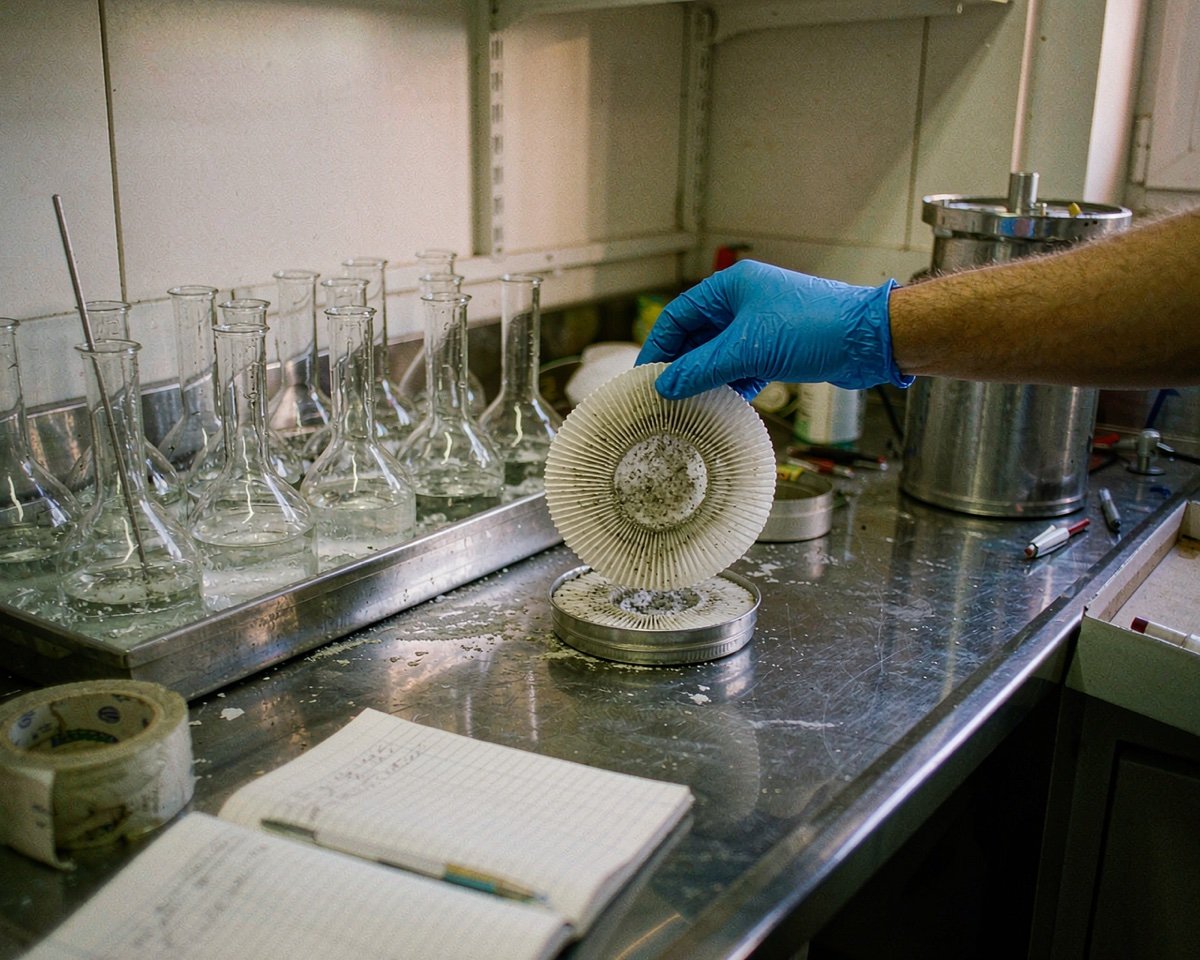
If the smoking machine is the heart of the lab, the Cambridge filter pad is the part that beats. A standard 92 mm circular pad of bonded borosilicate glass fiber catches the particulate phase from up to five cigarettes (some labs use 44 mm pads for single-stick work). Pads are rated and specified in the methods, so you cannot substitute a generic fiberglass pad from the hardware store and expect comparable tar numbers.
Handling matters as much as specification
A pad gains or loses weight with every careless touch. Moisture pickup from bare hands, fiber loss from rough handling, static that flicks fibers off the balance pan: all of it shows up in your TPM result. Pads should equilibrate in the conditioning room alongside the cigarettes, typically at 22 °C and 60% relative humidity, then be weighed within a defined time window after smoking.
I once watched a full week of tar results get thrown out because a new technician stacked conditioned pads on an open bench near the window on a humid day. The pads gained weight before they were ever weighed. Nobody caught it until the quality control samples came back high. The fix was cheap, a lidded pad carrier, but the repeat week was not.
What to stock
Pads are cheap per unit and consumed at a rate tied directly to machine capacity. A 20-port rotary machine running a full day can burn through 100 to 200 pads between samples, blanks, and repeats. My default advice is to order pads by the case and set a reorder point at two weeks of peak demand, because pad shortages have a nasty habit of coinciding with regulatory submission deadlines. Buy from a supplier who can show consistency lot to lot; a pad with different fiber packing changes airflow and skews yields.
Glassware on the Smoking Machine
The glass components see heat, moisture, and constant handling, and they are method-defined equipment rather than simple accessories.
Fishtail holders and smoking chambers
Cigarettes sit in fishtail holders whose outlet is a thin flattened slot that spreads the smoke across the pad surface evenly. Chambers and holders are ground-glass matched to the machine. Chips on the glass sealing surfaces leak, and a leak changes puff volume, which changes every number downstream. Inspect the ground glass joints whenever you clean, and keep spare holders on hand because a dropped fishtail can idle a port for weeks while you wait for a replacement.
Cleaning glassware between runs is a consumables decision too. Most labs use solvent rinses followed by baking. If you outsource cleaning or use a washer, watch for detergent residue, since it can trap nicotine and bias low-level results. Identification is part of the system: etched or printed numbers on holders and chambers, plus solvent-resistant labels on traps, save an afternoon of guessing which fishtail goes to which port. Ordinary paper labels and marker ink do not survive an acetone rinse, as at least one technician finds out the hard way every year.
Impingers, traps, and special captures
Gas phase work uses impinger bottles with fritted or straight spargers. Menthol and other semi-volatiles can need a trap chain, where the smoke passes through a cooled solvent trap before the pad. The menthol assay is a good example of why consumables multiply quietly: one extra analyte adds traps, solvent, crimped collection tubes, and a GC vial spec of its own.
Smoke Chemistry Consumables: TSNAs and Carbonyls
Downstream of the pad, the work moves to chromatography, and the consumable list starts to look like any LC-MS lab’s, with a few tobacco-specific twists.
TSNA analysis by LC-MS/MS
For smoke TSNAs, the pad is extracted with an ammonium acetate buffer containing isotopically labeled internal standards, then the extract is filtered or centrifuged and injected. NNN, NNK, NAT, and NAB are the four reported compounds. Sensitivity requirements are brutal: these analytes sit near detection limits for some products, so extractables from vials and filters become a real analytical risk, not a theoretical one.
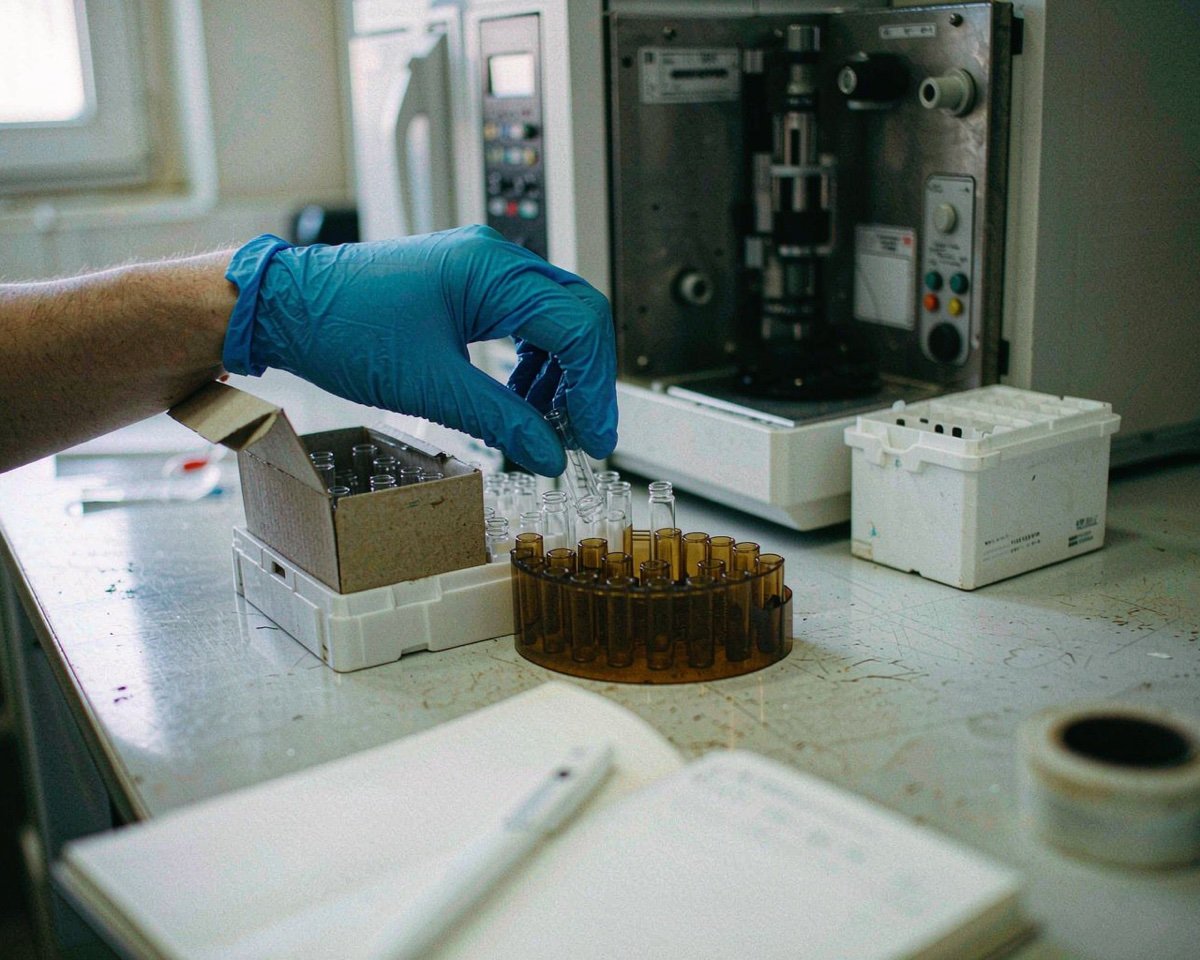
Use amber or clear glass autosampler vials with low-bleed PTFE/silicone septa, and if your method runs sub-ng/mL calibrators, consider low-adsorption or silanized glass, because pyridine-containing analytes can interact with active glass surfaces. For a deeper dive on that problem, our article on nitrosamine testing consumables covers the same failure modes from the pharma side.
Tobacco-side TSNA work (filler, snus, smokeless products) adds its own prep list. Typically you shake a weighed portion of tobacco with buffer in 50 mL centrifuge tubes, centrifuge, then pass the extract through a syringe filter or an SPE cleanup cartridge before injection. Polypropylene tubes are fine here, but check the cap liners: nicotine-containing extracts can swell cheap liners and leak during the shake. If you mix brands or thread styles across instruments, read our GC autosampler vial compatibility guide before standardizing; most LC-MS/MS autosamplers accept 9 mm screw-thread vials, but the newer Agilent and Thermo drawers are pickier than the spec sheet suggests.
Carbonyls and DNPH cartridges
Formaldehyde, acetaldehyde, acrolein, and other carbonyls in smoke or aerosol are captured by bubbling or drawing the gas phase through cartridges or impingers coated with 2,4-dinitrophenylhydrazine (DNPH). The hydrazone derivatives are then eluted and run by HPLC with UV detection. CORESTA and national methods define the cartridge loading and elution volumes, typically a small acetonitrile volume pushed through the cartridge into a volumetric flask.
Cartridges are single-use and lot-sensitive. Ozone artifacts, background formaldehyde from poorly stored cartridges, and breakthrough at high loading are the classic failure modes. Restek publishes a practical application note on aldehyde and ketone DNPH analysis that explains why column choice and resolution matter for the derivative peaks, and it applies to smoke-derived samples just as well as to air monitoring.
Some labs still run liquid impingers filled with acidified DNPH instead of cartridges, especially for older in-house methods. Impingers are reusable glass, so the recurring cost is lower, but you take on cleaning, solvent handling, and extra transfer steps, and each transfer is a chance for loss. My opinion: for new work, cartridges win, because the method traceability is cleaner and the failure modes are better documented. Whichever route you use, derivatives are light-sensitive, so the eluate belongs in amber vials in a dark tray, not on the bench by the window.
The eluate ends up in standard 2 mL HPLC vials. Keep a PTFE syringe filter step in mind if particles carry over from the elution; a 0.22 µm PTFE filter is the usual default because acetonitrile is the solvent.
E-Liquid and Vape Product Testing
E-liquid work is the fastest-growing segment in most tobacco labs, and its consumable list borrows from food and pharma more than from the smoking room.
Nicotine, impurities, and stability
Nicotine assay in e-liquid is a dilute-and-shoot HPLC or GC method in principle, but the sample prep still needs volumetric glassware, PTFE-lined caps, and vials that do not adsorb the alkaloids. Nicotine is hygroscopic and slightly volatile, so headspace above a partially filled vial can shift your concentration if samples sit in the autosampler overnight. Fill vials fully or use inserts, and cap promptly.
Impurity panels (glycerol, propylene glycol, minors from the extraction process, and increasingly nitrosamines in nicotine itself) pull in the same consumables as the TSNA work described above. Flavor-heavy products add another wrinkle: screening terpenes and volatile flavor compounds is usually a headspace GC job, which means 20 mL vials, crimp caps, and a stock of the right septa rather than the 2 mL LC vials the routine panel uses. A lab that adds vapor products often discovers this only when the first flavor-screening batch arrives. If your lab is building this capability from scratch, our vape testing article walks through the full list.
Aerosol carbonyl capture
Vaping products require puffing on a vaping machine with the aerosol captured in a cold trap or onto DNPH-loaded pads and cartridges. Here the consumable list doubles up: you need the e-liquid consumables and the carbonyl capture consumables, plus the cryovials or amber storage vials for collected condensate. Formaldehyde levels in aerosol can change with storage, so many labs elute and derivatize the same day they collect, which means DNPH cartridges need to be stocked deeper than the test schedule implies.
The Quieter Assays: pH, Moisture, and Fillers
Not everything in a tobacco lab is chromatography, and the supporting assays have their own consumable footprints.
Moisture and water activity
Moisture in filler tobacco is measured by oven drying, Karl Fischer titration, or NIR, depending on the lab. Oven work needs glass weighing bottles with ground lids; Karl Fischer needs dry vials and crimp-sealed standards. Both are cheap until you run out mid-batch. Cryogenic storage shows up when labs bank tobacco samples or condensates for stability studies, so a small stock of cryovials and labeled storage boxes is worth maintaining.
pH, sugars, and physical testing
Tobacco pH is measured on an aqueous extract, which means extraction bottles, filtration, and buffers on the bench. Sugar panels run by ion chromatography or HPLC need the usual filtered samples in vials. Physical tests such as fill value and pressure drop use dedicated fixtures rather than consumables, but the sample cups and tubes those fixtures use still come out of the same storeroom.
For headspace-style measurements (some labs screen volatile flavor compounds this way), the vial choice follows the same logic as any headspace method: 20 mL crimp vials, PTFE/silicone septa, and consistent fill volumes.
Tests and Consumables at a Glance
The table below condenses the workflows above into a stocking view. Your method may add or drop items, so treat it as a starting template.
| Test / workflow | Key consumables | Notes |
|---|---|---|
| Tar / NFDPM (ISO 4387, ISO 20778) | 92 mm Cambridge filter pads, pad holders, fishtail holders, weighing bottles | Pads are the highest-volume item in the lab |
| Nicotine and menthol in smoke | Pads, extraction vials, syringe filters, GC or HPLC vials | Menthol adds traps and solvent |
| TSNAs (smoke and tobacco) | Extraction bottles, ammonium acetate reagents, 0.22 µm filters, LC-MS/MS vials | Low-adsorption glass helps at trace levels |
| CO in gas phase | NDIR analysis needs no consumable; gas wash bottles may | Mainly an instrument-side test |
| Carbonyls (smoke and aerosol) | DNPH cartridges or pads, acetonitrile, 2 mL amber HPLC vials, PTFE filters | Single-use cartridges, lot-sensitive |
| E-liquid nicotine and impurities | Volumetric flasks, 2 mL screw vials, PTFE/silicone septa | Watch headspace and evaporation |
| Moisture (oven, KF, NIR) | Weighing bottles, crimp vials, dry sample containers | Keep conditioning-room workflow in mind |
| pH and sugars | Extraction bottles, pH buffers, filters, LC vials | Standard aqueous panel consumables |
| Sample banking | Cryovials, storage boxes, labels | For condensates and stability work |
Where Labs Actually Run Short
Stockouts in tobacco labs follow predictable patterns, and none of them happen during quiet weeks.
The most common one is the item with the longest supply chain attached to a weekly routine. DNPH cartridges often come from a single importer with 6 to 8 week lead times, and usage spikes whenever a vapor product study lands on the schedule. Pads run short for the opposite reason: everyone assumes the case in the storeroom is full, and nobody counts until the machine is idling. Autosampler caps and septa sit somewhere in between, since a switched vial thread size (moving samples between an Agilent GC and a Shimadzu LC, for example) doubles your apparent consumption overnight.
I keep two spares of every glass smoking component per machine, and I have done so since a dropped fishtail holder left an 8-port machine running at 7/8 capacity for five weeks. The holder was a special order. Nothing else about that month was memorable, which is exactly the point.
The second-order effect is that stockouts push people toward substitutions, and substitutions in a method-defined field are how data gets thrown out. A pad of the wrong diameter, a cartridge from an unverified lot, a PTFE liner swapped for silicone because that is what was in the drawer: each one is a small, reasonable decision at the bench and a much bigger problem in the report. If you take one idea from this guide, let it be that the reorder point matters more than the unit price.
Stocking Strategy: What to Buy Deep and What to Buy Carefully
Consumables in a tobacco lab split into two groups, and they need different buying behavior.
Buy deep: the method-critical, high-volume items
Pads, smoking vials, autosampler vials, septa, and DNPH cartridges all share a property: a run cannot start without them, and methods constrain the spec. For these, hold buffer stock equal to at least one month of peak schedule, and qualify a second supplier in advance. A pad or cartridge lot change is the kind of event that can shift yields, so when a new lot arrives, run your monitor smoke or a QC reference product before you commit the lot to client work.
Buy carefully: the specification-sensitive items
Glass chambers, fishtail holders, impingers, and any custom trap are machine-specific and often made in small batches. A mismatched holder leaks, and leaks masquerade as bad cigarettes. Buy these against drawings or confirmed part numbers, keep spares proportional to how often your technicians drop things (be honest with yourself here), and log lot or batch numbers so a problem can be traced.
One more habit worth building: keep certificates for every consumable lot in the project file. The FDA guidance referenced earlier, plus the general quality culture around regulatory submissions, means auditors increasingly ask where your pad or vial came from. A folder of certificates is a boring artifact until the day it is the only thing standing between a data set and a repeat study.
Lead times deserve their own line in your planning. Consumables manufactured to tobacco specifications (pads, DNPH cartridges, machine-specific glass) are low-volume products with few suppliers, and quotes of 6 to 10 weeks are normal rather than exceptional. Order against the submission calendar, not the storeroom shelf, and ask suppliers upfront about minimum order quantities so a “small top-up order” does not turn into a six-month supply you have to store.
A note on cost: compatible consumables from specialized suppliers usually cost a fraction of the original manufacturer’s price, and for pads, vials, and filters the analytical risk of switching is low as long as you verify one new lot against the old one before committing to it.
Conclusion
A tobacco testing lab is really two labs sharing a storeroom: the smoking room, where Cambridge filter pads and glass chambers decide whether your yields mean anything, and the chromatography wing, where vials, filters, and DNPH cartridges guard trace-level results. The methods, ISO 3308 and 4387, CORESTA recommendations, Health Canada T-115, FDA guidance, remove most of the guesswork about specifications, so your job as a buyer is mostly about depth of stock and lot discipline. Stock the high-volume method-critical items by the case, buy glassware against confirmed part numbers, and keep a certificate in the file for every lot. If your scope is expanding into vapor products, the flavor and volatility work that follows leans heavily on good headspace technique, so keep our headspace vials guide within reach.
Frequently Asked Questions
What is a Cambridge filter pad and why is it the key tobacco testing consumable?
A Cambridge filter pad is a circular pad of bonded glass fiber, typically 92 mm in diameter, that captures the particulate phase of cigarette smoke on a smoking machine. Tar, nicotine, and TSNA results all start from the pad, so its specification and handling directly affect reported yields.
Can I substitute a cheaper generic pad or vial in standardized tobacco methods?
For pads and DNPH cartridges, the methods assume defined materials, so verify any substitute lot against your current one with a monitor product before switching. For autosampler vials and filters, compatibility is usually straightforward, but trace-level TSNA work justifies a low-adsorption or certified vial.
How many Cambridge filter pads does a typical lab use per month?
It depends on machine capacity and smoking regime, but a mid-size lab running one or two 20-port machines can consume several hundred pads a week between samples, blanks, and repeats. Track consumption over a full quarter, including intense-regime work, before setting reorder points.
What vials are used for TSNA analysis by LC-MS/MS?
Most labs use standard 2 mL glass autosampler vials with 9 mm screw threads and PTFE/silicone septa. At trace calibrator levels, low-adsorption or silanized glass can reduce analyte loss, and amber glass protects light-sensitive derivatives during carbonyl work.
Do e-liquid and vape testing labs need different consumables from cigarette labs?
Partially. E-liquid assays reuse standard HPLC vials, filters, and volumetric glassware, while aerosol work adds DNPH cartridges, cold traps, and cryovials for condensate. A lab doing both smoke and vapor testing effectively stocks two capture systems.