
It is a 40-dollar part that sits in your solvent bottle all day doing nothing, until the morning your pump cannot hold flow and the whole sequence has to stop. The solvent inlet frit is the most ignored consumable on an HPLC, and it is also the only thing standing between your reservoir and every bit of dust, salt crust, and microbial slime that ends up in a mobile phase.
The direct answer: a solvent inlet frit (also called a solvent filter or mobile-phase inlet filter) is a porous filter element on the end of the suction line inside your solvent reservoir. It screens particles out of the mobile phase before they reach the pump check valves and seals. Replace it when pressure fluctuates or flow drops, when you see visible fouling, or on a preventive schedule, which most manufacturers put in the three-to-six-month range for typical use.
What the Frit Actually Does
The pump at the front of an HPLC is a precision reciprocating mechanism. Its check valves rely on tiny sapphire balls seating against machined surfaces, and its piston seals run against a polished cylinder. Particles in the mobile phase, whether dust, precipitated buffer salts, or microbial growth, act like lapping compound on all of that.
The inlet frit catches those particles at the source. Pore sizes commonly run from 2 to 10 microns, with 10 µm typical for general aqueous-organic work and finer porosities where the application demands them, as one inlet filter manufacturer’s technical page lays out. Materials split into three camps: stainless steel for durability and general solvent resistance, PTFE-based elements for aggressive organics, and PEEK or other inert polymers for bio-inert and ion-sensitive applications. Some designs are weighted so they stay submerged and sit flat on the bottle bottom even as the solvent level drops.
There is a second, quieter job: the frit also acts as a bubble diffuser. A well-wetted frit breaks up the bubbles that form when solvent degasses inside the suction line, which smooths pump pressure and keeps the baseline steady. LCGC’s filtration blog makes a related point about system filters generally: know what porosity you have, and know the symptoms that indicate it is done.
The Symptoms of a Clogged Frit
Frits fail slowly, then suddenly. Here is the progression I have learned to watch for:
Early stage: the pump priming takes longer than it used to. You purge, and purge again, and only the second or third attempt pulls a steady stream.
Middle stage: pressure readouts wobble. Small rhythmic fluctuations grow into visible ripples on the baseline, and retention times start to drift a little. In gradient work, a starved A-line pump shows up as composition error alarms.
Late stage: flow simply falls. The pump strokes but moves almost nothing, because the frit is drawing air instead of liquid. Left long enough, a running-dry pump chews its own seals, and now you have a four-figure repair that a consumable was supposed to prevent.
One diagnostic trick worth knowing: swap the suspect frit for a known-good spare and see whether the symptoms clear. If they do, you are done in five minutes. If they persist, the check valves are the next suspect, and the frit just saved you from a misdiagnosis.
When to Replace It
Three triggers, whichever comes first.
The schedule trigger. For routine use on reasonably clean solvents, a replacement interval in the three-to-six-month range is a common manufacturer guideline, and some labs stretch to a year with filtered, well-stored solvents. Labs running high-salt buffers or unfiltered lab-water systems should shorten that dramatically; a couple of LC maintenance guides recommend one to two months for routine work and as little as two weeks for dirty samples.
The symptom trigger. Any of the pressure or flow symptoms above, confirmed by a frit swap, means the old one comes out regardless of age.
Finally, the sight trigger. Pull the frit out and look at it. A clean stainless frit is bright and even in color. If yours has a white salt crust, a brown tint, or visible slime, it is done. Honestly, if you are looking at it and doubting, replace it. The part costs less than the hour of troubleshooting.
Cleaning vs Replacing
You can extend a frit’s life with sonication. The standard routine is a water-then-methanol ultrasonic bath, ten to fifteen minutes each, with dilute nitric acid as the heavy-duty option for mineral scale. That works, and many labs do it routinely.
But here is my honest opinion after watching this play out a few times: cleaning is a postponement, not a fix. Each cleaning cycle leaves some fouling behind, and the pores never quite return to spec. A frit that has been sonicated three times is not the frit it was when new. I would rather see a lab replace on schedule and keep sonication for the emergency middle-of-a-sequence save. The one thing you should never do is scrub a frit with anything abrasive, which gouges the porous surface and sheds particles in exactly the wrong direction.
Frit Choice and Small Details That Matter
Match the material to the solvent. A stainless frit is fine for most aqueous-organic phases, but if you run high-salt or chloride-containing mobile phases, corrosion becomes a real risk, and PEEK-bodied filters are the safer pick. For reservoirs of pure organics, PTFE handles the chemistry without complaint.
Match the porosity to the risk. Fine porosities protect better but clog faster. If your solvents are HPLC-grade and handled well, a 10 µm frit is plenty. If you draw from bottles that have been open on the bench for a week, go finer and replace more often.
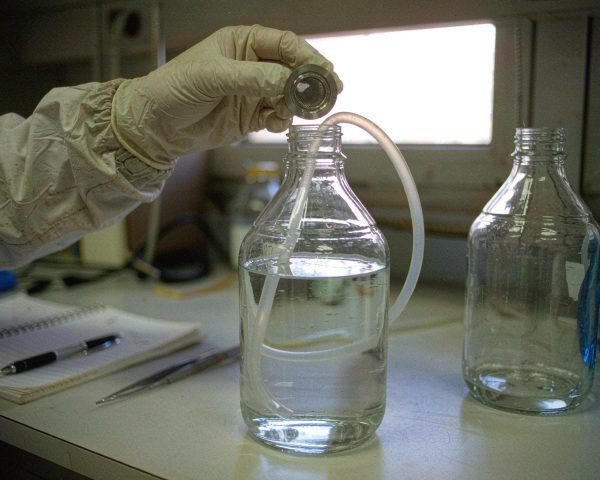
And mind the whole suction path. The tubing, the bottle cap seals, and the reservoir itself all matter. A scratched-up reservoir bottle that never gets cleaned will kill a brand-new frit in a month. Our solvent reservoir guide covers what to look for in the bottle side of that system.
The Prevention Habit
Fold the frit into an existing routine so it never depends on memory. The pattern that works: every scheduled pump maintenance or seal change, the frit comes out, gets inspected, and gets replaced if there is any doubt. Log it the same way you log column serial numbers, so that when a pressure mystery appears six months later, you know exactly which frit was in the line and when it went in.
That log becomes unexpectedly valuable in regulated labs. When an auditor asks how you ensure mobile phase integrity, “the inlet frit is on a documented quarterly replacement” is a one-sentence answer that closes the topic. If your mobile phases are filtered before they ever reach the bottle, which our mobile phase filtration guide recommends, the frit becomes a backstop rather than the primary defense, and your replacement intervals get longer and more predictable.
Conclusion
The solvent inlet frit is a tiny consumable with a disproportionate job: everything downstream, from check valves to piston seals to your afternoon of data, depends on it doing its boring work in the bottom of a bottle. Replace it on a three-to-six-month schedule for typical use, sooner with salty or dirty solvents, and immediately when pressure wobbles or flow drops. Inspect it whenever it is in hand, keep one spare on the shelf, and log every change. That is the entire maintenance program, and it costs less per year than one lost sequence day. If you are building out the rest of the filtration picture, our guide to why syringe filters clog covers the sample side, and the bubble point test guide explains how to verify filter integrity when the stakes are higher.
Frequently Asked Questions
What pore size should a solvent inlet frit be?
For typical HPLC work with HPLC-grade solvents, a 10 µm stainless frit is the common default. Choose 2 to 5 µm when you want tighter protection, for example with salt-containing buffers or older systems, accepting that finer frits clog faster and need more frequent replacement.
Can I sonicate and reuse a solvent inlet frit?
Yes, a water-then-methanol ultrasonic bath clears most fouling and is a legitimate emergency measure. But repeated cleaning never fully restores the pores, so treat sonication as a bridge to the next scheduled replacement, not a way to avoid buying new frits.
How do I know if the frit or the check valves are the problem?
Swap in a known-good frit. If pressure and flow recover immediately, the frit was the culprit. If the symptoms persist through a good frit, the check valves are the likely suspect, and that is the point to look at valve maintenance instead.
Do I need an inlet frit if I filter all my mobile phases?
You should still run one. Filtered solvents dramatically reduce the particle load, but bottles open on the bench, reservoir surfaces, and tubing all shed particles over time. The frit is your backstop, and with pre-filtered solvents its replacement interval gets comfortably longer.