
If you buy sterile filters, integrity test filters, or simply argue with vendors about what “0.22 micron” really means, the bubble point test is the piece of physics behind all of it. It’s also a test your own lab can run in ten minutes with basic equipment.
The bubble point test measures the gas pressure at which the first continuous stream of bubbles pushes through a fully wetted filter membrane. That pressure maps directly to the membrane’s largest pore: small pores need high pressure, big pores or defects let go early. One number, and you know whether the membrane matches its rating and whether it’s undamaged.
Here’s how it works and when it matters for buyers.
The Physics, Minus the Pain
A wetted membrane holds liquid in its pores by capillary force. Surface tension keeps the liquid in place until the applied gas pressure exceeds the capillary pressure of the largest pore. At that threshold, the liquid is expelled and a steady bubble stream appears.
The relationship follows the Young-Laplace equation: bubble point pressure is inversely proportional to pore diameter, scaled by the surface tension of the wetting liquid. Wet the membrane with water and a 0.22 µm membrane holds roughly twice the pressure of a 0.45 µm one. Real-world numbers from integrity testing practice put water-wet sterilizing-grade membranes around 3.4 bar (about 50 psi) at 0.2 µm and near 30 psi for 0.45 µm membranes.
The method is standardized in ASTM F316, which defines both bubble point and mean flow pore measurement for membrane filters.
How a Lab Runs One
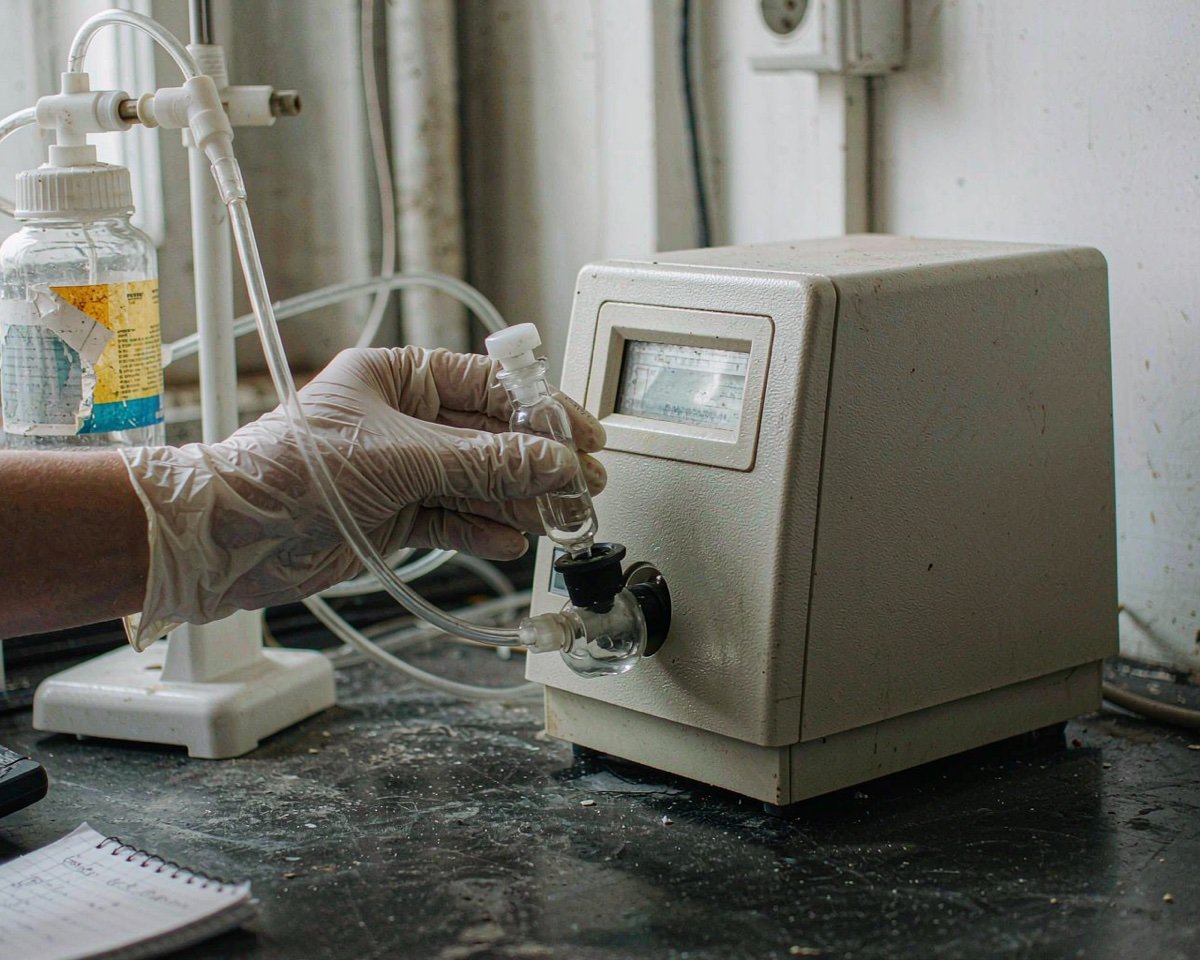
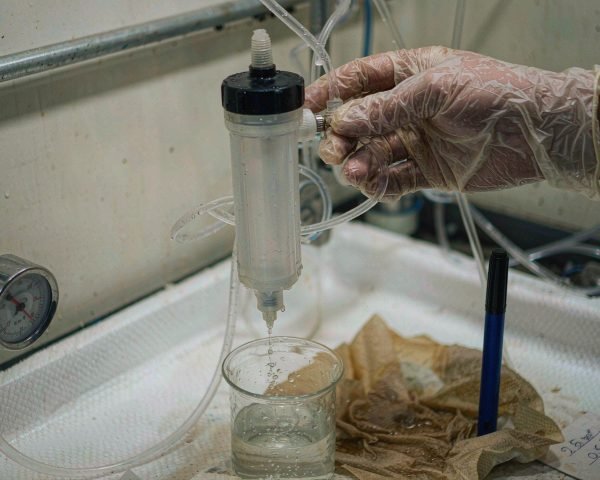
The manual version needs only a filter holder, a pressure source with a regulator, and a beaker of liquid:
1. Wet the membrane completely. Incomplete wetting is the number one false-failure cause. Hydrophilic membranes wet with water; hydrophobic ones need a low-surface-tension wetting liquid such as an alcohol-water mix.
2. Mount the filter and pressurize the upstream side slowly, with the downstream side submerged so bubbles are visible.
3. Watch for the first continuous bubble stream and record the pressure. That’s the bubble point.
Compare against the membrane manufacturer’s minimum specification. A measured point at or above spec means the membrane is intact and correctly rated. A low bubble point means either a defect, a wetting problem, or a temperature effect, and the standard troubleshooting order is re-wet, check temperature, then suspect the membrane. Published bubble point data across pore sizes shows how narrow the passing ranges are for good cartridges, which is what makes the test so discriminating.
Why It Matters for Buyers
• It’s the proof behind the pore size on the box. When a filter vendor claims 0.22 µm, bubble point testing is how that claim is verified batch by batch. Certificates often carry the integrity test result; my CoA vs CoC explainer covers which document carries which proof.
• It’s the release test for sterilizing-grade filters. Pharma practice runs integrity tests before and after use on filters that claim bacterial retention, because a passing pore-size paper doesn’t exclude a pinhole from handling or installation. If your lab produces sterile-filtered media or buffers, this is the test that lets you trust your own membrane filters between autoclave cycles.
• It detects damage you can’t see. A dropped filter holder, a hairline crack in a membrane support, a membrane that lifted at the edge: none of these are visible, and all of them show up as an early bubble point. This is why I treat any dropped filter as consumed, a habit that once saved a lab I know from a contaminated media batch.
Wetting Liquid Choice Changes the Number
The same membrane gives different bubble points depending on what wets it. Water has high surface tension and produces the highest, most reproducible values; alcohol-water mixes lower the surface tension and therefore the measured pressure, which is why hydrophobic membranes tested after alcohol wetting use corrected specifications. Temperature plays a role too: warmer liquid means lower surface tension and a lower bubble point, which is why integrity specs assume a defined temperature range.
This matters when comparing vendors or troubleshooting. A “low” bubble point may be a defective membrane, or a water-wet membrane tested after someone flushed it with IPA, or a test run on a warm afternoon. Change one variable at a time, and always compare against the spec written for your wetting liquid.
Where the Test Fits Among Filter Checks
The bubble point test sits alongside two siblings:
• Pressure hold / diffusion testing, which measures gas flow through the wetted membrane below the bubble point and catches gross defects on large-area filters
• Flow rate and throughput checks, which say nothing about integrity but everything about loading
For everyday analytical syringe filters, labs rarely bubble point test each unit; the value is in vendor batch control and in validating unusual filters. For cartridge and capsule filters in sterile service, integrity testing is standard practice. If you’re choosing membranes by chemistry rather than integrity, my membrane comparison guide covers that axis, and the pore size tradeoffs cover the 0.22 versus 0.45 decision the bubble point underlies.
Conclusion
The bubble point test converts “trust the label” into “verify the membrane.” By measuring the pressure at which gas first breaches a fully wetted membrane, it confirms the largest pore size, exposes invisible defects, and backs the pore-size ratings and sterilizing-grade claims you rely on every time you filter a sample. The manual version costs ten minutes and a regulator, the results are standardized under ASTM F316, and the failure modes it misses are few. If your lab runs sterile or high-stakes filtration, learn the test and spot-check new lots; if you’re a buyer, ask filter vendors for integrity test data on their certificates. One number on a certificate is worth more than a page of marketing, and now you know how to read it. For the broader filter selection picture, start with the complete syringe filter buyer’s guide.
Frequently Asked Questions
What is a good bubble point value?
It depends on pore size and wetting liquid. As rough anchors, water-wet 0.22 µm membranes typically test near 3.4 bar (50 psi) and 0.45 µm membranes near 2 bar (30 psi). Always compare against the manufacturer’s stated minimum, not another brand’s number.
Why did my filter fail the bubble point test?
Most false failures come from incomplete wetting or elevated temperature. Re-wet thoroughly and test at room temperature before condemning the membrane. Genuinely low results indicate a defect, a lifted edge seal, or a membrane whose rating doesn’t match the label.
Is the bubble point test destructive?
No. It’s a non-destructive test, which is exactly why it’s used for pre-use and post-use integrity checks on sterilizing-grade filters. The membrane can still be used after testing if the test conditions were clean.
Can I bubble point test a syringe filter at my bench?
Yes, with a syringe filter holder, regulated air or nitrogen, and a beaker of water. It’s a worthwhile spot check when qualifying a new filter lot or after any handling incident, though full integrity programs belong on cartridge-scale filtration.