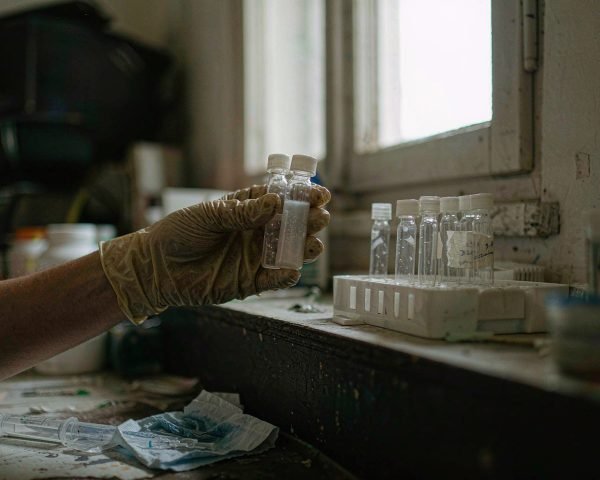

Few things erode confidence in sample prep like holding a freshly filtered sample up to the light and seeing haze. You filtered it. It’s supposed to be clean. So why is the filtrate cloudy?
In about a decade of watching labs fight this, cloudy filtrate comes down to five causes, and four of them are fixable in a minute. Here’s the diagnostic path I use, ordered by how often each cause turns out to be guilty.
Cause 1: The Pore Size Is Too Big for the Sample
The most common reason. A 0.45 µm membrane passes colloids and fine particulates that a 0.22 µm membrane catches. If your sample is a biological matrix, an emulsion, or an extraction with fine precipitate, 0.45 µm filtration may clarify the liquid without truly cleaning it.
The fix: switch to 0.22 µm. Yes, it’s slower and clogs sooner. That’s the membrane doing more work. The full tradeoff between pore sizes lives in my 0.22 vs 0.45 micron comparison.
Quick check before you blame the pore: spin a portion of the sample in a microcentrifuge for two minutes. If the supernatant is clear but your filtrate isn’t, the particles are smaller than your pore rating and you need a finer membrane.
Cause 2: You’re Forcing Particles Through
Pushing hard on the syringe drives particles into and partly through the membrane, especially near the end of a filter’s life. Filtration should take seconds to a minute for a milliliter. If you’re leaning on the plunger, the filter is loaded and the particles are riding through.
The fix: change to a fresh filter and let gravity and gentle pressure work. If a single milliliter clogs a fresh filter instantly, the problem is sample loading, not the filter; dilute or pre-settle the sample first. Chronic clogging has its own playbook in my filter clogging guide.
Cause 3: Membrane Bypass or Damage
A cracked membrane, a lifted edge, or a poorly seated filter in a reusable holder lets unfiltered sample stream around the membrane. The filtrate looks barely better than the feed, and the flow is suspiciously fast for the pore size.
The tell: with syringe filters, fast flow plus cloudy output equals bypass. With reusable holders, check that the support screen and O-ring are seated and that you haven’t over-torqued the holder, which deforms the membrane.
The fix: discard the unit (a dropped or squeezed filter is consumed, in my book), or re-seat the membrane properly in the holder. If bypass keeps happening with one brand, the membrane-to-housing seal is suspect; my filter breakthrough guide covers the housing-side failure modes.
Cause 4: The Sample Is Precipitating After Filtration
This one fools people because the filter is innocent. Dissolved analytes and matrix components can come out of solution when the filtrate cools, changes pH, or meets a different solvent composition in the collection vial. The cloud appears minutes after filtration.
Protein samples do this after dilution shocks. Salt-rich aqueous extracts do it when they meet organic-rich collection vials. And some preservatives and surfactants haze when they hit glass with residual water.
The fix: collect into a vial with a compatible residue, filter at a stable temperature, and if haze still forms, let the sample sit and centrifuge or re-filter the final solution. Dilution and temperature control are the usual tools here.
Cause 5: Extractables and Wetting Artifacts
A hydrophobic membrane that isn’t fully wetted lets some feed pass unwetted, and the first fractions can carry a fine haze of wetting-fluid emulsion or membrane extractables. The haze usually clears after the first milliliter.
The fix: wet the membrane completely (push a few hundred microliters through and discard), then collect. This doubles as the extractables wash; studies of filter extractables and leachables show the first fractions carry most of the chemical baggage.
Both bypass and wetting failures tie back to membrane integrity fundamentals. The background on membrane wetting and defect detection explains why an incompletely wetted hydrophobic patch behaves exactly like a pinhole, and the bubble point data across pore sizes shows how narrow a good membrane’s passing range is. You don’t need to run integrity tests on syringe filters, but understanding the physics turns cloudy-filtrate mysteries into ten-minute diagnostics.
When to Pre-Clear the Sample First
Some samples should never meet a syringe filter as their first step. Heavy particulate loads (soil digests, homogenized tissue, milled tablets) do in seconds what would take a filter minutes, and the filter loads without ever producing clear filtrate. Pre-clearing changes the economics: let solids settle overnight, centrifuge for five minutes, or prefilter through glass fiber, then bring the clarified liquid to your 0.22 or 0.45 µm membrane for the final polish.
Glass fiber prefilters deserve a mention here because they’re underused. A glass fiber pad, rated coarser than any membrane, catches the bulk of particulate load cheaply and protects the real filter. Labs that process plant or soil matrices daily go through membranes at a fraction of the rate once they add this step, and the final filtrate gets clearer, not just cheaper.
A Worked Example
A customer filtering plant extracts for pesticide residue analysis fought cloudy filtrate for a week. The sequence of fixes that worked: they moved from 0.45 to 0.22 µm (cause 1), stopped bearing down on the syringe (cause 2), and finally learned the last of the haze was the extract precipitating as the acetonitrile cooled in the collection vial (cause 4). Three causes, one sample, and none of them were a bad filter.
When Cloudy Is Actually Normal
One honesty note: for some high-load samples, a faint haze after a single filtration pass is the sample’s honest state. If your method’s recovery and column pressure stay healthy, chasing optical perfection can cost more filtration-induced bias than the haze itself. Decide based on the downstream method, not aesthetics.
Conclusion
Cloudy filtrate is a diagnostic, not a disaster. Work the list in order: pore size too large, excessive pressure pushing particles through, membrane bypass or damage, post-filtration precipitation, and unwetted-membrane haze in the first fractions. Two minutes of checks (centrifuge comparison, flow speed, fresh filter, collection vial compatibility) usually names the cause. And remember that the goal is a sample your column and detector can trust, not a visibly sterile-looking liquid. Build the habit of wetting membranes and discarding the first fraction, match pore size to the matrix rather than habit, and treat sudden cloudiness as information about the sample instead of an indictment of the filter. If you’re rethinking your filtration setup after a run of these issues, the complete syringe filter buyer’s guide is the place to start.
Frequently Asked Questions
Should I always filter twice if the filtrate is cloudy?
Only when you know why the first pass left haze. Double filtration through the same loaded filter can add adsorption losses and extractables without removing colloids. Fix the cause: finer pore, fresh filter, or sample pretreatment.
Can cloudy filtrate damage my HPLC column?
Yes. What clouds the filtrate can also lodge on the column inlet frit, raising pressure and shifting peaks. If your filtrate is hazy and your backpressure is creeping, the two facts are probably related.
Does filtering faster make cloudiness worse?
It can. High pressure drives particles into the membrane and partly through, and it can lift a poorly seated membrane into bypass. Gentle, steady pressure with an appropriately sized filter gives cleaner output.