
I once watched a summer student try to push 500 mL of buffer through a 25 mm syringe filter. It took forty minutes, two filters, and most of her patience. A bottle-top unit on the house vacuum would have done the same job in under five, hands-free.
Volume is the whole question here. Everything else, membrane, pore size, sterility, is the same conversation in both formats.
The short answer: syringe filters are the right tool up to roughly 100 mL, where speed and simplicity win. For larger volumes, typically 150 mL to 1 L or more, bottle-top vacuum filters are faster, cheaper per milliliter, and far easier on the operator. Pick by volume first, then by membrane chemistry.
How the Two Formats Actually Differ
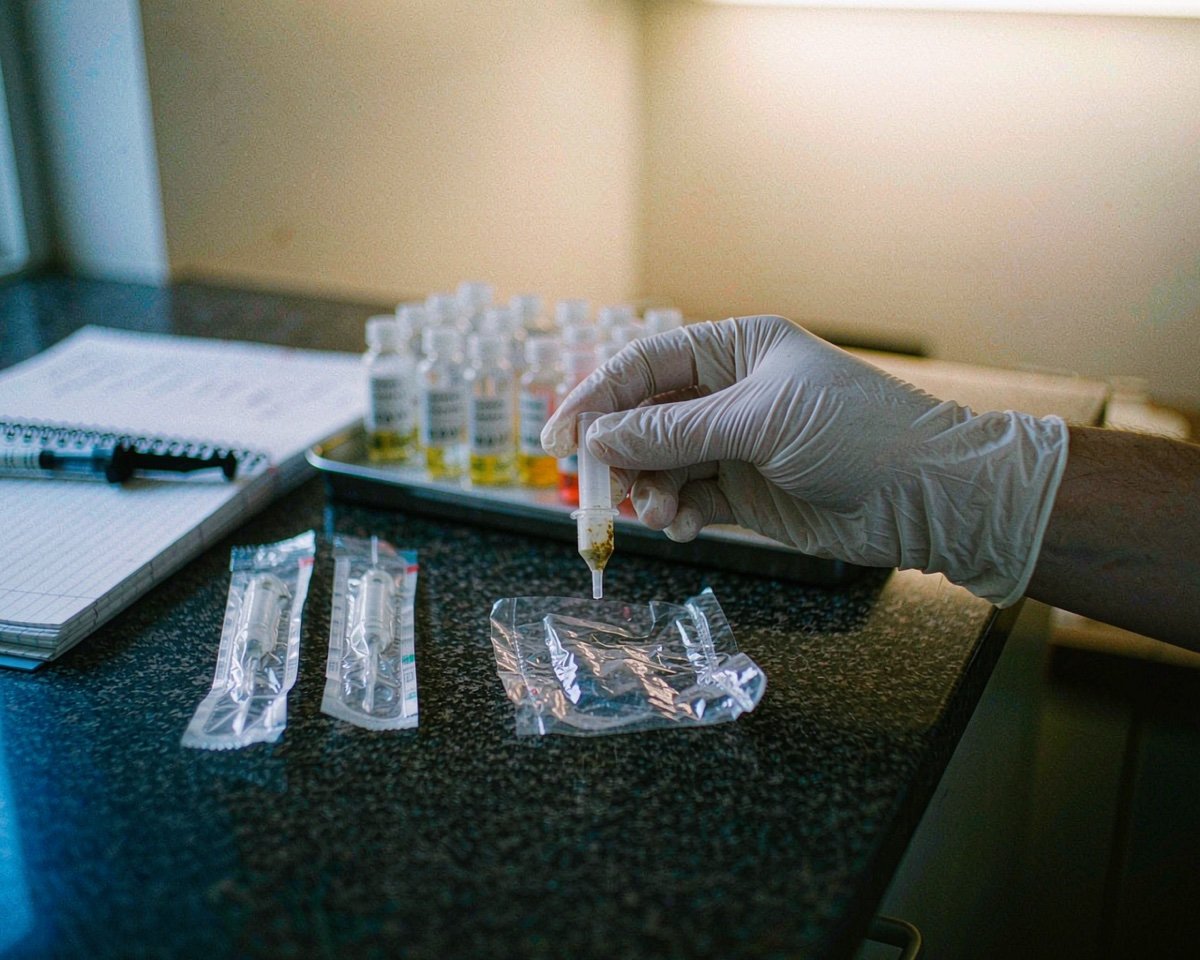
A syringe filter is a small membrane disc in a plastic housing that screws onto a luer syringe. You push the liquid through by hand. It is the fastest possible setup for one small sample: grab, fill, filter, done. Cleanup is throwing it away.
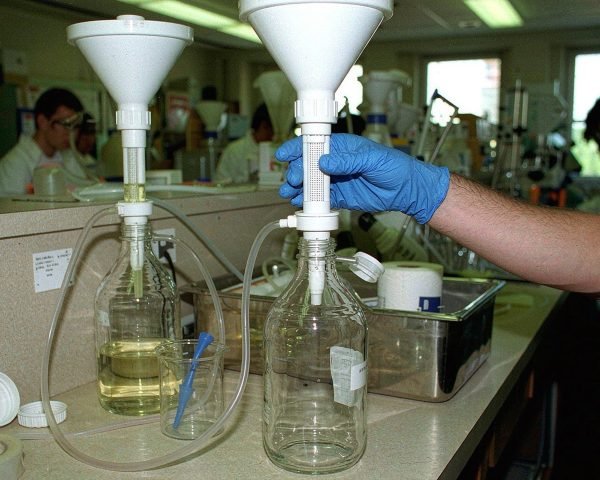
A bottle-top filter is an integrated unit: an upper funnel, a membrane, and a lower receiver, threaded onto a standard GL45 media bottle or supplied as its own sterile receiver. Vacuum, not muscle, does the work. You pour, the pump pulls, and you can walk away for a few minutes.
The Thermo Fisher filtration guide draws the same line: syringe filters for small-volume sample prep, bottle-top units for larger volumes filtered directly into the receiving bottle. The format difference is not really about the membrane. It is about area and pressure.
Why Volume Changes the Answer
Membrane area scales filtration capacity. A 25 mm syringe filter has a working area of about 2 to 4 square centimeters, while a bottle-top unit offers 50 or more. Ten times the area means ten times the throughput before clogging, and clogging is what actually limits small filters.
Push too much volume through a small disc and the membrane surface loads with particles. Flow slows to a trickle, pressure builds, and either you abandon the effort or you burst the housing seal. The mechanics of that failure are the same whether the filter is 13 mm or 33 mm, and our guide to clogged syringe filters covers the details.
There is also the hands problem. Filtering 1 L through syringe filters means refilling a syringe fifteen or twenty times, and every disconnect-reconnect cycle is a contamination opportunity. The practical lab filtration guides put the practical single-pass limit for a standard 25 to 33 mm filter at around 100 mL of aqueous solution, which matches what I have seen on real benches.
When a Syringe Filter Is Still the Right Call
Small volume is not a compromise; it is a legitimate use case with real advantages.
For HPLC sample prep, you are filtering 1 to 5 mL into a vial. A syringe filter is the entire workflow: no vacuum source, no receiver, no assembly. For anything under about 20 mL, honestly, nothing beats it. Setup time is fifteen seconds.
Syringe filters also win on hold-up volume when the sample itself is precious. A bottle-top unit wets a large membrane and holds liquid in its funnel; if you only have 10 mL of sample, that loss matters. Our explanation of hold-up volume covers how much liquid each format keeps, and small filters keep far less in absolute terms.
Finally, syringe filters handle viscous samples better because you control the pressure directly. Vacuum systems pull at a fixed differential, and a viscous solution can stall entirely.
When the Bottle-Top Unit Pays for Itself
Past 100 mL, the math flips hard.
Cell culture media is the classic case: a 500 mL bottle of DMEM filters through a PES bottle-top unit in a few minutes under standard house vacuum, hands-free, directly into the bottle you will store it in. The format comparison in UK lab filtration guides describes bottle-top units as the standard for sterile media and buffer prep, and that matches every biotech lab I have worked in.
Three economic notes. First, cost per milliliter drops sharply with bottle-top units at volume, because the membrane area is doing far more work per unit. Second, operator time is real money: hands-free filtration lets one person process a batch while doing the next task. Third, the vacuum requirement is modest, typically 15 to 25 in. Hg, which any house vacuum or small diaphragm pump provides. One caution from the same sources: stay under the manufacturer’s maximum vacuum, because exceeding it can rupture the membrane and silently compromise sterility.
Matching the Membrane in Either Format
The format decision and the membrane decision are separate, and mixing them up is the most common ordering mistake I see.
PES is the default for aqueous media and buffers: high flow, low protein binding. PTFE handles organic solvents. PVDF sits in between with broad compatibility and low binding. Nylon is a general-purpose workhorse with a caution on protein adsorption. Our membrane comparison guide breaks down the chemistry, and the good news is that nearly every membrane type is available in both formats from the major suppliers.
Pore size follows the job, not the format. Sterile filtration uses 0.22 µm; clarification uses 0.45 µm. That logic is identical whether the membrane sits in a syringe housing or a bottle-top funnel.
For sterile work specifically, both formats come pre-sterilized with lot documentation, so sterility never has to drive the format choice.
What I Actually Stock
Labs ask me for a rule of thumb, so here is mine. If your daily routine is vials and small aliquots, keep a drawer of syringe filters in your two most-used membranes and pore sizes, and never think about it again. If anyone in the lab prepares more than 200 mL of anything per week, add one bottle-top unit per typical batch size and a small pump, and your hands will thank you.
The mistake to avoid is standardizing on one format for identity reasons. I have seen labs buy thousands of syringe filters a year because the bottle-top unit was “extra equipment,” while paying for the labor to push every milliliter by hand. The equipment pays for itself in a quarter.
Conclusion
Syringe filters and bottle-top filters share the same membranes and the same pore-size logic, so choose by volume and workflow. Under roughly 100 mL, and especially for precious small samples going into autosampler vials, the syringe filter is faster and loses less to hold-up. Above that, bottle-top vacuum units win on speed, cost per milliliter, and operator sanity, filtering directly into the bottle you will store. Match membrane to chemistry separately: PES for aqueous media, PTFE for solvents, PVDF when you need both. If your lab is still hand-pushing liters through small discs, the upgrade is cheap and the time savings start the first afternoon. And if you are setting up either workflow for the first time, our complete syringe filter buyer’s guide walks the full selection in detail.
Frequently Asked Questions
What volume can a syringe filter handle?
For aqueous solutions, a standard 25 to 33 mm syringe filter is practical up to about 100 mL in a single pass, and small 13 mm filters are best under 10 mL. Beyond that, flow slows as particles load the membrane, and pressure can rupture the housing.
Can I use a bottle-top filter without a vacuum pump?
Not effectively. Bottle-top units rely on a pressure differential, typically 15 to 25 in. Hg from house vacuum or a small diaphragm pump. Gravity filtration through the same unit works but is slow, which defeats the main advantage of the format.
Which membrane should I use for cell culture media?
PES at 0.22 µm is the standard choice: high flow for fast batch prep and low protein binding to preserve serum components and growth factors. Avoid nylon for serum-containing media because of protein adsorption.
Are bottle-top filters sterile?
Most bottle-top units come gamma-irradiated or otherwise pre-sterilized with lot documentation, ready for sterile media and buffer preparation. Check the packaging claim per product line, since a few economical versions are sold for clarification only.