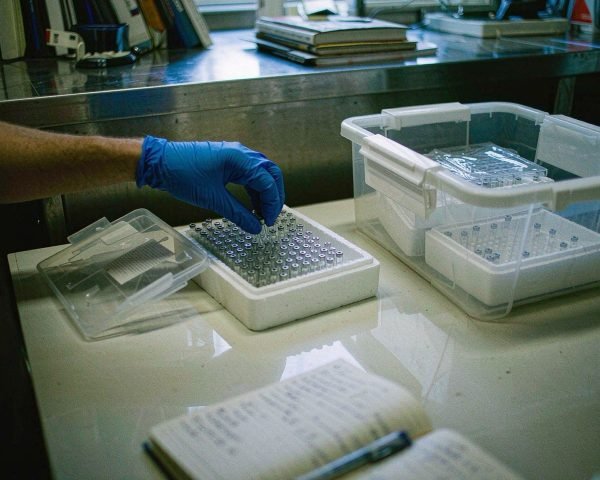

A lab I worked with spent three weeks chasing a mystery peak that appeared only in their blank injections. New column, new mobile phase, new operator. The culprit turned out to be background leaching from ordinary vials at trace level. The fix was boring: pre-cleaned, low-background vials.
That is the problem MS-certified vials exist to solve.
The short answer: MS-certified vials are standard autosampler vials that have gone through a documented pre-cleaning process and lot testing for particulates and extractable background by LC/MS and GC/MS. You need them when your method runs at trace levels, typically low ng/L or pg on-column, where normal vial background becomes visible in your data.
Read on if your blanks are not as blank as they used to be.
What “MS Certified” Actually Means
The label is a manufacturing claim, not a generic industry standard, so it pays to know what a supplier is promising.
Thermo Scientific, whose MS Certified line set the template, documents a proprietary cleaning process performed in a controlled cleanroom environment, followed by lot testing for three things: particle counts, LC/MS background, and GC/MS background. The manufacturer’s vial documentation reports that an ordinary unprocessed vial can carry more than 5,000 particles per mL, mostly below 0.5 µm, and that the certified cleaning process cuts that by roughly an order of magnitude.
Each production lot gets tested, and the results ship with the product as a Certificate of Conformance. The MS Certified product page also notes ultra-low-bleed septa in the matching caps, because the closure can contaminate a trace run just as easily as the glass.
So the claim has three legs: pre-cleaned glass, tested background, and documented per-lot traceability. If a supplier’s version of “MS certified” has only the first leg, ask what the other two are doing in the name.
Why Ordinary Vials Become a Problem at Trace Levels
Glass vials are not perfectly inert. Forming glass at high temperature leaves behind residual organic contaminants and inorganic submicron particles, and standard manufacturing does not remove all of them.
For decades this did not matter. Conventional UV or FID methods had detection limits far above what a vial could contribute. Modern instruments changed the math. A triple quadrupole running MRM can see things a vial leak can hide from a UV detector entirely, and suddenly the container is a signal source.
I think of it like background radiation. It was always there. You just bought a better Geiger counter.
The practical symptoms look like this: rising baseline in blank injections, unexplained peaks that migrate between methods, poor reproducibility at low calibrator levels, and carryover that cleaning cycles do not fix. If you want a systematic way to separate vial background from other sources, our guide to extractables and leachables covers the same logic for filters, and the diagnostic thinking transfers directly.
Who Actually Needs Them
Not everyone, and paying a premium for certified vials on a routine assay is wasted budget. Here is the honest split.
Strong candidates:
- Trace quantitation by LC-MS/MS or GC-MS/MS: bioanalytical assays, residue analysis, environmental monitoring at ng/L levels.
- Methods where blank contribution directly affects the LOQ, because you cannot report a calibrator below your container’s background.
- Regulated work where you must defend data integrity, since the per-lot documentation is part of the record.
- High-sensitivity GC with on-column injection, where particulates from the vial accumulate at the head of the column.
Weak candidates:
- Routine QC at mg/mL levels, where vial background sits far below your detection limit.
- Teaching labs and method development scoping, where a standard vial tells you everything you need.
- Any assay where the vial premium multiplies across hundreds of thousands of injections per year without a trace-level requirement.
A quick sanity check before you buy: inject blank solvent into your current vials and look at the total ion chromatogram between 10 and 25 minutes. If it is flat, standard vials are probably fine for now. If it looks like a seismograph, you have your answer. Our guide to inspecting vials for quality covers the physical checks worth doing too.
What You Pay and What You Get
MS-certified vials typically cost several times more than standard equivalents, so the decision deserves arithmetic, not vibes.
What the premium buys: the documented cleaning, the per-lot MS background scans, verified particle counts, and packaging designed to keep the vials clean until you open them. The supplier white paper describes packing in Class 10 cleanroom trays inside resealable containers, which is why proper storage of opened packaging matters more than people assume.
What it does not buy: immunity from bad technique. A dirty syringe, a contaminated filter, or a septum coring problem will contaminate a certified vial just as efficiently as a cheap one. If your troubleshooting points to sample prep rather than the vial, work through your filters and handling technique first.
Making the Switch Without Overhauling Everything
You do not need to convert the whole lab. The sensible rollout is per-method: identify the one or two trace methods where background actually bites, qualify certified vials there, and leave the routine benches alone.
When you qualify, run the comparison honestly. Inject the same low-level standard and blank through standard and certified vials in one sequence, and compare signal-to-noise at your lowest calibrator. If the difference is real on your instrument, the premium justifies itself. If it is not, you have saved yourself a line item.
Store unopened trays sealed and away from solvent vapors, and once you open a tray, use it within a reasonable window. Clean surfaces do not stay clean in a working lab forever, and our storage guide for lab consumables covers the environmental side of that.
Conclusion
MS-certified vials are pre-cleaned autosampler vials with lot-tested background by LC/MS and GC/MS, and they earn their premium in exactly one situation: when your method’s detection limit has dropped low enough that an ordinary vial’s background shows up in the data. Check your blanks first, because they will tell you more than any brochure. If the baseline is climbing and the peaks are unexplained, the certified line is one of the cheapest fixes in trace analysis. If your blanks are flat and your levels are comfortably above detection limits, spend the budget somewhere it will show. And when you do buy certified vials, keep the per-lot certificates filed, because on the day an auditor or a reviewer asks how you know your blanks were clean, that paperwork is the answer. For the related question of what general vial certification claims cover, our guide to certified HPLC vials is the natural next read.
Frequently Asked Questions
What is the difference between MS-certified and certified vials?
Certified vials are tested for physical characteristics like dimensions and glass quality, usually with a Certificate of Conformance. MS-certified vials add documented pre-cleaning plus LC/MS and GC/MS background testing per lot, targeting extractable contamination that would appear in high-sensitivity runs.
Are MS-certified vials worth the extra cost?
For trace-level LC-MS/MS or GC-MS/MS methods, usually yes, because reduced background directly improves signal-to-noise at low calibrators. For routine assays running well above detection limits, the premium rarely buys anything measurable.
Can I clean regular vials to the same standard?
Not realistically. The certified process involves controlled cleaning agents, cleanroom handling, and per-lot instrument verification. Manual rinsing can help for less critical work, but you have no documentation, and documentation is half the claim.
Do MS-certified vials come in amber?
Yes, most suppliers offer the certified treatment in clear Type 1 Class A and amber Type 1 Class B glass, so light-sensitive trace samples do not force you back to uncertified vials.