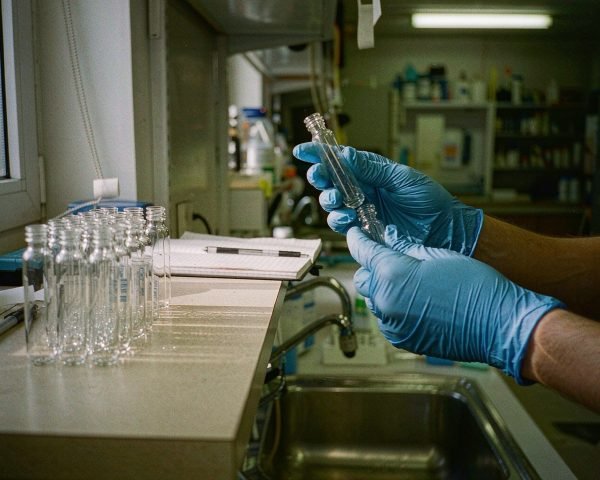

I once spent two days chasing a phantom benzene hit that turned out to live in the bottle caps, not the groundwater. That is the whole argument for this guide in one sentence: in water testing, the consumables are part of the method, not packaging around it.
If you run or supply a water quality lab, this page walks through every consumable class you will buy: sample containers, preservatives, filtration gear, instrument vials, and the documentation that keeps regulators happy. I have written it from the bench side, the way I wish someone had explained it to me before my first EPA compliance season.
The short answer: a water quality lab needs certified sample containers matched to each analyte group (VOA vials for volatiles, amber glass for semi-volatiles, acid-washed plastic for metals), membrane filters and holders, autosampler vials and septa for the instrument bench, and lot-traceable documentation for all of it.
Read on and I will break down each category, the mistakes I see most often, and where the money is actually worth spending.
Why Consumables Are a Compliance Issue in Water Testing
Most industries treat consumables as a cost line. Water labs cannot afford that luxury, because the container you collect in is literally the first step of the analytical method.
Regulators treat it that way too. The EPA’s approved methods under 40 CFR 136 specify not just the instrumentation but the container, preservation, and holding time for each analyte. Show up with a nitrate sample in an unpreserved milk jug and it does not matter how good your ion chromatograph is. The result is invalid before injection.
The failure modes are invisible. A soda-lime glass bottle can leach sodium and silicate into a metals sample. A wrong septa polymer can add ghost peaks to a VOC scan. For every analyte group, the container either protects the sample or quietly becomes part of it.
There is also the paperwork side. When a result gets challenged, the auditor asks for the lot number of the vial, the certificate inside the box, and the chain of custody. Labs that buy documented consumables answer in five minutes. Labs that buy mystery boxes answer in depositions.
Sample Containers by Analyte Group
This is the heart of the buying list. Water testing splits into analyte families, and each family wants its own container. The EPA Region 9 lab publishes its container and preservation matrix publicly, and it is a good template for building your own stockroom plan.
Volatile Organic Compounds (VOA vials)
VOC work runs on 40 mL VOA vials with PTFE-lined septa caps. The rules that matter:
- Fill to a convex meniscus with zero headspace. A single bubble can be grounds for rejection.
- Preserved with HCl to pH < 2 gives a 14-day holding time; unpreserved gives 7.
- Amber glass for light-sensitive analytes, clear when the method allows.
- Trip blanks and field blanks travel with every cooler.
The EPA’s Region 4 surface water protocol describes the classic technique: cap the vial, invert it, tap it against your palm, and watch for trapped bubbles. If a bubble appears, top off with a little more sample or start over. I have trained new techs on exactly this move, and the ones who skip the palm-tap always send back a rejected cooler eventually.
Semi-Volatiles, PCBs, Pesticides
Semi-volatile organic compounds, organochlorine pesticides, and PAHs go in 1 L amber glass bottles with PTFE-lined caps, usually two bottles per sample. The amber glass matters because several of these analytes photodegrade. If your bench staff grab clear bottles because the amber rack was empty, you have invalidated the sample and probably nobody will notice until a data review weeks later.
Metals
Metals want plastic, which surprises people who assume glass is always purest. Polyethylene or polypropylene bottles preserved with nitric acid to pH < 2 are the standard, because borosilicate glass itself contains metals that can leach into an acidified sample. The lesson generalizes: the cleanest container is the one that does not share chemistry with your analyte.
Nutrients and General Chemistry
TKN, total phosphorus, TOC, and similar analytes typically go in plastic bottles preserved with sulfuric acid, while TDS and TSS travel unpreserved and chilled. These are the cheapest consumables you stock, which means they are also the ones people run out of on a Friday afternoon. Set a reorder point and stick to it.
Containers for Microbiology
Bacteriological sampling needs sterile, sodium thiosulfate-treated bottles to neutralize residual chlorine in treated water. These are single-use, sealed, and certified by the manufacturer. Reusing them is not a thing, so your inventory math should assume every sample consumes one.
Match the Consumable to the Matrix
Drinking water, wastewater, and groundwater all fall under “water quality,” but they punish different consumable shortcuts.
Drinking water compliance is the strictest documentation environment. Every container lot, preservative batch, and blank travels with the data, and the chlorine residual measured at collection determines how much dechlorinating agent the vial needed. Labs in this space should buy certified containers as a matter of course, because the cost of certification is trivial next to the cost of an invalidated compliance sample.
Wastewater stresses consumables chemically. High solids clog field filters, matrices foul septa, and aggressive preservatives eat through liners that would survive clean water. If your intake list includes industrial discharge, upgrade liner chemistry (FEP or PFA for the nastiest streams) and keep prefiltration membranes stocked in quantity. A 0.45 µm prefilter ahead of the final membrane doubles or triples throughput on solids-heavy samples.
Groundwater sampling brings its own discipline: low-flow techniques and dedicated tubing, plus containers ready for redox-sensitive analytes. Ferrous iron and sulfide samples oxidize during careless transfer, so the container, the fill technique, and the preservation are a single package deal. The point across all three matrices is the same: read the method first, then buy the container the method actually describes, not the one that looks close enough.
Preservation, Holding Times, and the Clock
Every water lab manager knows holding times, and every water lab manager has also lost a sample to them. The consumables angle is that preservation is a supply-chain problem before it is an analytical one.
If you run VOC work with HCl-preserved vials, you need a standing stock of pre-dosed vials, plus the unpreserved ones for samples with high carbonate content where acidification causes effervescence. The EPA protocol I linked above describes exactly this split, and it is worth reading before you standardize on one vial type.
Ascorbic acid and sodium thiosulfate for dechlorination are the same story. The Texas state lab’s drinking water VOC instructions spell out the math: for every mg/L of chlorine above 5, add another 5 mg of ascorbic acid. That means your bench kit needs a way to dose variable amounts, usually pre-portioned sachets, and a tech who knows the rule.
My own scar tissue here: we once lost a full compliance batch because the preserved-vial stock ran out and someone substituted unpreserved vials without checking holding times against the courier schedule. The samples arrived on day 8. That is a four-figure rewrite of a field day, caused by an empty shelf.
Field Sampling Kits: What to Stock
A field kit is consumables plus logistics. When I help labs build these, I push them toward a single labeled tote per sampling team, restocked after every run rather than when someone notices it is empty.
A practical checklist:
- Pre-labeled sample containers for the planned analyte list, plus two spares of each.
- VOA vials, both preserved and unpreserved if your methods allow both.
- Trip blank vials, already filled and sealed by the lab.
- Nitrile gloves, pH strips, preservative sachets, and decon supplies.
- Custody seals, chain-of-custody forms, and a waterproof pen.
- Cooler with ice packs and temperature blank.
The labels deserve a note. Pre-printed labels applied in the lab before departure beat handwriting in the field, because field handwriting is where custody errors start. The shipping side of this discipline gets its own treatment in our guide to shipping lab samples safely, and the two topics overlap more than people expect, which our guide to shipping lab samples safely covers from the courier side.
Filtration Consumables: Membranes, Holders, and Vacuum Gear
Filtration shows up in water labs in two distinct jobs, and they need different gear.
Field filtration
Dissolved metals analysis requires field-filtering the sample, usually through a 0.45 µm membrane, before acidification. Disposable inline filter cartridges have mostly replaced the old syringe-and-disc dance in the field because they are faster and cleaner, but many labs still run syringe filters for low-volume work. Stock 0.45 µm membranes in both formats and check them against your method text, because some methods specify the filter type explicitly.
Bench filtration
At the bench, filtration protects columns and prepares samples for IC and HPLC. The workhorse is a 0.45 µm membrane for clarification and 0.22 µm where sterile or low-particulate filtrate is needed. For the reason behind those numbers, our syringe filter pore size guide covers the chemistry in depth.
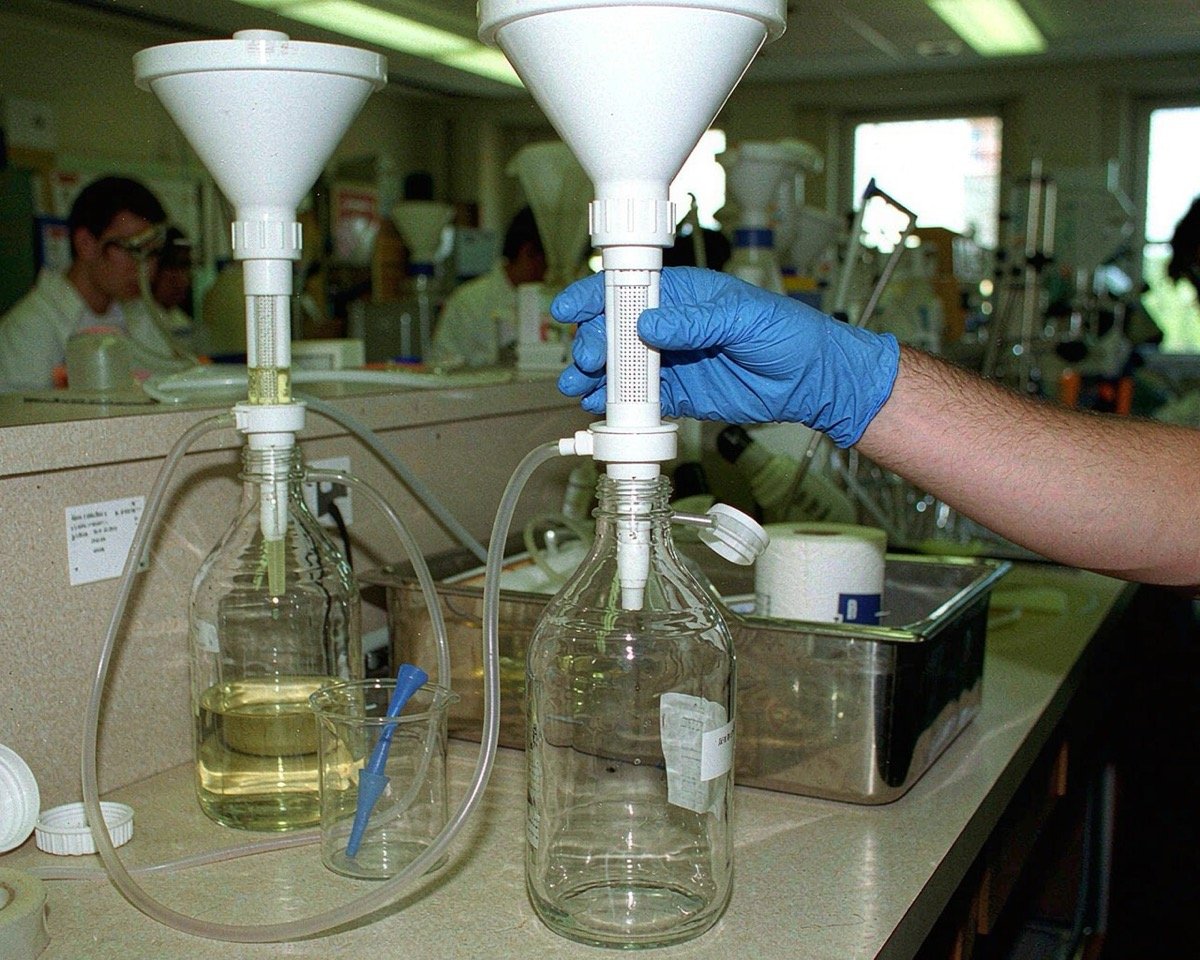
Volume drives format. Under about 100 mL, a syringe filter on a luer syringe is the right tool. Beyond that, bottle-top vacuum filters threaded onto GL45 media bottles are dramatically faster, and a single tech can process a batch of samples while doing something else. Labs that try to push 500 mL through a 25 mm syringe filter learn two things: it takes forever, and the membrane clogs halfway. If you keep breaking this rule, understand what is happening inside the membrane: suspended solids load the surface, flow dies, and the filtrate you do get may have bypassed a compromised seal.
Do not forget the holder hardware. Reusable stainless filter holders with replacement membranes are the economical choice for high-volume benches, while sealed disposable units win on contamination control.
The Instrument Bench: Autosampler Vials and Septa
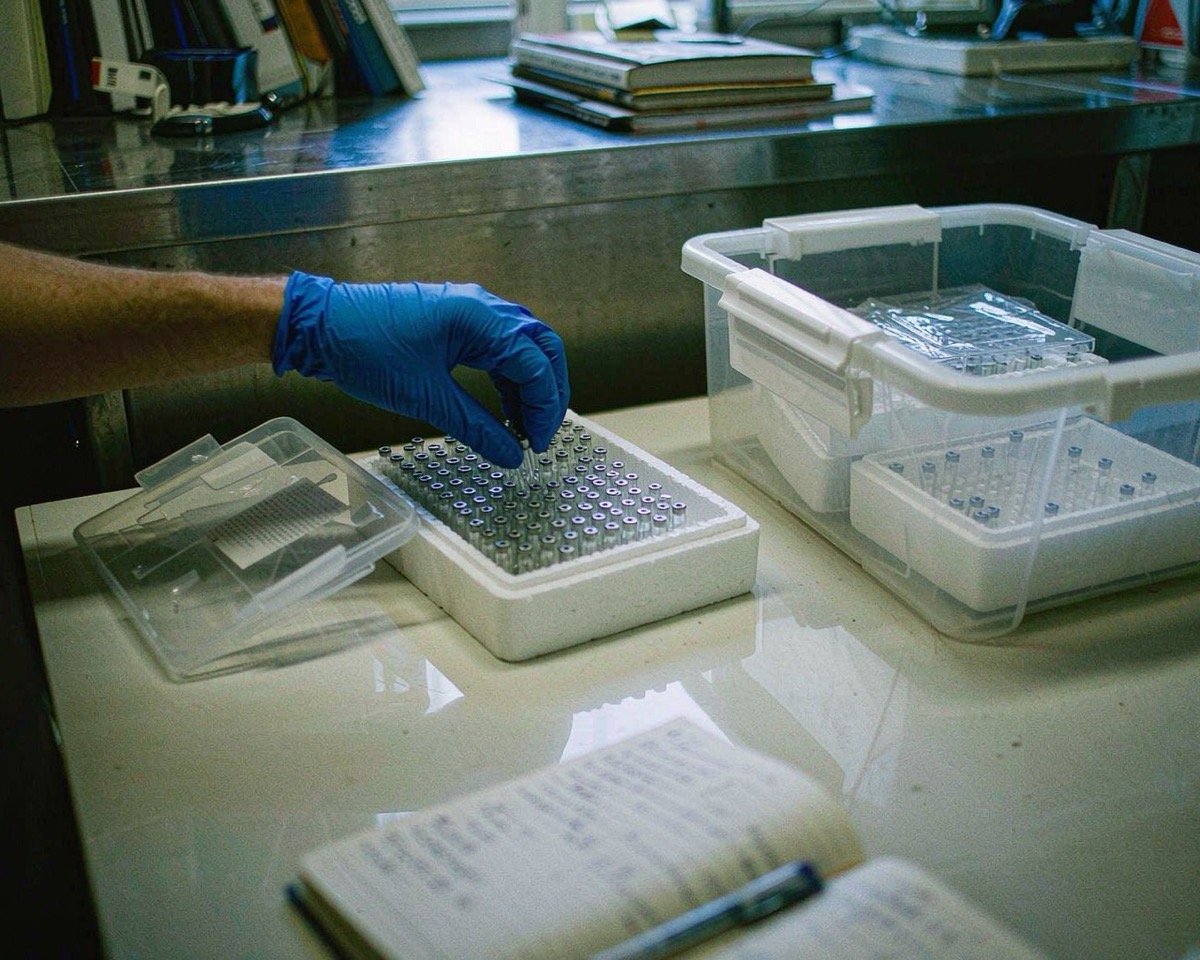
Water labs live on GC/MS and HPLC/MS, and both consume autosampler vials at a steady clip. A few specifics for this vertical.
VOC confirmatory runs reanalyze from the same 40 mL VOA vial via headspace or purge-and-trap, but anything you transfer to a 2 mL autosampler vial follows standard HPLC/GC practice: 9-425 screw neck, PTFE/silicone septa, and fills that leave minimal headspace to slow volatilization. The physics is unforgiving, since every micro-liter of headspace is escape room for volatile analytes between injections.
Two water-specific notes. First, low-level work rewards low-background vials, because a trace-level method cannot tell a contaminant leaching from glass or septa from a real hit in the sample. If your lab runs trace organics, it is worth understanding what certified vial claims actually mean before you pay the premium. Second, amber 2 mL vials exist and are cheap insurance for light-sensitive extract fractions, the same logic as the 1 L amber bottles upstream.
Septa choice follows the solvent. The guide to PTFE vs silicone vs PTFE/silicone septa applies here unchanged, and I would only add that water labs running dual GC and HPLC benches should standardize on one vial platform where possible. The inventory savings are real.
The Bench Beyond GC and LC: IC, ICP, and TOC
Most “water lab” imagery is a GC/MS, but three other benches consume consumables in volume and deserve their own line items.
Ion chromatography runs anions and cations on high-purity eluent, and its weakness is contamination. IC is one of the few techniques where the lab’s own water system and the cleanliness of every bottle matter at the same order of magnitude as the analyte. Eluent goes in dedicated high-density polyethylene or glass bottles with tight caps, because carbonate uptake from ordinary lab air shifts retention times within hours. If your IC anion runs drift seasonally, check where your eluent bottles live before you touch the instrument.
ICP-MS consumes acid-cleaned plasticware constantly. Sample cups, autosampler tubes, and digestion vessels all need to be trace-metal grade, and rinsing between samples is where the consumable budget quietly grows. Labs switching to lower-cost generic tubes should verify the polymer first: some cheap polypropylene carries enough background metals to show up at low calibration levels, which is the ICP version of the vial background problem from earlier in this guide.
TOC analysis wants its own container discipline too. TOC vials and bottles must be baked or otherwise pre-cleaned, filled with minimal headspace, and analyzed promptly, because ambient carbon sneaks into any container that sits open. A TOC blank contaminated by an unclean bottle reads as process carbon, and nobody catches it at the bench.
Certified, Pre-Cleaned, and Unprocessed Containers
Container cleanliness is where water labs separate themselves from labs that get challenged. The market offers three tiers, and each has a legitimate place.
Certified containers arrive pre-cleaned, with a lot-specific certificate documenting the testing, often including TOC background below a stated threshold. EPA performance-based specifications for VOA work expect certified bottles to contribute negligible background, and reputable manufacturers document this per lot with barcoded traceability.
Pre-cleaned but uncertified containers cost less and are fine for screening work, training, or methods where the analyte is orders of magnitude above background. The risk is documentation: they may perform identically, but you cannot prove it.
Unprocessed containers are for labs with their own cleaning and QA programs. If that is not you, skip them.
The decision rule I use with clients: match the certification level to the data’s consequence. Compliance data that might end up in an enforcement action deserves certified containers with full paperwork. Internal trend monitoring may not. Where this gets subtle is drinking water compliance, where the certificate in the box is part of your defense file, and it connects to the broader question of what CoA documents actually prove.
The Pitfalls Table
I keep a running list of consumable failures I have either caused or witnessed. The pattern across all of them is that the mistake looked reasonable in the moment.
| Pitfall | What happens | Fix |
|---|---|---|
| Reusing VOA vials after cleaning | Residual organics create false positives at trace levels | Single-use only for VOC compliance work |
| Clear bottles for PAH samples | Photodegradation before analysis, biased-low results | Amber glass, always, for this group |
| Metal-capped bottles for metals | Cap leachables contaminate the acidified sample | Plastic caps with inert liners |
| Empty preserved-vial stock | Tech substitutes unpreserved vials, holding time clock burns | Par level with reorder trigger |
| Wrong septa polymer on 2 mL vials | Ghost peaks in GC/MS scans | PTFE/silicone, matched to solvent |
| Handwritten field labels | Custody mismatch, sample rejected at login | Pre-printed labels from the lab |
None of these are exotic. All of them are cheap to prevent. That combination is exactly why they persist in otherwise well-run labs.
Storage and Shelf Life of Water Lab Consumables
Consumables age, and water labs keep enough inventory that aging matters. Preserved VOA vials have practical shelf lives tied to the preservative volume staying right, and pre-dosed bottles for microbiology carry expiry dates that auditors check.
The habits that work: date-stamp every box on arrival, rotate oldest-first, and keep VOA vials sealed in their original packaging until use because septa adsorb vapors from an open lab environment. The same discipline applies to 40 mL VOA stock: septa adsorb lab vapors, preservative volumes drift, and an expired pre-dosed bottle is a rejected sample waiting to happen.
One more storage note specific to this vertical: never store empty sample containers near solvents or the GC’s waste stream. I walked into a client lab once where the VOA vial rack sat two meters from an open methanol bottle, and their method blanks had a methanol signature. The fix cost nothing and took four minutes.
Par Levels and Standing Orders
Holding times make water labs unforgiving of stockouts, so inventory discipline is part of the consumable strategy, not a separate administrative chore.
Set par levels by burn rate, not by feel. Count how many of each container a typical week consumes, double it, and make that the reorder trigger. Anything with a preservative attached or a holding time downstream deserves a bigger buffer, because a stockout does not just delay sampling, it changes which vial gets used and therefore how long the sample remains valid.
Standing orders suit the predictable half of the list: VOA vials, 1 L amber bottles, membranes, and 2 mL autosampler vials burn at rates that barely move month to month. The unpredictable half, big field campaigns and special projects, works better on a mini-market basket approach: one approved supplier, one call, everything in the tote restocked in a single delivery.
A Worked Stocking List for a Small Water Lab
To make this concrete, here is a starting list for a two-bench lab running drinking water VOC, metals, and nutrients. Scale volumes to your throughput.
| Item | Spec | Notes |
|---|---|---|
| VOA vials, 40 mL | HCl-preserved + unpreserved, PTFE septa | 14-day vs 7-day holding times |
| Amber glass bottles, 1 L | PTFE-lined cap | Semi-volatiles, pesticides, PAHs |
| Plastic bottles, 250-500 mL | HDPE/PP, acid-washed | Metals, nutrients |
| Sterile thiosulfate bottles | Certified, single-use | Microbiology |
| Membranes | 0.45 µm and 0.22 µm, PES/RC | Field + bench filtration |
| Field inline filters | 0.45 µm disposable | Dissolved metals |
| Autosampler vials, 2 mL | 9-425, PTFE/silicone septa | GC/HPLC bench |
| Custody supplies | Seals, forms, labels, temp blanks | Every cooler |
Audit your stockroom against the table quarterly. The gaps you find are usually the consumables that will cause the next rejected cooler.
Train the Bench, Not Just the Buyer
Every consumable failure I described in this guide had a human step in the middle, which means training belongs in the consumable program.
New techs should learn three moves before their first unsupervised sampling run: the VOA fill-and-tap technique, the preserved-versus-unpreserved vial decision, and the cooler packing order that keeps temperature blanks where the courier can see them. Each takes ten minutes to teach and saves a rejected cooler to learn the hard way.
At the instrument bench, training covers vial handling basics: fill levels that protect volatile analytes, septa inspection before a sequence, and the discipline of not topping off vials mid-run. I keep a laminated one-page card at each station for exactly these checks, because nobody rereads a 40-page method manual on a busy afternoon.
The audits that go well are usually the ones where the bench staff could explain why a container matched its method without looking it up. That fluency is the real deliverable of consumable training, and it costs nothing but an hour per new hire. When an auditor asks your newest technician why a metals sample ships in plastic rather than glass, the answer you want is instant, and it is free.
Choosing a Supplier for This Vertical
Water lab consumables have a feature most verticals lack: the method text constrains you. That changes supplier evaluation.
Check the documentation first. For every container class you buy, the supplier should provide lot-specific certificates, and the claims should map to the EPA specifications your methods cite. A supplier who cannot produce a current CoA for the exact lot in your stockroom is a risk regardless of price.
Second, check the range. A water lab buys across a wide footprint: 40 mL VOA, 1 L amber, plastic bottles, membranes, 2 mL autosampler vials, headspace vials. Consolidating onto one or two suppliers cuts the paperwork surface area, which matters when an auditor walks in and you need to produce certificates across five product families.
Third, ask about lead times on the items you burn fastest. The 09-18-week scare I described earlier was a supplier lead-time problem wearing a holding-time costume. For the vertical-specific detail, our environmental testing consumables guide covers the ground this page touches only briefly.
Where does this leave the purchasing conversation? In my experience, water labs that document their consumables like they document their calibrations simply stop having consumable-related findings. That is the whole strategy.
Conclusion
Water quality testing is one of the few verticals where the consumable is part of the regulated method. The container decides the holding time, the preservation decides the validity, and the paperwork decides whether your data survives a challenge. Walk your stockroom against the analyte groups in this guide: VOA vials for volatiles, amber glass for semi-volatiles, acid-washed plastic for metals, matched filtration gear, and low-background vials at the instrument bench. Buy certified where the data is consequential, keep par levels on anything with a holding time attached, and file the certificates where an auditor can reach them in minutes. If you take this seriously, your next assessment will be boring, and boring is the goal. For the adjacent vertical, our environmental testing consumables guide is the natural next read.
Frequently Asked Questions
What vials are used for VOC water testing?
Standard practice is 40 mL amber or clear glass VOA vials with PTFE-lined septa caps, filled with zero headspace. Compliance methods typically use HCl-preserved vials for a 14-day holding time, or unpreserved vials for a 7-day window when acidification is unsuitable.
Why do metals samples go in plastic bottles instead of glass?
Borosilicate glass contains metals such as sodium and boron that can leach into an acidified sample and bias low-level results. Acid-washed polyethylene or polypropylene bottles are chemically quieter for trace metals work, which is why approved methods specify them.
Do sample containers really need to be certified?
For compliance monitoring under EPA methods, yes in practice. Certification means the manufacturer tested the lot for background contamination and documented it, which is part of your data’s defense file. For internal screening or training, pre-cleaned containers without certification are usually acceptable.
What filter pore size do water labs use?
Dissolved metals field filtration typically uses 0.45 µm membranes, while bench filtration for HPLC/IC sample prep uses 0.45 µm for clarification and 0.22 µm where sterile or very clean filtrate is required. Always check the method text, because some specify the membrane type.
How long can a water sample sit before analysis?
It depends entirely on the analyte and preservation. Preserved VOC samples allow 14 days, unpreserved VOC samples 7, and some analytes like pH or chlorine residual must be measured within minutes. Your lab’s method manual, ultimately derived from 40 CFR 136, is the authority.