
I once inherited a collaboration where every shipment arrived fine for months, until one August week when three packages of plasma samples sat on a loading dock over a weekend. The assay results told the story before anyone opened the boxes. Shipping is the part of the workflow you do not control, which is exactly why it deserves a written procedure instead of good intentions.
The Short Answer
Safe sample shipping comes down to four things: classify the material correctly (biological substances follow UN 3373 rules), package in the triple-pack system (leakproof primary receptacle, absorbent-cushioned secondary packaging, rigid outer box), control temperature honestly for the whole journey, and label the outside completely so handlers and receivers know what they have. Rules differ by material and country, so confirm your classification and carrier requirements before the first shipment, and never ship on a Friday for a Monday arrival.
Step 1: Classify Before You Pack
The classification decides everything downstream, so it comes first.
Most diagnostic and clinical samples (patient specimens suspected of containing pathogens, but not cultured or concentrated) are UN 3373, Biological Substance, Category B. Category A substances (infectious in a form capable of causing permanent disability or life-threatening disease) follow much stricter rules with different packaging instructions. Exempt items (tested negative, non-infectious environmental samples, dried stains) may travel under lighter regimes, but “I think it is exempt” is not a classification; document it.
The UK government’s specimen packing guide for sample submission is a readable worked example of Category B handling under ADR/P650, and the CDC’s clinical specimen packaging guidance shows the same logic on the US side, including the point that packaging and shipping training must be refreshed on a two-year cycle.
Step 2: The Triple-Pack System
UN 3373 packaging has three layers, and every layer has a job:
- Primary receptacle: the vial, tube, or cryovial in direct contact with the sample. It must be leakproof and sealed properly. The CDC guidance includes a detail people skip: do not open collection tubes while packing, because breaking the vacuum seal increases leak risk.
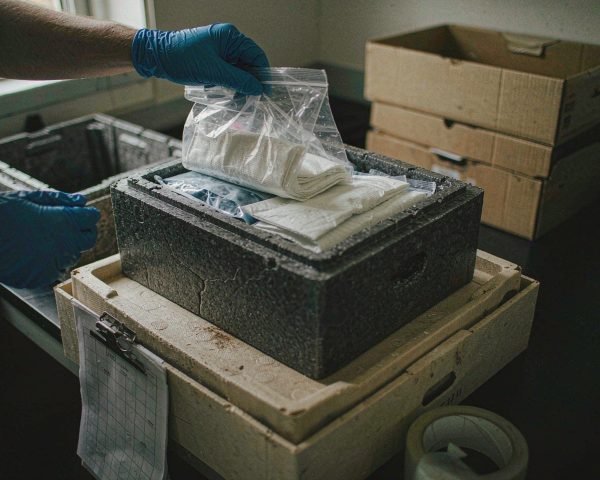
- Secondary packaging: a watertight layer around the primaries with cushioning, and enough absorbent material between the layers to absorb the entire liquid contents if everything leaks. For liquids, this is not optional generosity; it is a requirement.
- Outer packaging: rigid, marked, and strong enough for conveyor belts and dropped corners.
The MSF sample transport manual chapter adds practical numbers: each primary receptacle is individually wrapped so samples cannot touch, and total liquid per outer package is limited (4 liters or 4 kg of dangerous substances, excluding refrigerants). Those limits exist because a package is rated as a system; overstuffing voids the rating.
Step 3: Temperature Control for the Real Journey, Not the Ideal One
Cold chain failures are the most common quiet shipping failure, because a warm box looks perfectly normal on arrival.
- 2-8 °C: frozen ice packs placed outside the secondary packaging, with the secondary packaging supported so it holds position as the packs thaw.
- Frozen: dry ice (shipping frozen samples raises its own storage questions; our article on freezing samples in HPLC vials covers the pre-ship side), placed outside the secondary packaging, in packaging that lets CO2 escape (sealed dry-ice packaging can rupture), with the outer box marked with the UN 1845 dry ice label and the net weight.
- Ambient: fine for many fixed and preserved samples, but confirm your assay tolerates the realistic transit time.
The honest question to ask: how long is the worst-case journey, including customs holds and weekend docks? Size your refrigerant for that number, not for the best case. The MSF chapter’s example (four pre-frozen ice packs holding 2-8 °C for about 48 hours at 28 °C ambient) is the right kind of concrete planning.
Step 4: Labeling and Paperwork
The outer package needs the UN 3373 diamond mark (at least 50 mm, with “Biological Substance, Category B” in letters at least 6 mm high), full sender and receiver addresses with a phone number reachable during the journey, and, when dry ice is used, the dry ice label and weight. Include the paperwork in a pouch on the outside, not inside the box where it soaks up any leak.
Three details that save shipments in practice:
- The receiving lab’s phone number and a person’s name, so a dock problem is a call, not a return trip.
- Storage conditions printed on the box (“+4 °C unless specified otherwise”, as the APHA guide puts it), because couriers read boxes, not method sheets.
- Ship early in the week. Both the CDC and APHA guidance converge on avoiding Friday shipments for the obvious reason: weekend loading docks do not call you.
A Pre-Ship Checklist You Can Steal
Run this before every shipment type you have not sent in the last month:
- Classification documented (UN 3373, Category A, or exempt, with the reason).
- Triple pack assembled, absorbent sized to total liquid volume, primaries individually wrapped and sealed.
- Temperature plan matches worst-case transit time, refrigerant secured, dry-ice venting confirmed.
- Outer box marked: UN 3373 mark, Category B text, addresses, phone, storage condition, dry-ice label if used.
- Paperwork outside in a pouch, manifest matching the contents, receiver expecting the box.
The last item matters more than it sounds. A receiver who is not expecting a package is the number-one cause of packages sitting in mailrooms.
Conclusion
Safe shipping is a system, and every failure I have seen traced back to one missing link: an honest classification, a real absorbent calculation, a refrigerant plan that survived a weekend, or a label that told the handler what was inside. Build the checklist once, train whoever packs against it, and refresh the training on the two-year cycle the regulations expect. Temperature planning deserves special respect: size it for the worst journey, not the best one, and never let a shipment land on an unattended weekend dock. Do those things and shipping becomes boring, which is the goal. The receiving end matters too: our guide on proper HPLC vial storage covers what should happen the moment your box arrives, and our article on how long samples can stay in a vial explains what the clock you just protected is actually worth.
Frequently Asked Questions
What does UN 3373 Biological Substance Category B mean?
It is the shipping classification for infectious substances that are not in a generally life-threatening form, which covers most patient and diagnostic specimens in transit. These must be packed in the triple-pack system per IATA Packing Instruction 650 or equivalent road rules, marked with the UN 3373 diamond, and shipped by trained personnel.
Can I ship biological samples with regular ice packs?
Yes, for 2-8 °C shipments, as long as the packs sit outside the secondary packaging, the secondary packaging is supported so it keeps its shape as packs thaw, the outer box is leakproof, and your refrigerant covers the worst-case transit time. Frozen samples typically need dry ice instead, with vented packaging and proper UN 1845 labeling.
Why can’t I ship samples on a Friday?
Most weekend delays are loading docks and unstaffed receiving rooms, so a Friday shipment risks sitting unpacked and unrefrigerated until Monday. Both CDC and APHA guidance advise shipping early in the week so the package lands on a staffed, expecting dock within your cold-chain window.
Do I need special training to pack and ship biological samples?
Yes. Regulations require function-specific training for anyone packing or shipping infectious substances, refreshed every two years under DOT/IATA rules. The training covers classification, packing instructions, marking, and documentation; shipping a Category B box without it exposes you and your employer to real liability.
What absorbent material should I use in the secondary packaging?
Use non-particulate absorbent (paper towels, cellulose wadding, commercial absorbent sleeves) sized to absorb the entire liquid volume of all primary receptacles in that packaging. Avoid sawdust or vermiculite, which regulators call out as unsuitable, and place the absorbent between the primary receptacles and the secondary packaging.