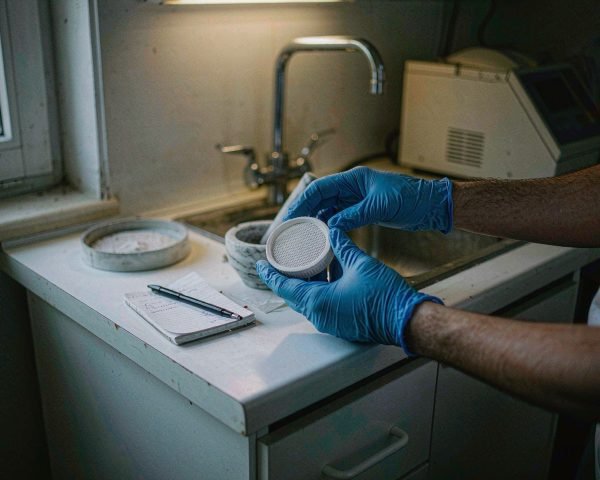

XRF sample preparation is where most bad results are quietly made, not at the instrument. The good news is that the shopping list is short once you know which prep route your samples take. Get the right cups, films, binders, and dies in place and the spectrometer suddenly behaves.
Short answer: Sample cups with support films (Prolene, Mylar, Kapton, or Etnom), binder wax or boric acid for pressed pellets, platinum-gold crucibles and lithium borate flux for fusion, grinding vessels or agate mortars, and pellet dies plus press accessories.
Read on for how each consumable maps to a prep route, where film selection most often goes wrong, and the buying details that save reorders.
What XRF Actually Needs From a Sample
XRF is unforgiving about sample presentation. The instrument reads a shallow surface layer, so your sample has to be homogeneous, of finite thickness (thin enough that the X-rays escape, thick enough that you hit “infinite thickness” for heavier lines), and in a matrix you can model or calibrate against. A powder that segregates in the cup will drift on you. A pellet with a rough, cracked face reads lower intensity than a flat one, and the software has no way to know the difference.
That’s why prep exists at all: every consumable below serves one of those demands.
The four common presentation routes are loose powder in a cup sealed with film, pressed pellets (sample plus binder, pressed in a die), fused beads (sample dissolved in molten lithium borate and cast in a mold), and liquids in cups with a support film. EPA Method 6200, the field method for soils, credits much of its precision to consistent cup and sample handling rather than the analyzer (EPA Method 6200 (PDF)).
Consumables by Prep Route
Sample cups and support films
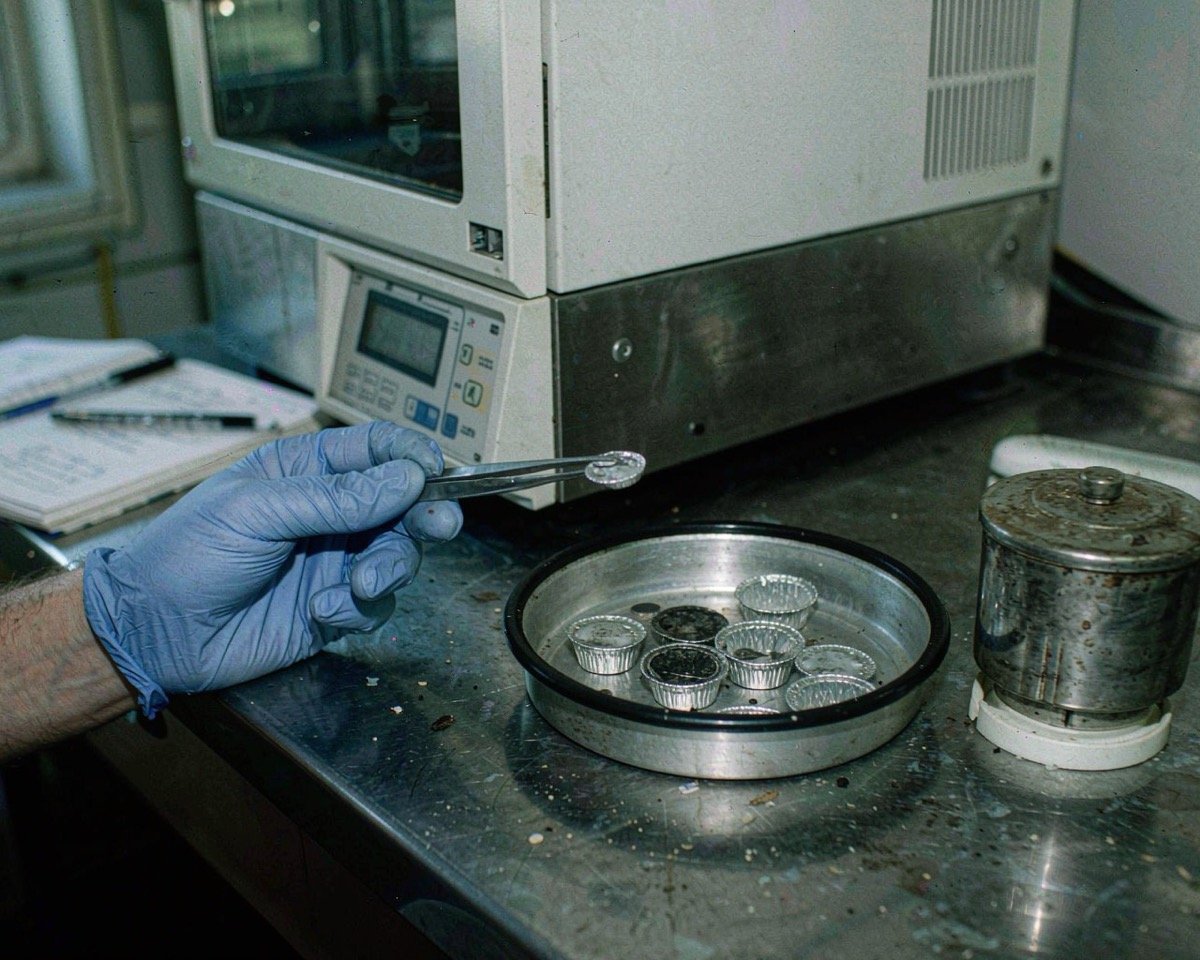
Loose powders and liquids both need a cup with a thin film window that transmits X-rays and survives the sample. The usual suspects:
• Prolene (polypropylene): the workhorse. Low background, good transmission for light elements, chemically resistant to most aqueous samples.
• Mylar (polyester): stronger and cheaper, but higher background for some analytes and poorer transmission below ~1 keV.
• Kapton (polyimide): heat and chemical resistant, common when samples are aggressive or warm.
• Etnom: a purpose-made XRF film many labs pick for low-background performance similar to Prolene with better durability.
Film thickness matters more than most people expect. A 6 µm Prolene film can quietly add background around the vanadium line, and I’ve seen that exact problem cost a team two days of chasing a phantom vanadium contamination. If you’re quantifying elements below titanium, ask the supplier for transmission curves and check them against your element list before committing to a roll.
Binders for pressed pellets
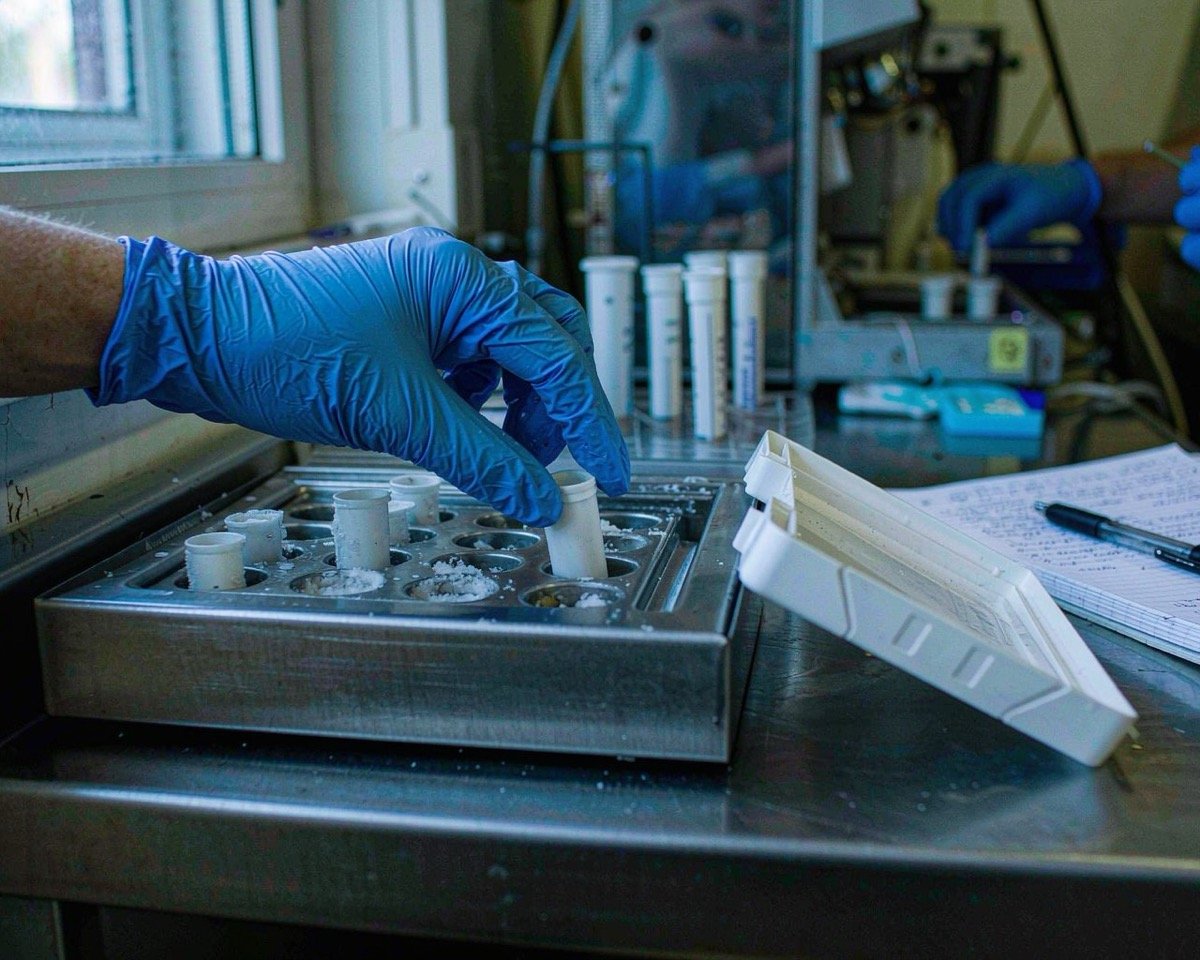
Powders won’t press into a self-supporting pellet without help. You mix in a binder: typically cellulose or wax at roughly 2 to 10% by weight, or boric acid for a matrix closer to the sample. The binder dilutes your sample slightly, so keep the ratio constant across a batch. Published work on soil reference materials describes exactly this routine: 10 g of sample with about 1.25 g of wax binder, ground together, then pressed at 25 tonnes in a 40 mm die (XRF prep of NIST SRM soils).
Boric acid backs are the alternative: sample pressed onto a boric acid puck. Cheaper per pellet, more fragile faces.
Fusion consumables
Fusion gives the most homogeneous, matrix-free presentation, so it’s the route of choice for major-element work on rocks, cements, and ceramics. Consumables: platinum-gold (95/5) crucibles and molds, lithium borate flux (tetraborate, metaborate, or a mix chosen by your matrix), and a non-wetting agent like lithium bromide or lithium iodide so the bead releases cleanly.
Crucibles are a real investment, several hundred dollars each, and they last years if nobody scratches the interior. Flux choice changes your accuracy more than the crucible brand does, so match the flux to your sample chemistry rather than grabbing the cheapest 5 kg bag.
A 2019 study comparing the two routes on coal plant wastes found results between fused beads and pressed pellets differing by 2 to 33%, with grinding below 0.050 mm reducing the error (fused beads vs pressed pellets). Fusion wins precision; pellets win cost and throughput.
Grinding vessels and mortars
Particle size is a hidden variable in XRF: coarse particles absorb and scatter X-rays unevenly, and the effect is strongest for light elements and short wavelengths. So you need consumables for size reduction: agate mortars and pestles for small batches where trace-metal contamination matters, ring-and-puck or planetary ball mills with agate, zirconia, or tungsten carbide vessels for throughput.
Match the vessel to the analyte list. Tungsten carbide mills can add W and Co contamination (the SRM study above flagged exactly that), so for cobalt work, agate or zirconia is safer.
Press and die consumables
Pressed pellets need a die set (usually 32 mm or 40 mm diameter), a hydraulic press, and often pellet caps or backing. Die cleanliness is part of consumable management: wax buildup transfers to the next pellet and smears one sample’s matrix into another’s face. Wipe die faces between samples; keep a dedicated die per matrix if you can.
ASTM D7343, the practice covering XRF sample handling for petroleum products and lubricants, gives real attention to storage vessels, sub-sampling, and the handling of sample holders and cups, which tells you where the variance lives (ASTM D7343).
Choosing Film by Analyte and Matrix
Match film to your elements and sample chemistry:
• Light elements (Na through Ca, roughly): need thin, low-Z film. Prolene at 6 µm transmits far better than Mylar at the same gauge. Sodium and magnesium are barely workable through film; many labs run them under vacuum in a film-free holder.
• Heavy elements: film choice matters less for transmission, but background still counts. Thicker, tougher films (10 µm Mylar, Kapton) are fine for Pb, Cd, Ba, and friends, and they survive aggressive samples.
• Aqueous or corrosive samples: Kapton or heavier-gauge films resist attack. Mylar hydrolyzes slowly in strong base, and a film that fails mid-run drips your sample onto the instrument window. I learned that the expensive way: a 4 µm Mylar film on an alkaline leachate tore mid-run, liquid went down into the chamber, and the instrument was down for a day plus a service visit.
Honest hedge: vendor transmission data overlaps between brands, and real differences show up on your own instrument. Verify with a standard on the film you plan to buy.
Contamination and Cross-Contamination Risks
Films themselves can be a contamination source. Most XRF films carry trace impurities; some polypropylene lots show measurable Zn or Ca. Run a film blank against your reporting limits before you trust it, and keep one lot per calibration series.
Cross-contamination routes:
• Reusing cups between samples without cleaning. Fine for screening, bad for quantification.
• Die faces carrying binder and sample dust.
• Mortar carryover when one mortar serves wildly different materials; grind a blank between them.
• Flux handling: open flux jars absorb moisture and CO2, and dosing gets sloppy.
Pre-ground samples in sealed cups are another route; the film is the sample’s only barrier, so store cups film-up, not stacked film-down on a bench.
QA Tips That Actually Hold Up
• Replicates on prep, not just on measurement. A duplicate sample catches grinding and mixing variance, the kind that actually hurts XRF.
• CRMs through the full prep route. NIST sells a wide range of standard reference materials for XRF validation (NIST SRM program). Run the CRM through the same pressing or fusion your samples get; a CRM read neat checks the instrument only.
• A written cup reuse policy. Screening labs reuse cups after a wipe; quantitative labs should treat cups as single-use, or re-clean and blank-check them. Write down which you are.
• Film lot tracking. Note the film type and lot on your run sheets. When a background shifts, that note finds the cause in minutes.
Buying Notes Before You Order
Check film diameter against your spectrometer’s cup geometry before ordering rolls. Common XRF cups are 32 mm and 40 mm, and film sheets cut for one won’t seat cleanly on the other. The same applies to dies: a 40 mm die makes a pellet a 32 mm cup cannot hold. Confirm which your instrument takes before buying.
Order films by type and gauge, not “whatever is in stock.” Buy cups with lids if samples sit overnight; evaporation changes liquid thickness and, with it, your results. And keep consumables consistent within a calibration, because switching binder grade or film brand mid-project is a recalibration you didn’t plan for.
Consumable planning overlaps across techniques, too. Our guide to ICP-MS sample preparation consumables covers the acid-cleaned vials and digestion side of metals work (what consumables does ICP-MS sample preparation need), and the same grinding discipline appears in particle size analysis consumables (what consumables does particle size analysis need).
Conclusion
XRF sample preparation consumables fall into a short list: cups and films for the presentation, binders and dies for pellets, platinum-gold crucibles and flux for fusion, and grinding vessels sized to your contamination tolerance. None of them are glamorous, and every one of them shows up in your data if you get it wrong. Start with your prep route, then buy film by analyte transmission, binders by batch consistency, and dies by the diameter your spectrometer actually takes. If you’re building out a metals-focused lab more broadly, our complete guide to metals and materials testing lab consumables (metals and materials testing lab consumables) puts XRF supplies in context alongside digestion, ICP, and sampling gear. And when your XRF work overlaps with dissolved metals analysis, the choice between storage vials matters too; we’ve compared PFA vs glass vials for trace metal analysis (PFA vs glass vials) with buying guidance you can apply directly.
Frequently Asked Questions
What film is best for XRF?
For general work, 6 µm Prolene is the safest default: low background and good transmission for light and heavy elements alike. Mylar is a cheaper choice for heavier analytes, and Kapton suits corrosive or warm samples. Check a transmission curve against your element list before buying a roll.
Can you reuse XRF sample cups?
For screening work, yes, if you clean and dry them carefully. For quantitative analysis, most labs treat cups as single-use because residual powder in the seam or rim biases the next sample. Whatever you choose, write it into your SOP and blank-check reused cups.
What thickness of film should I use for XRF?
Thinner film (4 to 6 µm) maximizes transmission for light elements like Na, Mg, and P. Heavier gauges (8 to 10 µm) trade some transmission for durability on liquids and abrasive powders. Your analyte list, not habit, should drive the gauge.
Why does my XRF film keep tearing?
Usually the sample chemistry or a sharp particle edge: alkaline liquids attack Mylar, and coarse powders stress thin film during handling. Switch to a tougher film like Kapton, or grind finer before loading. Check the cup rim for burrs too, since a nicked rim cuts film on seating.
Do I need fused beads or pressed pellets for XRF?
Fused beads give better precision and remove matrix effects, which suits major-element work on rocks, cement, and ceramics. Pressed pellets are far cheaper and faster and work well for trace elements and routine screening. Many geochemistry labs run both routes on the same instrument for different element groups.