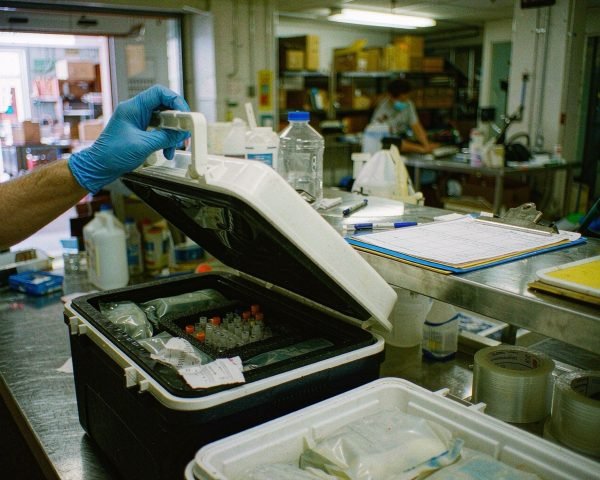

Most failed shipments don’t fail in the lab. They fail somewhere between the loading dock and the receiving bench. If your work depends on shipping lab samples that arrive valid, the eight rules below are the line between reportable data and a rejected cooler.
The Short Answer
Classify the shipment correctly, use containment rated to 95 kPa, control temperature door to door, respect holding-time windows, ship paperwork with the sample, choose carriers by risk, plan for delays, and run a receiving check. A shipment only counts when all eight hold.
Here’s the version with the details, the numbers, and the mistakes I’ve personally paid for. Read on, or skim the rule you know you’re weakest on. (Be honest with yourself.)
The Eight Rules
Rule 1: Know what category you’re shipping before anything touches a box
Every shipping decision flows from one question: what is this sample, legally? A routine environmental sample, a clinical specimen suspected of containing a moderate-risk pathogen, and a known infectious culture are three different shipments under transport law, and mixing them up is how packages get pulled off trucks.
Most routine clinical and diagnostic work falls under UN 3373, Biological Substance, Category B, which covers human or animal samples where exposure is unlikely to cause permanent disability or life-threatening disease. Category A samples, assigned to UN 2814 or UN 2900, are the ones known or reasonably believed to contain pathogens capable of causing that kind of harm, and they demand much stricter packaging. Some things are exempt entirely: dried blood spots, samples that have been neutralized or fixed, and certain low-risk materials. The USDOT/PHMSA transport of infectious substances guidance is the primary US reference, and it’s worth an hour of your time.
One trap people miss: the cooling agent has its own classification. Dry ice is UN 1845, a Class 9 dangerous good, so a box that’s legally “Category B” still triggers dangerous-goods paperwork the moment you drop dry ice in it. I’ve seen a shipment rejected at the counter purely because the paperwork declared the biological part but stayed silent on the dry ice. The classification question takes five minutes. Skipping it costs the whole shipment.
Rule 2: Use triple packaging and take the 95 kPa requirement seriously
The backbone of compliant shipping is triple packaging: a leakproof primary receptacle, a leakproof secondary packaging around it, and a rigid outer box. For air transport, and in practice for everything else, the primary and secondary components must survive an internal pressure differential of 95 kPa without leaking. That number sounds abstract until you think about what a cargo hold does to a sealed container during climb and descent, or what a package looks like after being thrown onto a sorting belt.
The 95 kPa test exists because pressure swings pop poorly sealed caps and force liquid into headspaces it was never meant to reach. Wrap every primary receptacle in enough absorbent material to soak up the entire liquid volume, cushion the secondary container, and keep the paperwork either inside the outer box or attached to it, never sealed inside the secondary packaging where an inspector can’t find it. Category B has volume limits too: for air transport, liquids are capped at 1 L per primary receptacle and 4 L per outer package.
Containers matter as much as the outer box here. For the primary side, tools like sterile sampling bags with leak-resistant seals earn their keep on this rule, and the WHO’s transport of infectious substances guidance walks through the full packaging architecture. If you want the step-by-step assembly instructions, that’s the practical packing side, which I’ve covered separately; this article is about what keeps the sample valid, not how to fold the absorbent sheet.
Rule 3: Control temperature for the whole journey, not only the packing step
Packing cold is not the same as arriving cold. The cold chain is a time function, and it includes the courier van, the sort facility, the airplane tarmac, and the hour your box sits on a receiving dock because nobody signed for it. A shipment packed to 2-8°C at 4 p.m. can still be warm at 9 a.m. the next day if the middle of the journey went badly.
Pick your cooling strategy by what the sample actually needs. Gel packs around frozen or refrigerated water samples work for short, well-behaved transits. Dry ice holds -78°C for genuinely frozen aliquots but sublimates steadily, so it has to be sized for the full journey plus margin, and carriers cap how much can fly. Ambient-stable preservatives are underrated: a properly preserved sample that tolerates room temperature removes an entire failure mode. CDC’s cold chain guidance for vaccine storage and handling is written for vaccines, but its core principle transfers directly: monitor the temperature the whole way, at every stage of it.
My cautionary tale involves a gel pack that had thawed completely by hour nine in a July van in Texas, a fact I only learned because the receiver logged the temperature and called me before accepting the box. The samples were salvageable. The client relationship needed work. Now I pack for the worst leg of the journey, not the average one.
Rule 4: Respect the stability window, because shipping time counts against it
Every sample has a holding time: the maximum period between collection and analysis that still produces valid results. It starts at collection, which means your sample burns its clock in the box just as surely as it does on the bench. A two-day transit plus a weekend in receiving can quietly consume a window that looked generous on paper.
The numbers vary by analyte, so check the specific method and permit, but they’re far shorter than most people assume. Under EPA holding time requirements in 40 CFR Part 136, pH has to be measured within 15 minutes of collection, BOD within 48 hours, many organic and inorganic parameters within 14 to 28 days, and most properly preserved metals within six months. Miss the window and the result can’t be reported for compliance purposes. The lab will flag it, but by then you’ve already paid for collection, shipping, and analysis.
The fix is arithmetic, not luck. Add your realistic transit time, receiving time, and a buffer before you schedule a shipment, then work backward. And don’t forget the consumables share the same clock: vials, bags, and preservatives have their own shelf life, which I explain in detail in our guide to HPLC vial shelf life and storage. A sample shipped in an expired vial with leached plasticizers has a validity problem no holding time table can fix.
Rule 5: The paperwork travels with the sample, so treat it as part of the sample
A sample that arrives without its chain of custody is, for many purposes, a sample that didn’t arrive. The chain of custody form records who collected it, when, who handled it, and when it changed hands. Receiving labs match it against the labels on the containers, and a mismatch, even a small one like a missing collector signature, can render the whole batch legally questionable.
Ship four things together: the COC, a sample inventory listing each container and its preservation, the required transport labels (UN 3373 marking with the proper shipping name, plus a dry ice label when applicable), and storage instructions stating the required temperature range. The CDC’s guidance on packaging and shipping UN 3373 specimens spells out the marking and documentation expectations for biological shipments.
A few practical habits pay off here. Put paperwork in a plastic sleeve taped to the outside of the outer box or inside it, where it survives condensation from gel packs. Number every container and list every number on the inventory, so a receiver can spot a missing vial in seconds. And sign every field that asks for a signature, because “I was in a hurry” is not a defense during an audit. Paperwork is boring until the day it’s the only thing standing between your data and a rejection letter.
Preservation details belong on the inventory too, not in someone’s memory. Write the preservative used, the pH adjustment, and the collection time next to each container ID. Receiving labs verify those details against the method table, and “preserved in the field” without a recorded time invites exactly the kind of ambiguity auditors love to probe.
Rule 6: Pick the carrier and service by risk, not by price
The cheapest service is expensive the moment it fails. Ground economy might cost $18 instead of $65, but if it routes your box through two sort hubs in 95-degree heat while your sample needs 2-8°C, you haven’t saved money, you’ve bought a lottery ticket against your holding time.
Choose by matching service characteristics to risk. Frozen or refrigerated samples that must arrive next morning belong on an overnight service with a direct route, ideally one hub fewer, and a morning delivery commitment that actually says morning. Ask couriers the questions that matter: Do you provide temperature monitoring or data loggers? What happens to my package over the weekend? What’s your standard handling for UN 3373? A carrier that answers these without hesitation is worth a premium. For air transport of anything with dangerous goods like dry ice, the IATA Dangerous Goods Regulations set the baseline rules every airline layers on top of, and carriers differ in how they enforce them.
I think of it as buying insurance with the shipping fee. The difference between economy and priority on a critical shipment is often less than the cost of one recollection trip, which usually runs to hundreds of dollars once you count labor, site access, and the client’s patience. Rate shopping makes sense for reagents. For samples whose validity is the entire point, the risk-adjusted choice is almost never the cheapest box on the screen.
One more note on service selection: check the delivery commitment for weekends, since some services treat Saturday delivery as an add-on you must request. If your box needs to arrive Saturday and the default service skips weekends, the extra day of cooling you packed becomes the only thing standing between the sample and a slow, warm excursion.
Rule 7: Plan for failure, because the shipping system will supply one
Something will go wrong eventually: a missed connection, a snowstorm, a Friday-afternoon box that lands at a closed receiving dock and sits for two days. The question is whether that failure consumes your sample or merely inconveniences it. The difference is preparation.
Build redundancy into the plan before you ship. Notify the receiving lab with tracking numbers and expected arrival, so a human looks for the box instead of assuming it comes Tuesday. Ship early in the week to keep the whole route clear of weekends. Include temperature indicators or a logger inside the package, because the post-arrival argument about whether an excursion happened ends the moment you have recorded data. Pack a thermal margin: if the journey needs 24 hours of cooling, pack for 48.
The one that haunts me involved a courier that sat a box over a long weekend because the delivery scan happened at 4:58 p.m. Friday at a facility that closed at 5. Nobody had told the receiving lab to expect it, so nobody called the depot, and Monday’s temperature readout told the whole sad story. Those samples were re-collected at full cost, and the client got my most apologetic email of the year. Every rule in this article came from shipping failures like that one. Planning for failure feels pessimistic right up until it feels like wisdom.
Rule 8: Do a receiving check that proves validity on paper, not on vibes
Validity is established at receiving, or lost there. A disciplined receiving check takes ten minutes and turns “the samples look fine” into a documented record you can defend in an audit.
The checks go in this order. Temperature: read the logger or indicator immediately and record the value before the box warms up, noting whether the reading falls inside the required range. Integrity: open the outer packaging and inspect every primary container for leaks, cracks, or shifted caps, and check that absorbent material did its job. Paperwork: match the chain of custody against the physical containers, container by container and number by number, confirming IDs, counts, and preservation notes. Disposition: accept and log, or quarantine and reject, with the reason written down either way.
If anything failed, document the excursion with photos, the logger file, and a note in the sample record before contacting the sender. Undocumented excursions don’t disappear; they resurface later as a question you can’t answer, usually from a regulator or a client. A shipment that passes all four checks has something no verbal assurance provides: evidence. That evidence is what “must arrive valid” actually means in practice, because valid is not a feeling about a cool box, it’s a record.
What a Rejected Shipment Actually Costs
It’s tempting to treat the rules as overhead, so here’s the ledger when they’re skipped.
| Failure mode | Direct cost | Hidden cost |
|---|---|---|
| Temperature excursion | Full re-collection trip, new consumables | Client doubts your cold chain discipline |
| Broken containment | Lab rejects package, cleanup and incident report | Delay of days, possible carrier claim fight |
| COC mismatch or missing paperwork | Data flagged or unusable for compliance | Audit exposure, re-analysis fees |
| Missed holding time | Sample void, analysis wasted | Permit or deadline consequences |
A single regional recollection with labor, mileage, site access, and fresh containers routinely runs into hundreds of dollars, and the deadline you were shipping toward doesn’t move to wait for you. Weigh that against the ten minutes each of these rules takes, and the economics stop being close.
Conclusion
None of these eight rules is complicated, and that’s exactly why they get skipped. Classification feels like formality until a counter agent refuses the box. The 95 kPa standard feels pedantic until a cargo hold ruins a poorly sealed cap. Holding times feel generous until a weekend eats them. Validity comes from the accumulation of small, disciplined decisions, and good intentions on packing day contribute none of them: the right category, the right containment, the right cooling strategy sized for the worst leg, the paperwork that travels intact, the carrier chosen by risk, the plan for the day things go sideways, and the receiving check that proves it all worked.
If you upgrade one thing this month, make it temperature documentation inside the package, because it settles every later argument about what happened in transit. And if your frozen aliquots are still riding in whatever tube was in the drawer, it’s worth reviewing your cryogenic vials and storage boxes so the container is as dependable as the cold chain around it. Your samples can only be as valid as the weakest link in the journey, and now you know where to look.
Frequently Asked Questions
Do all biological samples need UN 3373 packaging?
No. UN 3373 Category B applies to human or animal samples suspected of containing moderate-risk pathogens. Fixed, neutralized, or exempt materials such as dried blood spots may not require it, so classify each shipment before choosing packaging.
Can I ship samples with dry ice through a regular courier?
Usually yes, but dry ice is UN 1845, a Class 9 dangerous good, so it requires declaration, proper labeling, and quantity limits that vary by carrier and mode. Call your carrier before the first shipment and get their dry ice rules in writing.
How much transit time can I use before the holding time is violated?
Subtract the full transit window, receiving time, and a buffer from the analyte’s holding time, and ship only if what remains covers the lab’s turnaround. Check the specific method table, because 15 minutes and six months are both real answers depending on the parameter.
Who is legally responsible if a shipment arrives invalid?
The shipper owns classification, packaging, labeling, and documentation, so most responsibility lands on the sending lab. Carriers own what happens in their network, which is why temperature loggers inside the package matter for separating one party’s failure from the other’s.
What temperature record do I need at receiving?
Record the logger or indicator reading immediately, before the box warms, and log it against the required range from the method or COC. If the reading is outside range, photograph it, save the logger file, and quarantine the samples before accepting them.