
It always starts the same way. A precious sample, a brand-new syringe filter, and halfway through the filtration someone bumps the syringe and you lose half the extract. The natural question follows: if I push the rest through the same filter, what actually goes wrong?
The manufacturer’s answer is short: don’t. But the interesting part is why, because the reasons explain when the rule is soft and when it is absolute. I have reused exactly one syringe filter in my career, on a Matrix screening batch where the replacement stock had run out, and I spent the following week verifying that batch more carefully than any I have ever run. Never again, as they say, until the next shortage.
The Short Answer
No, syringe filters are single-use devices. Reusing one risks cross-contamination between samples, membrane fouling that blocks or channels flow, and analyte loss through saturated adsorption sites. If per-filter cost is the concern, the fix is a smaller diameter or a reusable filter holder with loose membranes, not a second pass through a spent device.
READ ON
Here is what physically changes inside a used filter, the risks quantified where they can be, and the alternatives that make reusing unnecessary.
What a Syringe Filter Actually Does on First Use
A syringe filter is a membrane (nylon, PTFE, PVDF, PES, regenerated cellulose) in a plastic housing, and its job is to catch particulates on and in its surface while letting your analytes pass. Sartorius, one of the big filter manufacturers, states the performance expectation plainly: performance is based on the first filtration, and reuse can hurt results through cross-contamination, sample loss, or blockage (Sartorius syringe filter FAQ).
Three things happen during that first pass:
- The membrane loads. Particles lodge in the pores. A filter that ran a dirty extract is partly blinded; the second sample pushes through slower and with different effective pore behavior.
- The adsorption sites saturate. Every membrane binds some of your analyte on first contact. That loss is (theoretically) consistent across identically prepared samples. A reused filter has already spent part of its binding capacity, so the second sample experiences different adsorption than the first. Consistency dies quietly. Filter makers repeat the single-use message across every brand and catalog for exactly this reason (Aijiren syringe filter FAQ).
- Residue remains. The filtrate you collected is clean; the membrane is not. It holds a few microliters of the previous sample, and no amount of air-pushing removes it reliably.
The Three Risks, Ranked by How Much They Hurt
Cross-contamination
The killer, and the reason reusing filters between different samples is never acceptable in anything with a quality system. The residual few microliters of the previous sample end up in the next one. At trace levels, a 1 percent carryover on a 100 µg/mL sample produces a 1 µg/mL ghost in the next inject, which is comfortably above the LOQ of many methods. Chrom Tech’s guide puts it bluntly: dispose of the used filter; syringe filters are single-use only, and reuse can contaminate future analyses (Chrom Tech syringe filter guide).
Recovery drift
Even reusing a filter on the same sample (the “I lost my extract” scenario) skews data. The first pass through a membrane is when adsorption happens; the second pass may pull bound analyte back off or bind more, depending on chemistry. Either way, your recovery is now different from your standards’, which were prepared fresh. In quantitative work that is a silent bias, and silent biases are the expensive kind.
Blockage and burst
A loaded membrane under extra pressure eventually does one of two things: stops flowing, or finds a weak point. If the housing or membrane lets go, unfiltered sample lands in your vial. A particulate-laden inject then does its own damage further downstream. Our guide to filter breakthrough covers that failure mode in detail.
The Exceptions That Prove the Rule
Are there circumstances where one filter sees two passages? Realistically, yes, and it helps to be honest about them:
- The same homogeneous sample, pushed through in stages. Filtering 10 mL through a 25 mm filter in two syringes-full is not “reuse”; the membrane never dries and the sample never changes. This is normal technique.
- Solvent rinsing before the real sample. Pre-rinsing a filter with a few mL of solvent (to wet the membrane and purge extractables) is standard practice, and that rinse liquid is discarded, not collected. Our extractables and leachables guide explains what that first mL is washing out.
What is never okay: the same filter for two different samples, or a dried-out filter re-wet for a later run. The first is contamination by definition; the second re-activates everything the membrane caught and dried onto.
If Cost Is the Motivation, Fix the Real Problem
Filters are too cheap for reuse to ever make economic sense, but let me play the argument out, because the alternatives are genuinely useful:
- Smaller diameter. A 13 mm filter has roughly a quarter of the membrane area of a 25 mm, and costs meaningfully less. For 1-2 mL samples it is also faster to push, which is the size-to-volume logic our filter sizing guide applies.
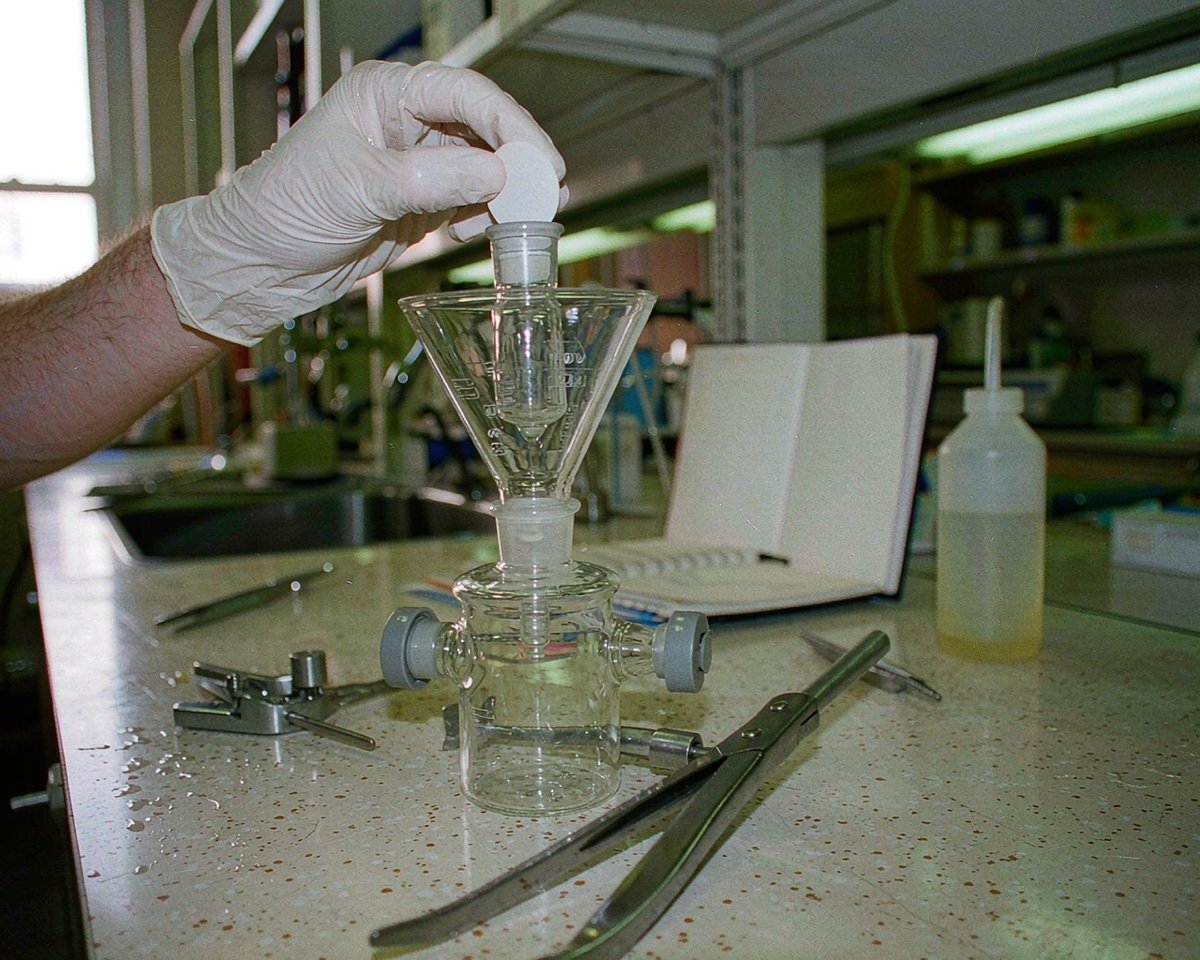
- Reusable filter holders. The real answer for high-volume work: a glass or steel holder with loose 47 mm membranes, where only the membrane (at a fraction of the cost) is consumed. We covered when that setup beats disposables in the syringe filter holder guide.
- Centrifugation instead of filtration. For particulate-heavy samples, a spin at 10,000 x g removes most solids for free, and the filter only polishes. Your filters last longer because they do less work, and slow filtration is the first symptom that this balancing act has failed.
Verifying Whether Your Filter Is Spent
If you ever doubt whether a filter has more life in it, the evidence is mechanical, not mysterious:
- Flow slows to a crawl: the membrane is loaded. Retire it.
- The filtrate is visibly hazy: retention has failed or the membrane was over-pressured. Retire the batch, not just the filter.
- Pushing harder “helps”: it helps until something bursts. High pressure is how particles and unfiltered sample end up downstream.
None of these tests justify reuse on a second sample. They are diagnostics for the current one.
Conclusion
Syringe filters are engineered, priced, and documented as single-use items, and the physics backs the label: the membrane loads on first contact, its adsorption behavior never repeats identically, and it holds residue of everything that passed through it. Reusing one across samples risks cross-contamination that a quality system cannot defend; reusing one for a single sample in stages is fine, and pre-rinsing is standard. When filter cost actually bites, solve it properly with a smaller diameter for small volumes or a reusable holder with loose membranes for big ones, and pre-centrifuge the dirty samples so filters do less work. Your data, your column, and your MS source all benefit from treating the filter as what it is: a consumable whose entire job happens once. For the broader setup, our complete syringe filter buyer’s guide rounds out the picture.
Frequently Asked Questions
Can I use one syringe filter for the same sample twice?
Yes, if it is the same homogeneous sample pushed through in stages and the membrane never dries out. That is standard technique for volumes larger than one syringe holds. Never use the same filter for two different samples.
How much sample actually stays in a used filter?
A few tens of microliters of liquid remain in the membrane and housing after a typical push. That is enough to contaminate the next sample at trace-analysis levels, which is why manufacturers classify syringe filters as single-use devices.
What is the cheapest way to reduce filter costs?
Match the filter diameter to the sample volume (13 mm for 1-2 mL), pre-centrifuge dirty samples so filters do less work, and use a reusable 47 mm holder with loose membranes for large-volume filtration. All three cut cost without touching data quality.
Do sterile syringe filters have the same reuse rule?
Stricter, if anything. A sterile filter’s value is its certified sterility, which is void the moment the wrapper opens and gone entirely after first use. Reuse destroys the sterility claim along with everything else.