
# What Consumables Does Rubber and Elastomer Testing Need?
I have walked into enough rubber labs to notice a pattern. The tensile machine gets all the budget attention, but the drawer of dies, blades and septa is what actually keeps samples moving. Run out of any one of those, and the whole test queue stalls.
Quick Answer
Rubber and elastomer testing needs dumbbell dies, blades and cutting boards, durometer indenter points, O-ring fixtures, microtome and cryo supplies, GC vials with high-temp septa, and extraction glassware with filters. The governing standards are ASTM D412, D2240, D573 and ISO 37.
Read on for the specifics, because a dull die or a bleeding septum can quietly wreck an entire batch of results.
The Consumables a Rubber Lab Goes Through Fastest
Tensile testing: dumbbell dies, blades and bench marks
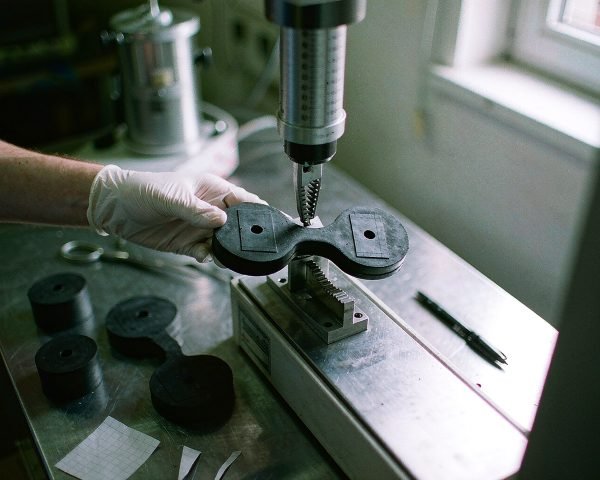
ASTM D412 governs tensile testing of vulcanized rubber and thermoplastic elastomers, and most labs run Method A with die-cut dumbbells. ASTM D412 defines six dies (A through F), and Die C, with its 25.4 mm gauge length and 6.35 mm waist, is the default for compound data sheets.
The consumables here are the dies themselves, plus everything that keeps cuts clean: honing stones for edge maintenance, talc or release agent, cutting boards, and ink or adhesive foil for bench marks. A blunt edge produces ragged shoulders, and ragged shoulders fail early. I learned this the hard way when a nicked Die C edge snapped every dumbbell at the tab. A week of retesting, all traced to an edge I could barely see under a 10x loupe. Inspect die edges under magnification and resurface once the edge radius grows past about 0.05 mm.
Hardness: indenter points and check samples
Durometer hardness under ASTM D2240 looks cheap and simple, which is exactly why consumable wear gets ignored. The Type A indenter point is a truncated 35-degree cone, and it dulls with use. Spring force drifts too. When readings on a reference block start creeping, the indenter point or spring is usually the culprit, not your rubber.
Labs that test seals also keep a Shore A 70 O-ring or two on hand as a check sample. If you want the broader picture on indenter points, test blocks and reference samples, our guide covers what consumables hardness testing needs.
O-ring and ring specimen fixtures
Method B of D412 uses cut rings pulled over spools, and labs that qualify seals typically add O-ring fixtures in the ASTM D1414 style. The consumable side is modest: rotary ring cutters with replaceable blades, spool sets, and a suitable lubricant.
Blades are the wear item. A dull rotary cutter drags the rubber and heats it, and a heat-affected cut ring reports low elongation. Cheap fix, expensive omission.
Sample prep: cutting, microtomy and cryo work
Not every sample can be die-cut at room temperature. Soft or highly filled elastomers smear under a warm blade, so labs section them frozen, typically below the polymer’s glass transition temperature. The consumables: glass knife strips, diamond knife resharpening budgets, specimen discs, embedding media, liquid nitrogen, and anti-static ionizers, because dry cryo sections cling to everything they touch.
Thermal analysis samples go through the same prep. If your lab also runs DSC or TGA on elastomers, our guide to DSC and TGA consumables covers pans, lids and crimping supplies in detail.
GC-MS Analysis of Elastomer Extracts
When you need to identify additives, plasticizers or degradation products in a rubber compound, solvent extraction followed by GC-MS is standard practice. The extraction itself is cheap. The inlet is where consumables decide your data quality.
Start with vials. When an extract is dilute, a 0.2 mL low-volume insert concentrates the analytes and keeps the autosampler needle wet. Septa are the real trap. Elastomer extracts often call for hot inlets, and a generic septum will bleed silicone peaks straight into your chromatogram. Restek’s published guidance is straightforward: Thermolite Plus septa for inlets up to 350 °C, BTO septa for up to 400 °C. Their Premium Non-Stick BTO septa are preconditioned and batch-tested for low bleed, which matters when you are chasing trace plasticizers at ppm levels.
I once chased a mystery ghost peak for two days before realizing the blue septa sitting in the inlet were the source. The extracts were fine. The consumable was the problem. Since then I treat liners, inlet seals and septa as analysis-critical supplies, not housekeeping. Restek’s GC inlet maintenance guide is a solid reference for building that kind of kit.
Solvent Extraction: Glassware and Filters
Classic extraction of rubber still leans on lab glass: reflux with acetone or hexane, Soxhlet setups, and amber vials for storing the extract. Stock these consumables:
• Borosilicate reflux glassware and Soxhlet extractors, with replacement cellulose or glass fiber thimbles
• PTFE syringe filters, 0.45 µm being the common choice, to clarify extracts before injection
• Amber 2 mL vials with PTFE-lined caps, since light and oxygen keep degrading some additives
Filter chemistry is where buyers slip. A PTFE membrane shrugs off organic solvents, while a regenerated cellulose membrane can dissolve in the same solution. Match the membrane to your solvent, not to the lowest price on the shelf.
Accelerated Aging: Oven Consumables
Heat aging under ASTM D573 exposes dumbbells and hardness slabs to hot air, often 70 °C for 70 or 168 hours, then compares properties against unaged controls. The oven is capital equipment, but the consumables matter more than people expect: aging racks and specimen spacers that keep samples from touching, stainless hooks and trays, and a matched control batch cut from the same sheet.
Keep racks out of the airstream. Oven air velocity and temperature uniformity decide whether your results mean anything at all, and a rack stuffed full blocks circulation and creates cool spots. Also avoid aging different compounds in the same single-chamber oven if one contains volatile additives. Cross-contamination is real, and it shows up as a control batch that hardened for no reason.
Which Standards Govern the Consumables?
The consumables exist because the standards say so. ISO 37:2024 specifies tensile stress-strain testing of vulcanized and thermoplastic rubbers and is the international counterpart to ASTM D412. The two are not interchangeable, so report which standard and die type your data came from. ASTM D2240 covers durometer hardness across twelve durometer types, from Type A for standard compounds to Type M for thin O-ring walls. ASTM D573 covers air-oven aging.
When a customer specification names a standard, it is naming geometry and conditions, and that decides which dies, indenters and fixtures you buy. Match the consumable to the named edition of the standard, not to whatever happens to be in stock.
Conclusion
Rubber and elastomer testing is a consumables-heavy discipline, and the small items decide data quality more often than the big machines do. Keep spare dumbbell dies with inspected edges, fresh durometer indenter points, sharp ring cutter blades, cryo knife stock, low-bleed septa rated for your inlet temperature, filtered extraction supplies, and aging racks that keep airflow honest. Stocking all of that in advance costs far less than a week of retesting after a failed batch, a bill I have personally paid. If you are building a full buying list, our complete guide to polymer testing lab consumables pulls every category into one checklist, and our melt flow index consumables guide covers the other end of the polymer bench. Get the consumables right, and the instruments will take care of the rest.
Frequently Asked Questions
What die do I need for ASTM D412 tensile testing?
Die C is the default for most compound specifications, with a 6.35 mm waist and a 25.4 mm gauge length. Buy the die your customer’s specification names, and check its cutting edge under magnification before every critical batch.
How often should durometer indenter points be replaced?
There is no fixed interval, so labs verify against a reference block and replace the point when readings drift. A Type A indenter is a precision ground cone, and any visible flattening means the point is done.
Why do I need special septa for GC-MS of rubber extracts?
Elastomer extracts often need hot inlets, and standard septa generate silicone bleed that contaminates the chromatogram. Low-bleed septa rated to 400 °C keep ghost peaks out of your data.
What filter should I use to clarify elastomer extracts before GC-MS?
A 0.45 µm PTFE syringe filter is the common choice because it resists organic solvents. Regenerated cellulose filters dissolve in many extraction solvents, so check compatibility before you buy.
Do ASTM D412 and ISO 37 give the same results?
No, they use different specimen geometries and test conditions, so results are not directly interchangeable. Report the standard and the die type alongside every tensile result.