
# Cleanroom-Packed Consumables: What Class 100 Actually Means
If you order sample vials or pipette tips with “cleanroom packed” on the label, you’ll usually find “Class 100” somewhere on the spec sheet too. The term was officially retired in 2001. It still appears on most quotations, and plenty of buyers repeat it without knowing what it actually measures.
Class 100 is the retired US Federal Standard 209E name for what ISO 14644-1 now calls Class 5: air containing no more than 3,520 particles of 0.5 µm or larger per cubic meter. Cleanroom-packed consumables are cleaned, bagged, and certified inside air that clean.
Keep reading and you’ll know exactly what that number promises your samples, how the packing process works, and when the premium pays for itself.
What ISO Class 5 (Class 100) Actually Measures
ISO 14644-1:2015 classifies cleanroom air by the concentration of airborne particles, and the lower the class number, the cleaner the air. For ISO Class 5, the ceiling is 3,520 particles per cubic meter at ≥0.5 µm, 83,200 at ≥1 µm, and just 29 at ≥5 µm. The standard itself is published by ISO, and the same document defines classes 1 through 9.
For perspective, ISO Class 8, common for support areas, allows 3,520,000 particles at ≥0.5 µm. Same particle size, a thousand-fold difference in the limit. That gap is why the class number on your consumable packaging matters far more than the word “clean” printed next to it.
Classification also depends on the state of the room: as-built, at-rest, or operational. Reputable suppliers pack in rooms certified at ISO 5 or better during operation, which is the strictest of the three conditions.
Particle class says nothing directly about microbes, either. A room can pass its particle count and still have unacceptable microbial contamination. If your method depends on sterility rather than particle counts, the two claims are not interchangeable.
The FDA treats ISO 5 as the benchmark for the critical area in aseptic processing, the zone where sterilized product and containers sit exposed. Counts must be taken during activity, near the exposed materials, not in an empty room. The agency’s guidance on aseptic processing spells this out.
Why “Class 100” Refuses to Die
The old Federal Standard 209E counted particles per cubic foot: Class 100 meant at most 100 particles ≥0.5 µm in every cubic foot of air. The US General Services Administration formally cancelled it on November 29, 2001, and directed users to ISO 14644-1 instead. IEST keeps the cancellation notice on record.
The conversion is close but not exact. One hundred particles per cubic foot works out to roughly 3,531 per cubic meter, and ISO 5’s official limit of 3,520 is the rounded figure. In formal qualification documents, cite the ISO class. On vendor paperwork, expect Class 100 to survive for years, since it’s shorter to say and older equipment nameplates still carry it.
How Cleanroom Packing Actually Works
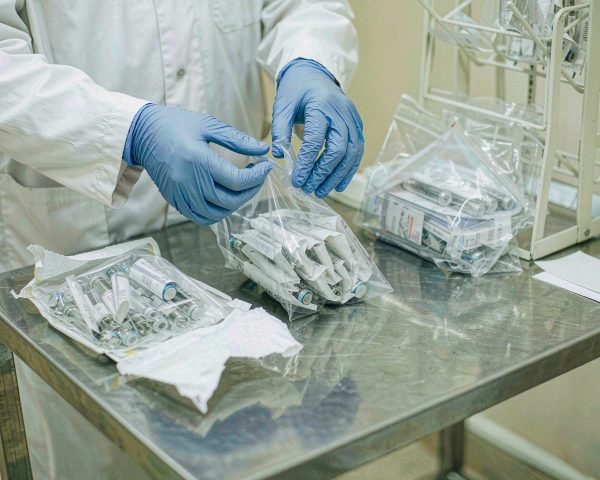
Manufacturers wash the product first, then bag it inside a packaging area held at ISO Class 5 or better. Thermo Fisher describes this process for containers and vials in detail. Double bagging is the norm, sometimes triple. The logic is simple: the outer bag gets wiped down and removed at the cleanroom entrance, so only the inner bag crosses the boundary.
Sterilization is a separate step, and it doesn’t happen for every cleanroom-packed item. Options include gamma irradiation, e-beam, and steam autoclaving, with a validated sterility assurance level (SAL) of 10⁻⁶ possible. If you’re weighing those options for your own application, see our breakdown of gamma irradiated vs autoclaved consumables.
A small detail I like: many irradiated packs carry indicator dots that change color once exposed. Gilson’s gamma dots, for example, shift from yellow to red after a proper dose, so you can see at a glance that the lot was treated. The product page shows how it works.
Consumables That Usually Come Cleanroom-Packed
Typical candidates include autosampler vials, pipette tips, syringe filters, nitrile gloves, and larger bottles or carboys for media and buffers. TOC vials are a special case worth knowing: they’re cleaned and certified to carry less than 10 parts per billion of background TOC, which ordinary vials can’t promise.
Filters and tips often add “low particle” or “low extractables” claims on top of the packing claim. Read those separately. The packaging tells you about the air the product was bagged in; the material claims tell you about the plastic itself.
When Your Lab Needs Them (and When It’s Overkill)
Trace work justifies the premium. If you run ICP-MS or ultra-trace HPLC, background contamination from a dusty vial can swamp your signal entirely. I once watched a trace-metal method chase ghost peaks for three days before someone traced them to ordinary retail vials opened on a regular bench. The re-runs cost more than a year’s supply of cleanroom-packed vials would have.
Vials are only one route, though. Samples pick up contamination at plenty of other points, and our list of nine ways samples get contaminated before injection covers the ones we see most often.
For routine QC on a standard bench, the premium may buy you nothing. General reagent prep, teaching labs, and method development rarely need certified packaging. So when does it pay off? When contamination would cost you a batch, a revalidation, or a week of re-runs.
The Paperwork That Should Ship with Every Lot
Expect a Certificate of Conformance from the original manufacturer, plus a Certificate of Processing or Certificate of Analysis where testing was actually performed. Thermo Fisher’s certificate definitions make the distinctions clear. Lot numbers should trace from raw material through cleaning, bagging, and any irradiation.
If the certificate in your shipment doesn’t match the lot number on the bag, reject it. If these documents are new to you, our guide to CoA vs CoC for lab buyers walks through what each one proves and what to check.
What Cleanroom Packing Costs
You’ll pay a premium over standard packaging, and it varies widely by product, certificate set, and sterilization method. My honest take: it’s cheap insurance for trace and sterile work, and wasted money for bench-scale routine testing. Decide based on the cost of a failed run, not on the unit price. A 30% uplift on vials looks trivial next to repeating a month of samples.
Conclusion
Class 100 is shorthand, nothing more. The current, correct label is ISO Class 5 under ISO 14644-1:2015, with a hard ceiling of 3,520 particles ≥0.5 µm per cubic meter. What matters for your decision is the match between that guarantee and your method’s sensitivity. Trace analysis, sterile applications, and cleanroom entry justify cleanroom-packed consumables; routine bench work usually doesn’t. Check the paperwork as carefully as the price, and confirm the lot documentation before the box is opened. If your work also depends on biological cleanliness rather than particle counts, our guide to sterile vs low-bioburden claims explains what each label actually guarantees. And when in doubt, ask your supplier what their packing area is certified to, and ask for the certificates up front.
Frequently Asked Questions
Is Class 100 the same as ISO Class 5?
Essentially yes. Class 100 was defined as 100 particles ≥0.5 µm per cubic foot, which converts to roughly 3,520 per cubic meter, the exact ISO 5 limit. Formal documents should cite ISO 14644-1, since the Federal Standard was cancelled in 2001.
Are cleanroom-packed consumables sterile?
Not automatically. Cleanroom packing controls particles, while sterility requires a validated sterilization step such as gamma irradiation with a documented SAL. Check the label for both claims before assuming one implies the other.
Do I need cleanroom-packed vials for routine HPLC?
Usually not. Standard high-quality vials work fine for most methods on a normal bench. Consider cleanroom packing for trace-level work, unexplained blank problems, or when your SOP demands certified consumables.
What does “double bagged” mean on the packaging?
The product is sealed in two sequential bags, both applied inside the cleanroom. You wipe down and remove the outer bag at the cleanroom entrance so only the inner bag crosses the boundary.
How should I store cleanroom-packed consumables after opening?
Keep the inner bag sealed until the contents are needed, and store packs away from dust and direct airflow. Once a pack is open, treat the remaining contents as exposed and use them promptly.