
# What Are Buechner Funnels and Filter Flasks Used For?
Walk into almost any chemistry, water, or QC lab and you’ll spot the same pair on the bench: a funnel with a flat, perforated bottom, and a conical flask with a small tube sticking out of the neck. They look unremarkable. They’re also one of the most-used tool combinations in wet lab work.
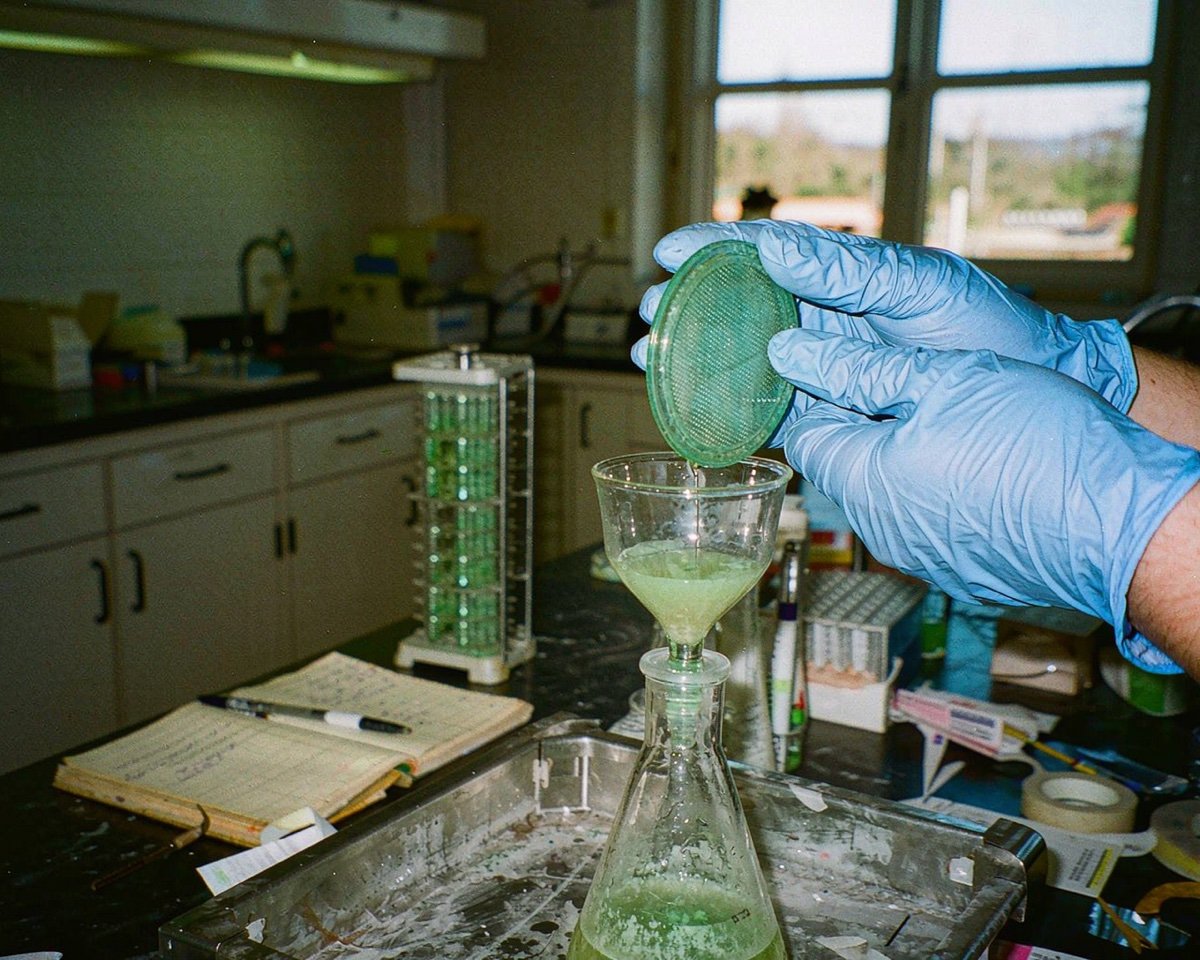
The funnel holds the filter medium, paper, glass fiber, or a membrane; the flask below collects the liquid that vacuum pulls through it. Together they do solid-liquid separation: washing crystals, collecting precipitates, membrane filtration for microbiology, degassing solvent.
If you’ve inherited one of these setups from a senior tech who left without leaving notes, or you’re ordering glassware for a new lab, the details below will save you some trial and error. I’ve broken a few of these myself, so you don’t have to.
The detailed answer: what each piece actually is
A Büchner funnel is a funnel with a flat, perforated plate inside, usually made of porcelain, borosilicate glass, or polypropylene. The filter medium sits flat on that plate and covers every hole. Common sizes run from about 50 mm up to 120 mm across the plate; a 90 mm porcelain funnel taking a 70 mm filter paper is a very typical teaching-lab setup. Its smaller cousin, the Hirsch funnel, works the same way but with a plate under about 50 mm, and it exists for one reason: recovering a few dozen milligrams of solid instead of a few grams.
The flask underneath is called a filter flask, side-arm flask, or Büchner flask, depending on who’s talking. It’s a conical flask with thick, heavy walls and a barb (the side arm) molded into the neck. The heavy walls matter more than people think. When you pull vacuum inside the flask, atmospheric pressure squeezes inward from every direction with about a ton of force on a 500 mL flask. A thin-walled Erlenmeyer will implode under that load. A purpose-made heavy-wall flask is built to take it, which is why every serious SOP says to inspect the flask for cracks and star-shaped scratches before every run.
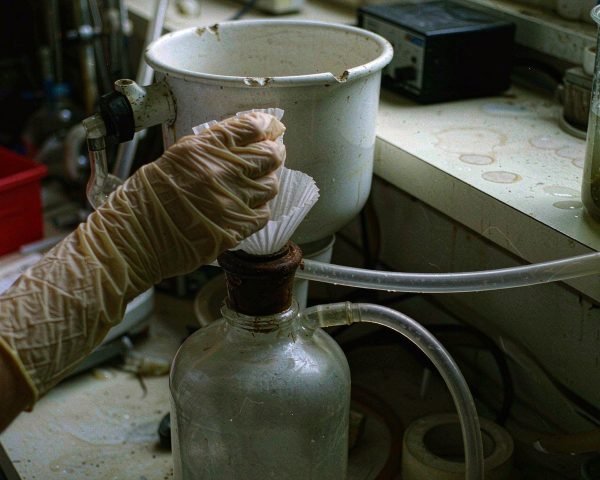
The setup itself is simple. The funnel seats into a rubber adapter or gasket on the flask neck. Thick-wall vacuum tubing connects the side arm to a trap bottle, and the trap connects to your vacuum source, usually a water aspirator or a diaphragm pump. When you switch the vacuum on, the pressure difference pulls liquid through the filter medium and down into the flask, while solids stay on the paper or membrane. Speed is the whole point. Gravity filtration of a fine precipitate can take an hour; under vacuum, the same separation often takes a couple of minutes, as the [suction filtration guide from LibreTexts](https://chem.libretexts.org/Bookshelves/Organic_Chemistry/Book%3A_Organic_Chemistry_Lab_Techniques_(Nichols)/1%3A_General_Techniques/1.4%3A_Filtering_Methods/1.4D%3A_Suction_Filtration) demonstrates step by step.
Two small habits make the difference between a fast, clean run and a frustrating one. First, wet the filter medium with a little solvent before pouring, then let the vacuum seat it flat against the plate. A dry paper floats and lets solids sneak underneath the edge. Second, keep the vacuum on while you pour. I’ve watched a new tech pour first and vacuum second, and the slurry just sat there draining by gravity while he stood there waiting.
The jobs they actually do day to day
Washing and drying collected solids
After a recrystallization or a precipitation, the solid on the filter is still soaked with mother liquor, and that liquor carries your impurities. The standard move is to pause the vacuum, dribble a few milliliters of ice-cold solvent over the cake, let it sit for a moment, then reapply vacuum. Cold solvent dissolves less of your product, so you lose less yield with each wash. Two or three small washes beat one big flood, every time. Then leave the vacuum running for another five minutes to pull air through the cake and start drying it. It won’t be bone-dry, but it’ll be ready for the drying oven or the desiccator.
Collecting a precipitate for weighing
In gravimetric analysis, the solid is the result. You filter, wash, dry, and weigh the residue on the filter, so the medium has to be ashless paper or a tared glass fiber disc. Whatever you filter through needs to contribute nothing measurable to the final mass. This is one case where spending a bit more on the right filter grade pays for itself, because re-running a gravimetric analysis costs far more than the filter did.
Membrane filtration for water microbiology
This is the classic water-lab job, and it’s why you’ll see a funnels-and-flasks bench in every environmental lab. You filter a measured volume, typically 100 mL of drinking water, through a sterile 47 mm membrane with 0.45 µm pores. Bacteria are retained on the surface. The membrane then goes onto an agar plate or an absorbent pad, gets incubated at 35°C, and the colonies that grow are counted. EPA Method 1604 for total coliforms and E. coli is built exactly on this workflow with a cellulose ester membrane. The flask-and-funnel rig here is the reusable version; many labs have moved to sterile disposable funnels like the Microfil system from MilliporeSigma, which come pre-sterilized with gridded 0.45 µm membranes.
Degassing HPLC mobile phase
Less famous, but real. Vacuum pulls dissolved gas out of solvent, which is why some older labs keep a Büchner setup purely for degassing mobile phase before it hits an HPLC pump. Online degassers have mostly taken over this job, and honestly I think that’s for the better, but the old trick still works when the inline unit fails at 5 p.m. on a Friday.
Choosing the filter media
The funnel is just hardware. What determines your result is the medium sitting on the plate.
Filter paper is the default for crystallization work and general solids. Qualitative papers like Whatman Grade 1 retain particles down to roughly 11 µm, which is fine for crystals but will clog fast with fine precipitates. Hardened grades survive scraping better if you’re recovering the cake.
The coarse, fast option is glass fiber. It handles heavy particulate loads, alkaline precipitates like iron and magnesium hydroxides that attack cellulose, and it’s the standard prefilter material when a sample would otherwise blind a membrane in seconds. If your syringe filters keep clogging mid-sample, adding a glass fiber prefilter ahead of the membrane usually fixes it for pennies.
When retention precision matters, reach for membranes: microbiology at 0.45 µm, sterile clarification at 0.22 µm, particle counting on gridded black MCE. One caveat from experience: a 0.45 µm membrane is not a particle filter. Pouring dirty surface water straight onto one gives you a clogged membrane and a compromised colony count, because EPA methods specifically warn that suspended solids interfere with both filtration and counting. Prefilter first, or dilute the sample.
The vacuum side: what people get wrong
The glassware gets blamed for problems that are actually plumbing problems.
Cracked flasks. A star-cracked filter flask is a grenade with a delay timer. I had a near miss early in my career: a flask with a hairline crack at the base survived three runs, then collapsed inward during a fourth while someone was leaning over it. Nobody was hurt, but I’ve tapped every flask and held it to the light ever since, and I make new hires do the same.
The trap bottle is the piece most people skip, and it’s the piece most people need. It sits between the flask and the pump and catches liquid that gets pulled past the flask, which is why every decent lab manual, including the vacuum filtration guide from Southern Illinois University Edwardsville, tells you to always run one. Skip it, and the moment you shut the pump off with vacuum still in the line, suck-back drags filtrate or tap water straight into your product or your pump. Breaking the vacuum at the trap or by slipping the tubing off the side arm before shutting anything off is the whole game.
Pump choice is a real decision. A water aspirator is cheap and fine for aqueous work, but it dumps solvent vapor into the drain and its vacuum depends on water pressure. A chemical-resistant diaphragm pump is the better default for solvent work. House vacuum is a gray area in my opinion: perfectly adequate for filtering aqueous buffers, but I don’t love it for volatile solvents, because whatever goes down that line ends up in the central pump every other lab shares.
If filtration is slow, the hiss you hear isn’t good suction, it’s air escaping. Nine times out of ten it’s the hose clamp on the side arm or a funnel adapter that’s the wrong size. Wet the adapter, seat the funnel, twist the clamp. Thirty seconds of fiddling beats an hour of pretending the filter is the problem.
When a syringe filter or bottle-top unit beats the setup
The glassware rig earns its keep for volumes above roughly 50 mL and for anything where you’re recovering the solid. Below that, it’s mostly overhead: washing, autoclaving, checking for cracks, assembling at 7:45 a.m.
For small samples, a syringe filter on a Luer syringe filters 1 to 10 mL in under a minute with nothing to clean afterward. Picking the right diameter and pore size matters more than people expect, so it’s worth reading up on matching syringe filter size to your sample volume before you buy a box of a hundred.
For large volumes, a bottle-top filter threads straight onto a vacuum-rated storage bottle and replaces the funnel, adapter, flask, and washing step in one disposable unit. We wrote a full comparison of bottle-top filters versus syringe filters for large volumes if you’re weighing the two. For microbiology in particular, disposable units also cut the sterilization bottleneck, which is why so many water labs have switched. The reusable Büchner setup still wins on cost per liter at real scale, so the honest answer is that most busy labs run both and match the tool to the volume.
Conclusion
A Büchner funnel and a filter flask are the mechanical core of vacuum filtration: the funnel holds the medium, the flask holds the vacuum, and the pressure difference does the work that gravity would do slowly and badly. Once you know the pair’s limits, choosing between them and disposable options gets easier. Small aqueous samples go through syringe filters, big volumes go through bottle-top units or glassware, and microbiology samples go through sterile 0.45 µm membranes whichever housing you pick, and a proper filtration manifold pays for itself fast once you’re running more than a couple of membranes per session. If you’re standardizing any of this across a team, put it in writing so the method survives staff turnover. The glassware has lasted a century in labs for a reason. Use it where it’s strong, and don’t feel sentimental about swapping in disposables where they’re faster.
Frequently Asked Questions
What is a Buchner funnel used for?
It’s used for vacuum filtration, meaning separating a solid from a liquid quickly. Typical jobs include collecting crystals after recrystallization, washing precipitates with cold solvent, and supporting filter paper, glass fiber, or a 47 mm membrane for microbiological analysis. The vacuum underneath is what makes it faster than gravity filtration.
Why is a filter flask cone-shaped?
The conical shape spreads the squeezing force of atmospheric pressure evenly across the walls, so the flask resists implosion far better than a straight-walled vessel. The shape also lets the flask sit stable on the bench and directs collected filtrate to the bottom, away from the side arm where the vacuum line attaches.
Can you vacuum filter with a Buchner funnel and a house vacuum?
Yes, for aqueous samples it usually works fine, though house vacuum is weaker than a dedicated diaphragm pump and filtration runs slower. Use a trap bottle between the flask and the house vacuum line, break the vacuum before shutting off, and think twice before pulling volatile solvents through a line that other labs share.
What’s the difference between a Büchner funnel and a Hirsch funnel?
Both do the same job, but scale is the difference. A Büchner funnel has a larger flat plate, commonly 50 to 120 mm, for filtering hundreds of milliliters or collecting grams of solid. A Hirsch funnel has a small plate under about 50 mm and is built for microscale work, like recovering a few dozen milligrams of crystals from a small reaction.