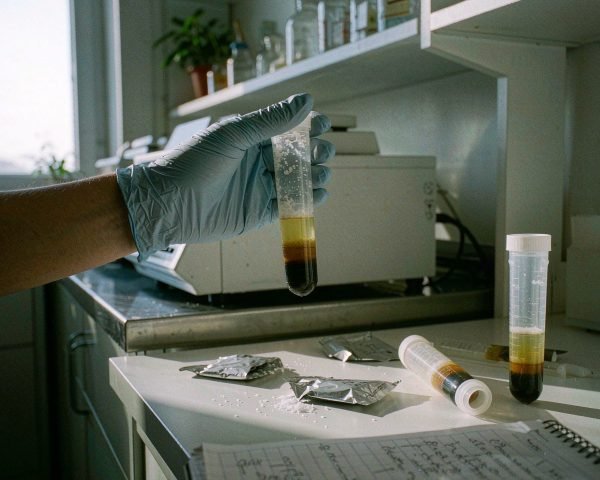

QuEChERS sounds like something a marketing team invented, and honestly the name (Quick, Easy, Cheap, Effective, Rugged, Safe) was never going to win awards. But underneath the acronym sits the most successful sample prep method of the last twenty years, and its genius is that almost everything it consumes comes prefilled, pre-weighed, and ready to shake.
The catch: “ready to shake” only works when you buy the right version. There are three salt formulations, several sorbent blends, and a maze of tube sizes, and grabbing the wrong one quietly changes your recoveries. I learned this the hard way with an avocado batch where a colleague grabbed the EN 15662 salts for our AOAC method. The data looked plausible. The recoveries were not.
Here is what the method actually consumes, and how to match consumables to your workflow.
The Short Answer
QuEChERS needs three consumable groups: extraction tubes with salt packets (MgSO4 plus buffering salts, formulated per AOAC 2007.01, EN 15662, or the original unbuffered method), dispersive SPE cleanup tubes prefilled with sorbents like PSA, C18, and GCB, and compatible centrifuge tubes (typically 50 mL for extraction, 2 mL or 15 mL for cleanup). Everything else is ordinary labware.
READ ON
Below is what each consumable does, how the two major method versions differ, and the selection mistakes that cost recoveries.
The Method in One Paragraph
You homogenize your sample, extract pesticides into acetonitrile, add salts to force the water out of the organic layer, shake, centrifuge, then clean up the extract with sorbents that grab the matrix junk (sugars, fatty acids, pigments) while the pesticides stay in solution. The original papers by Anastassiades and Lehotay turned a multi-hour cleanup into a salt shaker and a vortex, and official methods AOAC 2007.01 and EN 15662 standardized the recipes (Restek QuEChERS app note).
Consumable Group One: Extraction Salts
The salts do the phase separation. Magnesium sulfate is the workhorse (it binds water), and the buffering salts differ by method:
- Original unbuffered: 4 g MgSO4 + 1 g NaCl. Simple, works for stable analytes.
- AOAC 2007.01: 6 g MgSO4 + 1.5 g sodium acetate. Buffers at pH 4.8, protecting base-sensitive pesticides.
- EN 15662: 4 g MgSO4 + 1 g NaCl + 1 g trisodium citrate + 0.5 g disodium hydrogen citrate. Buffers at a gentler pH for the European method.
Pick the formulation your method specifies, full stop. The buffers exist because certain pesticides (anilines, some organophosphates) degrade at high pH, and mixing formulations changes the pH your analytes experience. Suppliers package these as foil packets pre-weighed for a 50 mL tube, which removes the biggest source of method drift: someone hand-weighing salts at 7 AM (Restek Q-sep extraction kits).
Extraction tubes themselves are 50 mL polypropylene centrifuge tubes, usually sold empty alongside the salt packets. Check that they can take your shaker’s violence; a cheap tube that cracks mid-shake is an acetonitrile shower and a lost sample.
Consumable Group Two: dSPE Cleanup Tubes
After extraction and centrifugation, you transfer supernatant into a smaller tube prefilled with sorbents, shake again, centrifuge again, and the cleaned extract sits on top. The sorbent blend is where QuEChERS becomes a menu rather than a recipe:
- PSA (primary secondary amine): removes sugars, fatty acids, and organic acids. In almost every blend.
- MgSO4 (again): polishes off remaining water.
- C18: removes fats and other nonpolar interferences. Essential for fatty matrices like avocado, nuts, dairy, olive oil.
- GCB (graphitized carbon black): removes pigments and sterols. Great for spinach, brutal for planar pesticides, which the GCB removes along with the color.
The classic pairing mistake I mentioned above: AOAC and EN salts differ, but so do the dSPE blends that suit each workflow, and the generic “fruit and vegetable” tube is not always right. Suppliers publish matrix-to-tube tables; the Restek guide to Q-sep dSPE formulations lists which tube matches which matrix, from “clean” produce to fatty and pigmented foods (Restek dSPE tube selection).
For a real-world anchor, the AOAC-format 2 mL cleanup tube contains 150 mg MgSO4 and 50 mg PSA, while a fatty-matrix version adds C18-EC, and the pigmented-matrix version adds GCB. Same tube size, different chemistry, different recoveries (Shimadzu Q-sep listing).
Consumable Group Three: Tubes, Caps, and the Small Stuff
Beyond the prefilled consumables, the method leans on ordinary labware with a few QuEChERS-specific demands:
- 50 mL PP extraction tubes: homogenization and extraction happen here. PP handles acetonitrile fine; glass is unnecessary and breakable.
- 2 mL (or 15 mL) dSPE tubes: matched to your extract volume. The 2 mL size feeds directly into autosampler vial transfers.
- Autosampler vials: the endpoint. Cleaned extract goes into 2 mL vials for GC-MS or LC-MS. Given how much work is in that extract by now, it deserves a clean vial; our syringe filter guide for sample prep covers the final polish if your extract needs one more cleanup step.
- Vortex/shaker and centrifuge: not consumables, but the method assumes a centrifuge that can handle 50 mL tubes at 3,000-4,000 rpm. Check yours before the first run.
One practical tip from hundreds of batches: label the extraction tube before the salts go in. Once the salt packet is in and the tube is shaking, timestamp discipline goes out the window, and AOAC timing (1 minute shake) has actual analytical consequences.
Where Labs Waste Money on QuEChERS Consumables
- Buying bulk salts and weighing by hand. The foil packets cost more per gram and save far more per batch in consistency. Hand-weighed salts are how two analysts produce different recoveries from the same method.
- Using one dSPE blend for everything. The universal tube is a compromise. A fatty matrix with a PSA-only tube leaves lipids in the inject, and your MS source will send you an invoice.
- Ignoring lot certificates. Sorbent activity varies by lot. For trace-level work, keep the CoA with the batch data; the paper trail matters more as sensitivity climbs.
- Over-buying GCB. Labs scared of pigments put GCB in everything and then wonder why their planar pesticide recoveries dropped 40 percent. Use it when the matrix is pigmented, not when the tube is on sale.
Matching Consumables to Your Matrix
A quick decision path that covers 90 percent of food work:
- Water-rich produce (apple, tomato): AOAC or EN salts, PSA + MgSO4 dSPE.
- Fatty matrices (avocado, olive, nuts, dairy): add C18 to the dSPE; consider a second cleanup.
- Highly pigmented (spinach, kale, tea): add GCB, but verify recovery of planar analytes with standards.
- Dry matrices (grain, flour): add water before extraction so the salts have something to partition.
Distributor catalogs mirror this structure, which makes them a useful cross-check before you commit: the major QuEChERS formats and their matrix pairings are browsable in one place (Fisher QuEChERS catalog).
If your lab also runs cannabis or hemp testing, the same logic applies with an extra emphasis on pesticide panels, which our cannabis lab consumables guide covers. And for food labs building a full consumables program around residue work, our food testing lab guide maps the wider picture.
Conclusion
QuEChERS earned its acronym because almost every consumable it needs arrives prefilled and pre-weighed: salt packets matched to your method version, dSPE tubes matched to your matrix, and centrifuge tubes that survive the shaking. The method’s simplicity is also its trap, because the wrong salt formulation or the wrong sorbent blend still produces a clean-looking extract with quietly wrong recoveries. Match salts to the official method you validate against, match sorbents to the matrix in front of you, keep lot certificates with the batch data, and resist the urge to hand-weigh anything. Do that and the consumables disappear into the background, which is exactly what a method built on the words Quick, Easy, Cheap, Effective, Rugged, and Safe deserves. To build out the rest of the workflow, our complete syringe filter buyer’s guide covers the polish steps after cleanup.
Frequently Asked Questions
What is the difference between AOAC 2007.01 and EN 15662 QuEChERS salts?
Both use MgSO4 as the drying salt, but AOAC 2007.01 buffers with sodium acetate while EN 15662 uses citrate buffers. The buffering pH differs, which matters for base-sensitive pesticides. Use whichever formulation your validated method specifies and do not substitute between them.
Can I reuse QuEChERS dSPE tubes?
No. The dSPE tubes are single-use by design; the sorbents capture matrix components and are spent after one cleanup. Reusing them means cross-contamination between samples and unpredictable recoveries. They are cheap precisely so nobody is tempted.
Do I need GCB in my cleanup tube?
Only for strongly pigmented matrices like spinach, kale, or tea. GCB removes pigments effectively but also strips planar pesticide structures, damaging their recoveries. For most produce, a PSA + MgSO4 blend (plus C18 for fatty matrices) is the right starting point.
What centrifuge speed does QuEChERS need?
Most official methods call for around 3,000 to 4,000 rpm (roughly 2,500 to 4,000 x g) for 5 minutes after each shake step. Check your centrifuge’s actual g-force rather than trusting rpm alone, and use tubes rated for the speed.