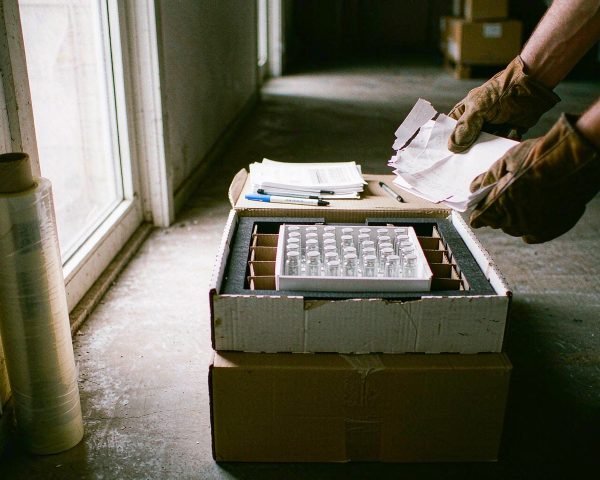

The first quote I ever received for custom-printed vial boxes was perfect: great price, clean artwork, fast production. Then I asked about quantity. The minimum order could have supplied a mid-sized country with sample vials until the next decade. That is the moment every buyer learns that MOQ and lead time are not footnotes on a quote. They are the actual shape of the deal.
If you are importing consumables, or even buying domestically from a distributor, knowing what is normal saves you from both overcommitting and from the other failure mode: assuming a two-week reality applies when your supplier’s calendar says six weeks.
The Short Answer
Typical MOQs for lab consumables range from about 1,000 pieces for standard vials and tubes to 10,000 or more for custom-printed or OEM items, and lead times usually run 15 to 45 days for stock or standard production, stretching to 60 to 90 days for OEM orders with custom artwork, packaging, and shipping. Plan inventory backward from arrival date, not order date, and hold safety stock against the gap.
READ ON
Here is what drives those numbers, how each product category behaves, and the planning math that keeps your shelf stocked without tying up a fortune.
Why MOQs Exist (and When They Move)
A production run has fixed costs that do not care how many boxes you buy: machine changeover, mold setup, QC batch testing, packaging line time. Below a certain quantity, the supplier loses money or has to charge per-unit prices that make nobody happy. The MOQ is simply where the economics start working.
What moves the number:
- Product type. Standard 2 mL vials are molded by the million; MOQs are low and stock is deep. Obscure neck finishes or amber 4 mL crimp vials are niche runs; MOQs climb.
- Customization. Custom printing, private-label boxes, or non-standard specs add setup steps, and each step carries a quantity threshold. A first OEM order with artwork approval, print plates, and carton design naturally starts higher than a repeat order.
- Whether the item is in stock. Distributors holding inventory can sell single cases. Factories selling direct quote production MOQs. Both are legitimate; they are just different products, economically speaking.
What Lead Time Is Actually Made Of
Buyers habitually count lead time from “I sent the PO” to “the box arrived.” Suppliers count something different, and the gap is where stockouts are born. Real lead time stacks these layers:
- Production time (the part everyone counts).
- Packaging and document preparation, especially for export orders with COAs per lot.
- Quality inspection and release.
- Transit: air freight is days, sea freight is weeks with customs on both ends.
- Receiving and incoming inspection on your side.
A realistic standard order (existing product, existing packaging) runs about 15 to 30 days door to door in my experience. OEM orders with custom artwork routinely run 60 to 90, because artwork approval and print production add weeks on their own, and every approval round-trip across time zones eats a day or two.
One planning trap deserves its own warning: if your supply chain runs through Chinese manufacturing, the factory holiday around Chinese New Year (late January to mid-February) pauses production for two to four weeks, and shipping congests in the weeks before. Orders placed in November cover consumption through mid-March comfortably; orders placed in late January do not.
Typical Numbers by Product Category
These are the ranges I quote when someone asks what to expect, based on real orders and supplier catalogs:
| Product | Typical MOQ | Typical lead time (standard) | OEM/custom lead time |
|---|---|---|---|
| 2 mL autosampler vials (standard) | 1,000-10,000 pcs | 7-20 days | 45-75 days |
| Syringe filters | 1,000-5,000 pcs | 15-30 days | 60-90 days |
| Media/reagent bottles | 500-2,000 pcs | 15-30 days | 60-90 days |
| Headspace vials | 1,000-10,000 pcs | 10-25 days | 45-75 days |
| Caps and septa | 5,000-10,000 pcs | 15-30 days | 60-90 days |
Treat these as planning numbers, not promises. Every supplier’s mold inventory differs, and “standard” for a manufacturer who runs your spec daily is very different from standard for one who does not.
The OEM Question: Is the Wait Worth It?
OEM (your brand on their product) is how most distributor economics work, and the MOQ and lead time premium is the price of having your own label. The honest trade: a first OEM order takes longer and starts bigger, but once artwork, molds, and packaging exist, repeat orders behave like standard orders with shorter lead times.
If you are weighing the decision itself, our OEM vs branded vials comparison walks through the quality and positioning questions. And if a supplier relationship needs to end, our supplier switching guide covers the transition period, which is exactly when lead-time surprises hurt most.
Planning Math: The Reorder Point That Actually Works
You do not need ERP software for this. Four numbers per SKU:
- Average monthly use.
- Highest recent monthly use (projects surge; quiet months lie).
- Real lead time, measured from PO to usable stock on your shelf.
- Safety stock: enough to absorb one late shipment of your most critical items.
Reorder point = (average daily use × lead time in days) + safety stock. When shelf count drops to that number, you order, no debate. Inventory guides for labs converge on exactly this discipline: par levels, safety stock, and a reorder point applied consistently (LabSupplies inventory guide).
A worked example from my own buying: a lab burning 60 boxes of 9-425 vials a month with a 40-day lead time needs a reorder point around 100 boxes (80 boxes of lead-time demand plus a buffer). The buyer who waits until the last carton opens has already lost; the supplier might have stock, but it will be a different lot, maybe a different carton count, and your validation paperwork now has opinions.
Questions to Ask Before You Commit
Get these answers in writing at quotation stage, because they are exactly the things that become disputes later. While you are at it, confirm the supplier’s quality certification is current and matches the factory actually making your goods (ISO 9001:2015).
- What is the firm MOQ per SKU, and can it be mixed across variants?
- Is the quoted lead time from PO or from payment?
- What happens on partial shipment: which lots, which documents?
- For OEM: who approves artwork, and what is the reprint lead time?
- What is the lot change policy on repeat orders, and will you notify us?
Reorder planning frameworks make the same point from the supplier side: buyers who lock SKU, packaging, and change-notification terms in writing avoid the “last carton problem” where a rushed replacement order arrives subtly different from what the method validated (OBObio reorder planning guide).
When the shipment lands, the paperwork decides whether it is usable. Our CoA vs CoC guide covers the two documents that should travel with every lot.
Conclusion
MOQ and lead time are not obstacles; they are the physics of how consumables get made and moved. Standard vials and filters carry modest MOQs and a few weeks of lead time, OEM orders ask for bigger first commitments and longer calendars, and the Chinese New Year wall punishes anyone who plans around late January. The buyers who never panic are the ones who measure real lead times, compute reorder points, and get MOQ and change-notification terms locked in writing before the PO goes out. Do that arithmetic once per SKU and the whole problem becomes boring, which is precisely what you want your supply chain to be. For the wider context, our procurement manager’s guide puts these numbers into a year-round ordering rhythm.
Frequently Asked Questions
What is a typical MOQ for HPLC vials from a Chinese manufacturer?
Standard 2 mL screw vials usually start around 1,000 to 10,000 pieces depending on the variant and whether the supplier holds stock. Custom-printed or private-label orders typically start higher, and the exact threshold depends on packaging customization as much as the vial itself.
How long does shipping lab consumables from China take?
Air freight typically delivers in under two weeks door to door; sea freight runs three to six weeks including customs. Add production time (7 to 30 days for standard items) and document preparation on top, and a realistic standard order lands 15 to 45 days after the PO.
Can I negotiate a lower MOQ?
Sometimes. Suppliers reduce MOQs for trial orders, especially when a repeat relationship looks likely, though unit prices rise. The compromise that usually works: full MOQ on your highest-turn SKU, trial quantity on the risky one, and honest intent to reorder if the samples validate.
Should I order ahead of Chinese New Year?
Yes, and earlier than feels necessary. Calculate consumption from mid-December through mid-March, add buffer, and place the order by early November. Factories close for two to four weeks and shipping congests beforehand, so late December orders routinely arrive in late February.