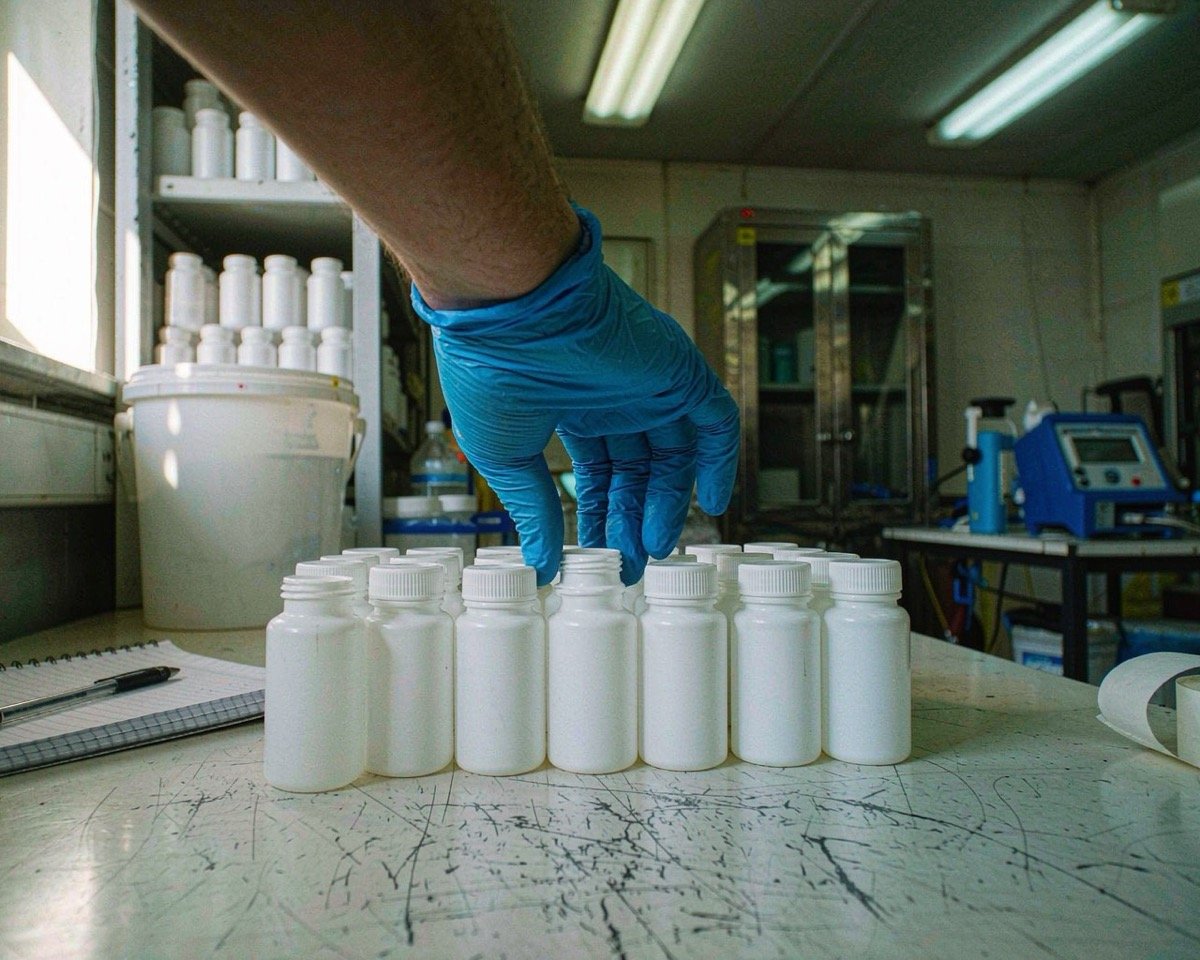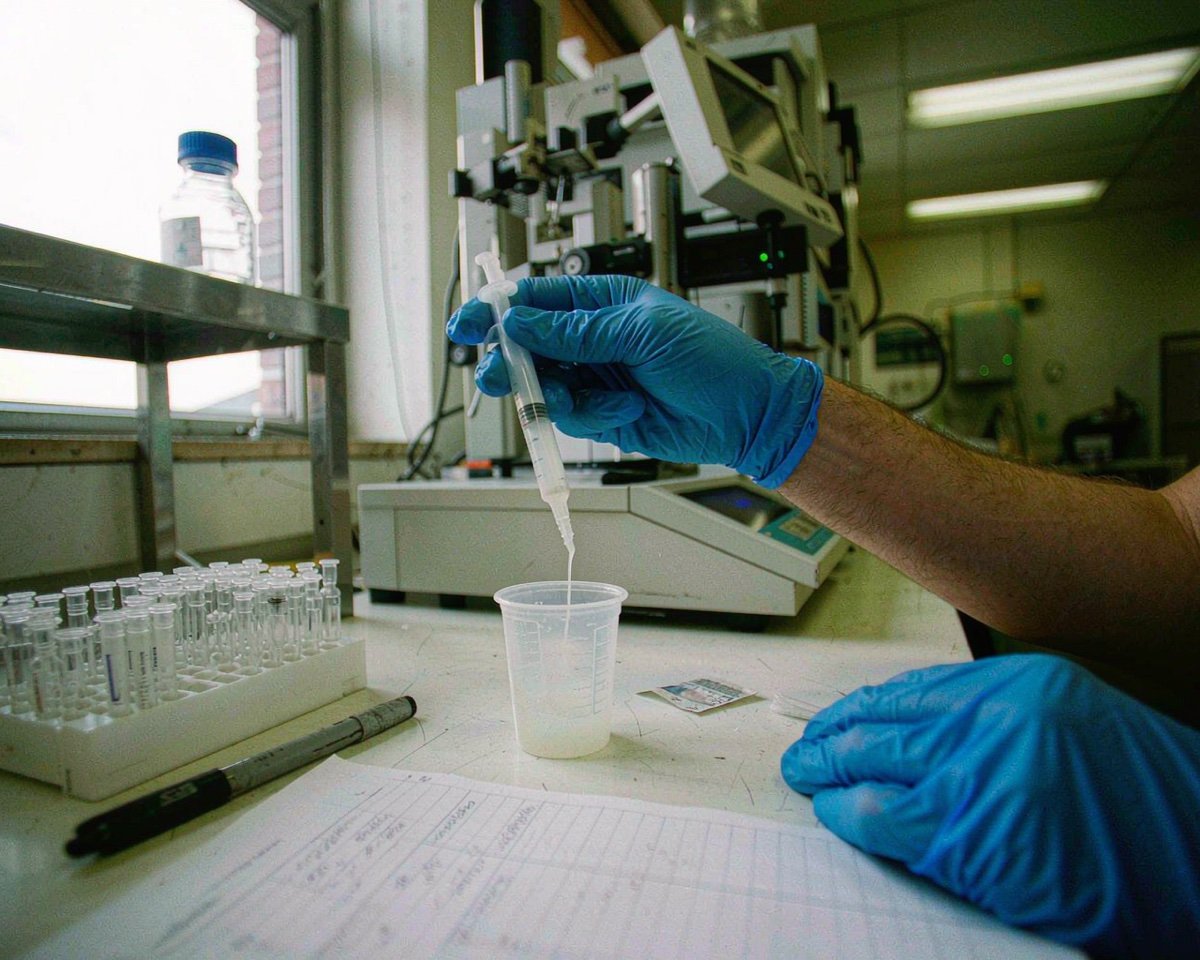


Last February, in a heated lab with the humidity down at 22%, I watched a row of empty 2 mL polypropylene vials cling to a plastic rack like they had been glued there. Weighing 10 mg of lyophilized standard into one of them was worse: the powder jumped to the wall, and the balance drifted 0.3 mg between readings. Nothing was wrong with the vial. The vial was charged.
So yes, static on plastic vials affects sample handling. Usually it is an annoyance. On a microbalance, or with dry powders, it is a real source of error.
What Static Actually Is on a Plastic Vial
Static charge builds through the triboelectric effect: two surfaces touch, electrons transfer, and the surfaces separate carrying opposite charges. Polypropylene is an excellent insulator with surface resistivity above 10^12 ohms, which means the charge has nowhere to go once it lands. Glass drains static far better because its surface is slightly conductive, especially with any humidity on it.
Every handling step charges a plastic vial a little: pulling it from a polypropylene rack, wiping it with a dry Kimwipe, tipping powder into it, even peeling off your nitrile gloves nearby. In humid air the charge leaks away in seconds. In dry heated labs, it sits there for minutes or hours. Powder handling researchers have documented exactly this: tribocharging intensifies at low relative humidity, with one study noting that controlling humidity is a precondition for reproducible charging measurements because ambient moisture dissipates surface charge. That study, on triboelectric charging of powders, is worth a read if you like the physics.
Where It Bites: Four Real Situations
Weighing into plastic tares is the classic case. Mettler Toledo states plainly that many tare vessels, especially plastic ones, are prone to static charging that negatively influences weighing results, and that powders scatter or stick to the container because of it. Their antistatic weighing solutions page exists for exactly this problem. If your tare is a 2 mL PP vial on an analytical balance, expect drift.
Then there are dry powders and lyophilized samples. Fine, low-moisture powders charge on contact and then repel each other, which is how you get powder “jumping” out of the vial or clinging to the walls so completely that your transfer recovery drops. The stuck layer is real sample loss.
Handling itself goes wrong too. Charged vials cling to plastic racks, flip when you try to pick one up with gloves, and stick to autosampler trays. It wastes time and occasionally launches a sample across the bench.
Dust attraction rounds out the list. A charged vial surface pulls airborne dust and fibers out of the air. For trace analysis or dirty matrices this is mostly cosmetic, but for clean work it is another contamination vector.
Does It Change Your Data?
Directly, rarely. A charged vial does not alter what is dissolved inside it, so a liquid HPLC sample in a charged PP vial gives the same chromatography as a calm one.
Indirectly, yes, in three ways. Weighing errors from charged tares flow straight into your standard concentrations. Sample loss from powder clinging changes the amount you actually transferred. And dust pickup can contaminate blanks or low-level samples. The damage happens at the handling step, not inside the instrument.
Why Vials Are Not Antistatic by Default
You might wonder why manufacturers do not just add antistatic additives to every vial. Eppendorf addressed this in their tube FAQ: their tubes are not made from antistatic material because antistatic agents used during production destroy or reduce the wettability of the plastic, and any migrating additive risks your sample. Their vessel material guide goes deeper on the polypropylene trade-offs, and the full Eppendorf tube FAQ covers the antistatic question directly.
That is the trade in one sentence: a vial engineered never to charge is a vial that may leach or behave unpredictably with your sample. For most analytical work, a plain, additive-free polypropylene vial plus good bench technique beats a specialty antistatic consumable.
What Actually Works at the Bench
Humidity first. Keeping the lab between 40% and 60% relative humidity does more than any accessory, because moisture gives surface charge a path to drain. If your lab sits at 20-30% RH all winter, that is the root cause and everything else is a patch.
An ionizer over the balance is the standard fix for weighing. Passing the vial through the ion stream before taring neutralizes the charge in seconds. It is the single accessory Mettler sells around this exact problem, and in my experience it pays for itself the first winter.
Ground yourself and the workspace. Touch a grounded metal surface before handling vials, work on a grounded dissipative mat, and use metal tweezers instead of plastic ones. A metal rack instead of a polypropylene rack quietly solves the “vials cling to the rack” problem too.
Two habits that backfire: wiping vials with dry wipes (that is how they got charged in the first place) and blowing on them with dry lab air. If a vial needs cleaning, rinse and dry it upright rather than scrubbing it with a Kimwipe.
When I Worry and When I Do Not
I worry about static when I am weighing milligram quantities into plastic, handling dry or lyophilized powders, or working in a visibly dry lab. Those are the cases where static becomes measurement error.
I do not worry when I am pipetting aqueous standards, running liquid HPLC samples, or handling wet biology. Charge still builds, but it changes nothing that reaches the data. If your workflow keeps pulling you toward plastic because of breakage concerns, our comparison of HPLC vial materials, glass versus plastic, and our guide to clear versus amber glass vials, cover when glass is the better call. The same material logic applies at bottle scale, which we covered in glass versus plastic reagent bottles.
Conclusion
Static charge on plastic vials is real, physical, and mostly manageable. Polypropylene is an insulator, so every rack-pull and wipe leaves charge that will not drain in dry air, and that charge shows up as balance drift, jumping powders, clinging vials, and dusty surfaces. The fixes are unglamorous: control humidity, put an ionizer over the balance, ground yourself, switch to metal racks and tweezers, and stop wiping vials with dry wipes. Manufacturers deliberately avoid antistatic additives in most vials because migrating additives are a worse problem than the static, so bench technique carries the load. If you handle dry powders or weigh milligram quantities, fix this now; otherwise, know it exists and move on. For the next step on related handling errors, our guide to preventing sample evaporation in autosampler vials covers the other silent way sample handling skews results.
Frequently Asked Questions
Why do plastic vials get static but glass vials do not?
Polypropylene is a strong insulator, so charge from friction stays on the surface. Glass is slightly conductive, especially with ambient humidity, so charge drains away almost as fast as it builds.
Can static charge affect my HPLC results?
Not directly. Charge on the vial does not change the dissolved sample. It affects results indirectly through weighing errors, powder loss during transfer, or dust contamination, usually at the sample prep step.
How do I discharge a vial before weighing?
Pass it through an antistatic ionizer for a few seconds, or at minimum wipe it with a slightly damp lint-free cloth and let it rest 30 seconds. Dry wiping makes the problem worse.
What lab humidity level reduces static problems?
Between 40% and 60% relative humidity is the comfortable range. Below about 35% RH, plastic surfaces hold charge long enough for it to interfere with weighing and powder handling.