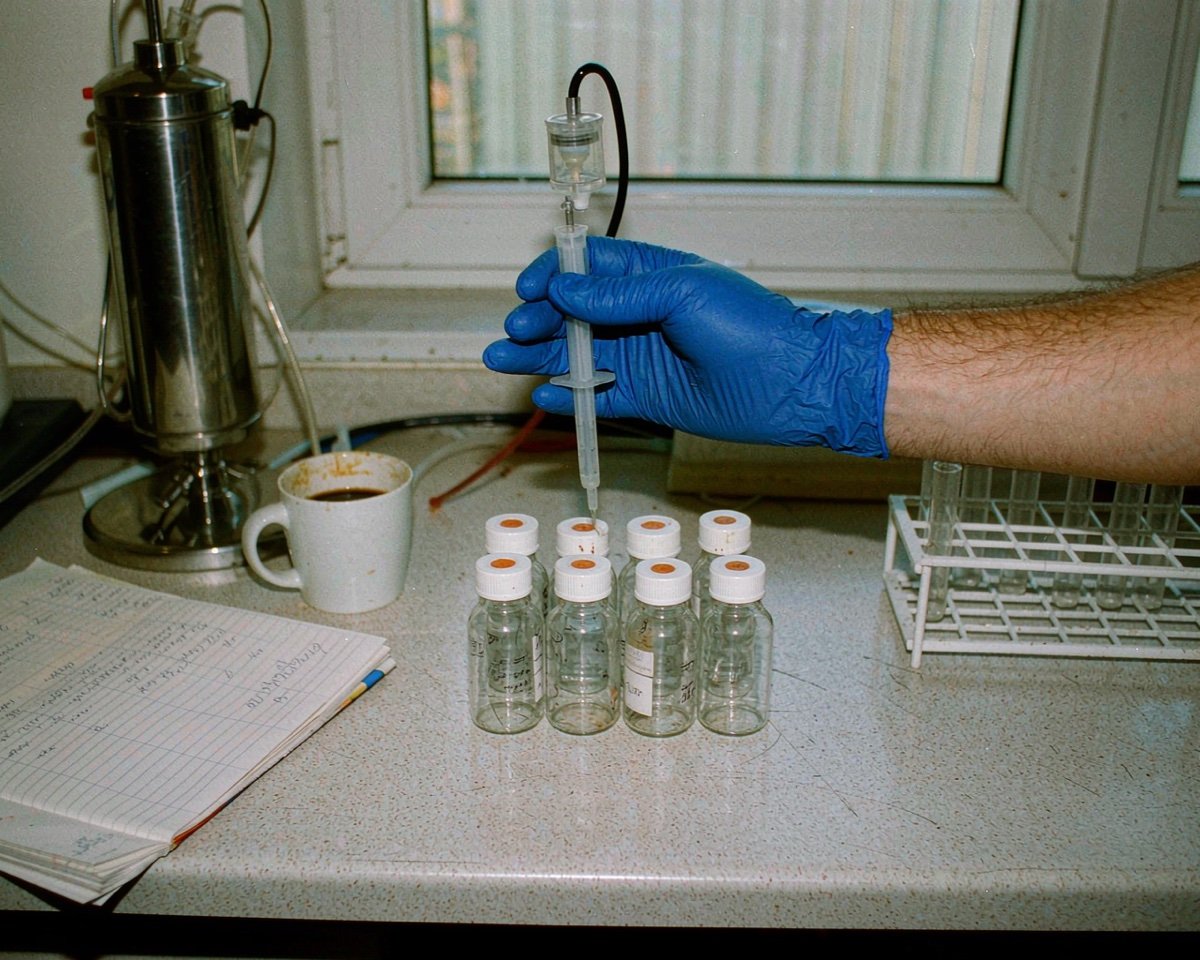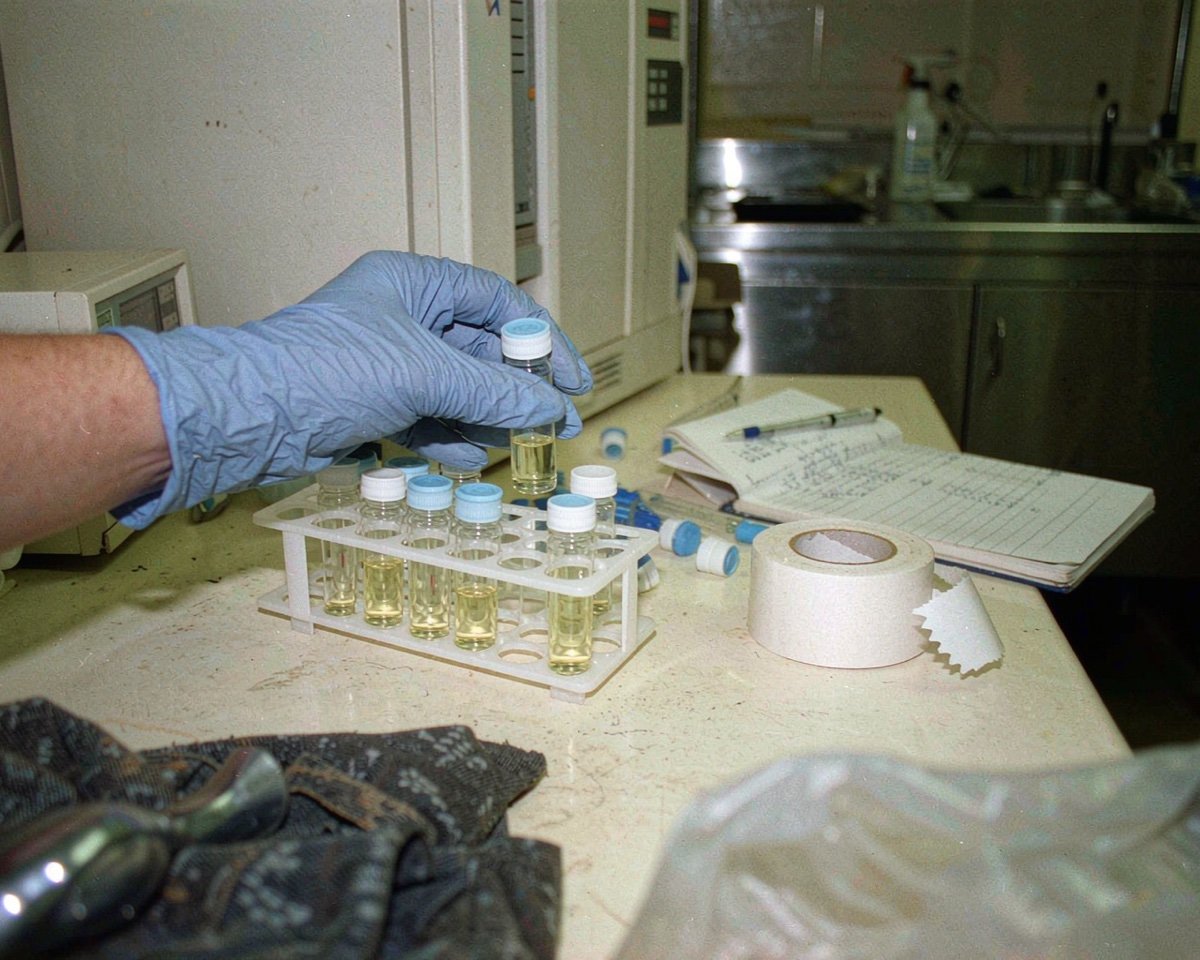

It always starts as a shortcut on a busy afternoon: one filter on one syringe, standards first, then the samples. It costs nothing extra, it saves maybe ten minutes, and ninety times out of a hundred nobody sees a difference. The tenth time is a calibration shift with no cause you can name.
Answer: No, not for quantitative work. Reusing a syringe filter across standards and samples causes analyte carryover between solutions and gives each solution a different adsorption history, so your standards and your samples are filtered under different conditions. Use one fresh filter per solution, and discard the first milliliter of filtrate. The exception is non-quantitative screening, and only if it is written into your procedure.
Read on for what actually happens inside a shared filter, how it biases results in a direction most people do not predict, and the one test that settles the question for your method.
What Happens Inside a Filter That Has Already Worked
A syringe filter is not a flat wall. It is a membrane with depth, a support layer, and a housing with pockets and dead space. Every solution pushed through leaves a little of itself behind: analyte adsorbed to the polymer surfaces, particulate trapped in the membrane matrix, and a film of liquid that never drains.
There is also a steady-state problem on top of carryover. A membrane needs a few milliliters of flow before its adsorption sites and extractable load settle down, which MicroSolv’s steady-state troubleshooting guide quantifies at 2 to 5 mL for a standard 25 mm filter. A shared filter never reaches a stable state for any single solution, because every new solution re-opens the question. Push a second solution through and two things happen in order. The residual film dissolves into the new filtrate, which is carryover. Then the new solution establishes its own equilibrium with all the surfaces the first solution already modified, which is the subtler problem.
MicroSolv’s carryover FAQ lists the consequences plainly: adsorbed analytes release over time, membrane saturation changes recovery behavior, and trapped particulate can dislodge into later samples. The visible symptoms are ghost peaks, elevated baselines, and RSDs that drift up through a sequence. The invisible symptom is worse, and it deserves its own section.
Why Your Standards and Samples Stop Being Comparable
Here is the part that surprises people. Even if carryover were zero, a shared filter still biases the comparison, because filtration is not a neutral event for every solution.
A membrane has a finite capacity to adsorb analyte. Your calibration standards, usually run first, partially saturate those sites. Then your samples arrive at a membrane whose adsorption behavior is already changed. If your samples contain the analyte at different concentrations or in a different matrix, each one interacts with a surface that has a unique history.
The result is a subtle mismatch: standards and samples filtered under different effective conditions. If adsorption steals a fixed percentage from everything, the calibration curve absorbs it and nobody notices. If it steals a fixed amount, the bias lands hardest on your lowest samples and your blank, which is exactly where method performance is judged.
I watched a version of this eat an afternoon in a contract lab. A junior analyst ran one 25 mm filter through six calibration standards and then the day’s samples, filter number fourteen in the tray, and the low calibrator kept reading about 12% low. Three hours of instrument troubleshooting later, someone re-ran everything with fresh filters and the curve snapped into place. The filter was never on the suspect list until it was the only thing left.
The Exception That Is Actually Allowed
Screening work, where nobody reports a number, can share a filter under conditions:
- Written explicitly into the local procedure, not improvised.
- Most dilute solution first, then upward in concentration.
- A solvent flush between solutions.
- Never for anything that feeds a compliance report, a release decision, or a published result.
Even then, understand what you accepted. The next solution through that filter is partly defined by the last one. If the screening result ever needs to become quantitative, start over with fresh filters and pretend the screening run was a map, not a measurement.
The Cheap Fix That Removes the Whole Question
One filter per solution, plus the first-drops discard. That is the entire protocol change.
- Attach a fresh filter to the syringe.
- Push 0.5 to 1 mL through and discard it. This flushes manufacturing residue and conditions the membrane.
- Collect the filtrate you keep into the vial.
- Drop the filter. It is single use by design.
Cost per filter at bulk pricing is a few cents to a few tens of cents depending on diameter. The retest it prevents costs a sequence. There is no scenario in routine quant work where the math favors sharing, and the conditioning discard matters even with a fresh filter, because filter extractables concentrate in the first fraction regardless of reuse.
One related trap: “one filter per solution” still means the filter sees one solution. Decanting half a filtered standard back through the same filter later, or re-filtering a filtrate, restarts the whole adsorption story.
How to Prove It for Your Own Method
If your lab needs the evidence rather than the argument, run the comparison once. It takes about twenty minutes:
- Prepare one mid-level standard, split into three portions.
- Filter portion A through a fresh filter with discard. Filter portion B through a filter that has already seen one solution. Leave portion C unfiltered (or centrifuged) as the reference.
- Inject all three under the full method.
- Repeat with a low-level solution if you run near the LOQ.
If A matches C and B matches A within your method’s precision, your analyte and membrane are forgiving, and you have documented it. If B drifts, you have your answer and your justification for the one-filter rule in the method file. The filter validation workflow from GenFollower formalizes exactly this kind of controlled comparison, and it generalizes to validating a new filter lot with the same three-portion logic.
Where This Fits in the Rest of Filtration Discipline
Sharing filters is one of several filter habits that quietly shape data. The bigger picture lives in our guide to syringe filters for HPLC sample prep, and the reuse question in its stricter form (reusing a single filter across many samples of the same solution) gets its own treatment in can you reuse syringe filters. The short version of both is the same: the filter is a precision component that is designed to be consumed, and the data it protects is worth more than the device.
Conclusion
One syringe filter across standards and samples buys you ten minutes and costs you a comparison that nobody can audit. The carryover is real, the adsorption history is real, and the bias lands on exactly the results you care about most: the blank, the low calibrator, the trace sample. The fix is almost free. One filter per solution, discard the first milliliter, and let the used filter retire with dignity. If your method genuinely tolerates sharing, run the three-portion test once, document it, and move on with confidence instead of folklore. Filters are the cheapest precision components on the bench. Treat them that way and they will never appear in an investigation.
Frequently Asked Questions
Can I reuse a syringe filter if I flush it with solvent between samples?
Flushing reduces gross carryover but does not reset adsorption. The membrane’s surface chemistry has been changed by the first solution, so subsequent solutions still filter under different conditions. For quantitative work, use a fresh filter; solvent flushing only makes shared-filter screening slightly less bad.
Does one syringe filter work for filtering both my mobile phase and my samples?
No. Mobile phase is filtered in volume (often liters) through membrane or bottle-top systems, while samples go through small syringe filters. They are different tools for different jobs, and a filter that has processed mobile phase carries wetting and residue history your samples should not inherit.
How much sample do I lose when discarding the first milliliter?
You lose the priming volume, typically 0.5 to 2 mL depending on filter diameter. For scarce samples, choose a smaller diameter filter (13 mm or 4 mm) to cut both the discard volume and the hold-up loss, then condition and collect from that.
Is it okay to share one filter across all my calibration standards?
It is better than sharing across samples, but it still means your curve points each saw a different membrane history, which adds avoidable variance to the fit. Fresh filters per standard cost pennies and make the curve reproducible from analyst to analyst.