
Three teams, one HPLC, and a method that validated cleanly in March. By June, the same method throws ghost peaks on Tuesdays and runs fine on Fridays. Nobody touched the method. Somebody changed the vials.
That’s the core problem with consumables on a shared lab instrument: the instrument has one owner on paper and a dozen owners in practice. The column log gets signed. The vial boxes, the mobile phase bottles, and the needle wash reservoirs usually don’t.
I learned this the slow way. A few years back, I spent two days chasing a phantom impurity at roughly 0.3% area before a colleague admitted he had swapped in a different brand of 9-425 caps because his usual order was late. Two days of my life, gone, because of a bag of caps.
The fix costs almost nothing: seven small rules, and most labs can adopt them inside a week.
Quick answer: shared instruments fail on consumables because ownership is vague. Assign one spec per method, label everything, keep lot control, log every change, stage a spare kit, rotate stock, and agree on who reorders what.
Each rule below includes the failure mode it prevents.
1. Agree on One Consumable Spec per Method
Every group that books time on the instrument brings its own habits. One team filters samples through 0.22 µm PTFE. Another uses 0.45 µm PVDF because that box was closer. A third skips filtration entirely and swears the guard column will handle it.
On a solo instrument, that’s your risk and your call. On a shared one, it produces numbers nobody can compare. Agilent’s LC best practices primer makes the point bluntly: small differences in operating practice, consumables included, show up directly in data quality and in instrument health. A method validated around particular vials and septa is not the same method when half the inputs change between users.
I’m not suggesting you police every pipette tip. Focus on the inputs that touch the sample or the flow path:
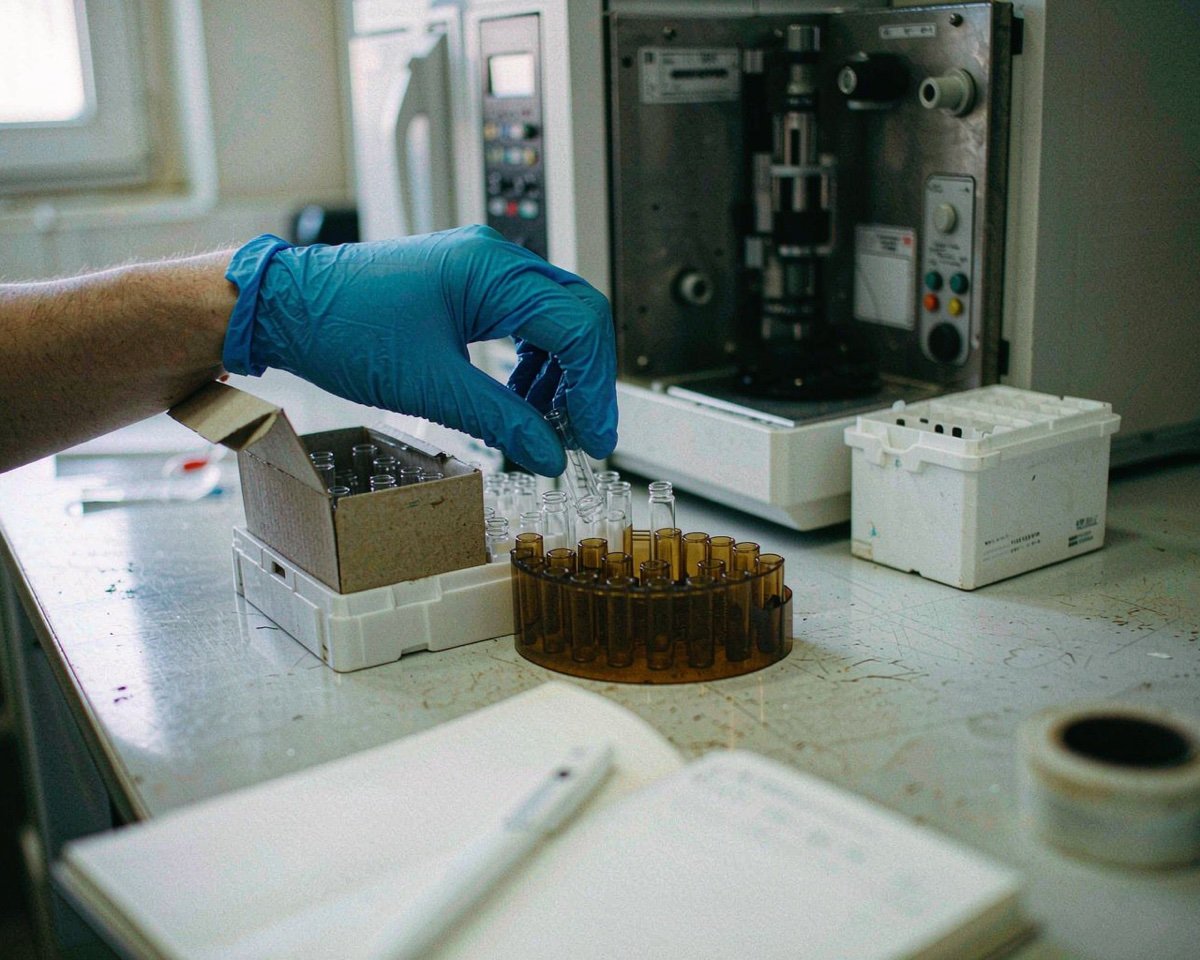
• Vial type and neck finish (a 9-425 screw neck does not interchange with an 8-425, and the needle sits at a different depth)
• Septa material and whether it’s pre-slit
• Syringe filter membrane and pore size
• Needle wash solvent and volume
Write these onto the method sheet itself, then tape a copy at the instrument. When someone arrives with off-spec consumables, the card does the arguing so you don’t have to. If you want to see how ugly the drift gets, our rundown of ten consumables that cause autosampler errors reads like a case history of this exact problem.
One more thing worth stating plainly: the spec is per method, not per lab. The same instrument can host three methods with three different filter pore sizes. What it can’t host is one method run three different ways depending on whose turn it is.
How do you get three groups to agree on one spec? Put it in writing before the argument, not after. A 30-minute meeting with the method sheets open beats six months of quiet resentment and “my results used to be fine.” If two groups genuinely need different consumables for the same method, that’s a red flag about the method, and it deserves a proper investigation rather than a compromise nobody documents.
2. Label Everything: Owner, Date, Lot
Walk into any shared lab fridge and find the unlabeled bottle. Amber glass, half full, no initials, no date. It might be someone’s mobile phase from Tuesday. It might be the third needle wash bottle, the one nobody has claimed since spring. That bottle is where shared labs hide their problems.
Regulators treat this with more force than most labs expect. The FDA’s data integrity guidance is built on ALCOA, and the first letter stands for attributable: records must show who created them and when. The same logic applies to physical consumables sitting on the bench. If a bottle or a rack can’t be traced to a person and a date, then any result generated with it sits on shaky ground, and so does every result filed next to it.
The habit is cheap. A roll of labeling tape and a marker live next to the instrument. Every mobile phase bottle gets initials, date, and lot. Every vial rack gets the same treatment, plus the method name if two methods share the autosampler that day.
In my experience, labs that skip this aren’t lazy. They’ve just never been the person troubleshooting at 6 p.m. with no idea whose solvent that is. Once you’ve been that person, you label everything, including the things that “obviously” don’t need it. Especially those. A rack label also answers the question auditors actually ask, which is rarely “what is this” and usually “who ran this.”
3. Don’t Blind-Share Lots
Picture a common setup: one box of 100 caps sits in a drawer, and both the QC group and the R&D group dip into it as needed. Then a method starts showing unknown peaks or unexplained carryover. Now someone has to answer a question with no obvious answer: which lot of caps was in play, and which injections used them?
Shared lots destroy traceability quietly. When two groups pool one box, you lose the ability to connect a suspect result to a specific consumable lot, and your investigation stops at “probably one of ours.” The option I’d default to is splitting the box on arrival. Each group marks its share with the lot number, and the lot goes into each group’s notebook alongside the sequence. Ten minutes of admin buys you a complete answer later.
Aqueous mobile phase deserves its own warning here, because it looks harmless and usually isn’t. Agilent’s guidance on aqueous mobile phases notes that microbial growth starts long before anything is visible to the naked eye, and recommends remaking aqueous phases roughly every other day at room temperature. Topping off someone else’s week-old buffer to save ten minutes is how contamination migrates from one group’s method into another’s chromatogram. If you’ve ever wondered where those mystery peaks come from, start with our guide to ghost peaks and where they hide, then go look at the fridge.
4. Log Every Consumable Change in the Instrument Logbook
Ask a shared-instrument lab what changed before a sequence failed and you’ll get a shrug. Ask what the logbook says and you’ll often get a second shrug. The logbook exists, but it only records injections and maybe a column swap. Meanwhile, septa, guard cartridges, inline frits, and needle wash bottles change silently, and each one can shift a baseline.
The OECD GLP principles are blunt on this point: documentation is what allows work to be reconstructed, and equipment records are explicitly part of that requirement. USP General Chapter <1058> adds the accountability angle: the user, not the vendor, is responsible for keeping an instrument qualified and fit for its intended use. You can’t demonstrate fitness for use if a week of septa changes is missing from the record.
The entry itself takes four lines. Date. Item. Lot or part number. Initials. That’s the whole system, and it fits in the margin of any existing logbook.
Our lab used to joke that septa were always swapped on a Tuesday, because Tuesday was when the one person who actually logged things worked. It stayed funny right up until an auditor asked why the maintenance record only covered Tuesdays. Nobody found that amusing in the debrief.
A complete log also does something subtle: it makes drift searchable. When retention times creep over a month, you can flip back and see that the needle wash was changed on the 9th, or that a new lot of caps arrived mid-month. Without the log, every drift investigation starts from zero, on an instrument where three groups are all sure they didn’t change anything.
If your lab resists even four lines, tie the entry to an existing action. You already touch the keyboard to start a sequence; log the septa change in the same minute you change it. The rule of thumb I trust: if it isn’t in the logbook, it didn’t happen, no matter how certain everyone is that it did.
5. Keep an Agreed Spare Kit at the Instrument
Downtime on a shared instrument is worse than downtime on a private one, because the queue behind you is long and every person in it is watching. In my experience the most common cause of a dead afternoon is not a broken pump. It’s a 40-minute hunt for a needle seat insert while four people stand behind you recalculating their week.
The solution is a bin, not a cabinet. Mine lived in a shoebox-sized plastic tub on the instrument’s lower shelf, and it held the list we settled on as a team:
• One sleeve of compatible 9-425 caps with PTFE/silicone septa
• Spare syringe filters in both specs named on the method card (0.22 µm and 0.45 µm)
• One unopened bottle of needle wash solvent
• A spare inlet solvent frit
• A marker and a roll of labeling tape
Two rules keep the kit honest. Someone is named as its owner, and anything taken from it gets a line in the logbook from Rule 4. Without those two rules, the kit becomes a communal drawer, and communal drawers empty out the week before the big audit. They always know.
Add a five-minute restock check to someone’s calendar, ideally the kit owner’s. Friday afternoon works well, because it catches anything the coming week’s bookings will need. A kit that is half empty is worse than no kit, since it advertises a safety net that isn’t there.
The kit isn’t a convenience. It’s the difference between a 20-minute fix and a rebooked week, and it costs less than a single failed sequence.
Agree the contents in writing, even if “in writing” means a taped index card. With the list settled, nobody gets blamed for stocking the “wrong” filter, and nobody discovers mid-sequence that the only spare filters in the building are in a drawer two floors up.
6. Rotate and Quarantine Shared Stock (FIFO, Expiry)
Every storeroom has a sediment layer: boxes pushed to the back in 2024 and forgotten. With plain vials, old stock mostly wastes money. With pre-slit septa, membranes, and anything sold as pre-cleaned, age quietly changes performance. And with mobile phase, age changes chemistry outright. Agilent’s own troubleshooting guidance for algae and microbial growth says it plainly: always discard old mobile phase, and never leave it standing in the instrument for days without flow.
Two habits handle all of this without buying software.
FIFO, or first in, first out: new stock goes behind old stock on the shelf. When a group needs a box, it takes the front box. It feels slightly wrong the first week, because the new boxes sit there looking abandoned, and then it becomes automatic.
Quarantine for anything opened: once a bag or bottle is opened, it gets an open date on the label. An opened sleeve of caps is fine this month and questionable next quarter. “Questionable” is not a word you want attached to a result that a sponsor or an inspector will read later.
Be clear with your team about which date matters. The expiry on the box covers unopened storage under decent conditions. The open date covers everything after a human being tore the bag. For some products those two dates are nearly the same thing; for others, particularly anything moisture-sensitive or pre-cleaned, the open date arrives far sooner. The label should carry both, because the box expiry alone tells the next user nothing about the three months the bag spent open.
Shared stock makes both habits matter more, because a box opened by Group A in March gets finished by Group C in September, and nobody in that chain knows the bag sat open through a humid summer. For product-by-product detail on what actually degrades and what doesn’t, see our guide to storing lab consumables for maximum shelf life.
7. Agree Who Orders What
The classic shared-lab failure isn’t scientific at all. Someone assumes someone else ordered caps. The last box runs out Thursday. Friday’s sequence dies at injection 3, and three groups send the same email to the same list while the instrument sits idle into Monday.
The fix is a small grid, taped next to the logbook, with a column for each consumable’s named owner and another for its reorder point. My default: every consumable gets exactly one name next to it, and the reorder point is behavioral rather than mathematical. “When you open the last sleeve, you order” beats any formula, because people remember actions better than thresholds. I’ve watched labs debate min-max levels for months while the caps ran out twice in that same window.
The grid also settles the quieter problems. Two groups stop double-ordering the same filter type while a third goes without. New staff stop guessing. And the person who “always ends up ordering everything” finally gets a visible, legitimate share of the load, which matters more for morale than anyone admits in meetings.
In a CRO, the grid has a second job: sponsor audits. When a sponsor asks who controls the consumables on the instrument their study runs on, “whoever notices we’re low” is not an answer that survives the meeting. A named owner per consumable, with reorder points on record, is the kind of small paper trail that makes the whole quality system look intentional rather than improvised.
For shared stock from Rule 6, the grid decides who consumes and who replenishes, so FIFO rotation has an actual person behind it. If you’re not sure where your lab stands today, run through the seven signs it’s time to reorder consumables as a quick self-audit. If three or more sound familiar, the grid goes up this week, not next quarter.
Conclusion
Shared instruments don’t fail because people are careless. They fail because nobody knows whose job any of this is. The seven rules above all attack that same gap from different angles, turning vague joint ownership into specific, named responsibility. One spec per method ends the brand zoo. Labels make bottles attributable. Lot control keeps traceability alive when something goes wrong. The logbook records what actually changed. The spare kit buys back lost afternoons. FIFO and open dates keep aging stock out of validated runs, and the ordering grid makes sure the last box never becomes a Monday crisis.
Start with the easiest rule this week. In most labs that’s labeling: a roll of tape and a marker cost less than one failed sequence, and the argument they prevent is worth far more than that. Then work outward through the rest, one rule per week if that’s what the lab will tolerate. Within a month, the instrument stops being a source of interdepartmental drama and goes back to being what it should be: a tool that gives every group the same answer, no matter who booked the slot.
Frequently Asked Questions
Do different vial brands really matter if the dimensions match?
Dimensions get you compatibility, not equivalence. Septa composition, surface treatment, and cleaning processes vary between brands, and those differences can add leachables or adsorb analytes. If a method was validated on one spec, keep the whole sequence on that spec.
What should go in a shared instrument spare kit?
Start with whatever fails most often on your instrument: compatible caps and septa, the syringe filter specs named on the method card, needle wash solvent, and an inlet frit. Add a marker and labeling tape, because Rule 2 applies to the kit’s stock too.
How often should aqueous mobile phase be replaced on a shared instrument?
At room temperature, remake aqueous phases roughly every other day, and refrigerate only if the method allows it. On a shared instrument, write the replacement date on the bottle and in the logbook so the next user knows how old the buffer is.
How do you get busy researchers to actually log consumable changes?
Make the entry shorter than the excuse: four lines, paper, pen, at the instrument. It also helps to log changes right when the next user is booking the slot, because people write things down when the audience is visible.
Who should own reordering in a shared lab?
One named person per consumable, written down where everyone works. Committees own nothing; a name on a card owns something. Rotate the names yearly if you like, but never let a consumable exist without one.