
Pick up any two caps from your lab drawer and the septa probably look identical. But flip them over and measure, and you’ll often find one is 1.0 mm while another is 1.5 mm or thicker. That small difference quietly shapes how your injections behave: how easily the needle penetrates, how often you see coring, how fast samples evaporate, and how many injections a cap survives.
Quick answer: Septum thickness controls the trade-off between needle penetration and resealing. Thin septa (around 1.0 mm) puncture easily and suit fine autosampler needles. Thicker septa reseal better and survive more injections but need more insertion force, which raises coring risk with blunt or misaligned needles. Match thickness to your needle gauge, injection depth, and how many times each vial gets pierced.
—
Let me unpack what happens at the moment your autosampler needle hits the septum, and why 0.5 mm of silicone changes so much.
What “Septum Thickness” Actually Means
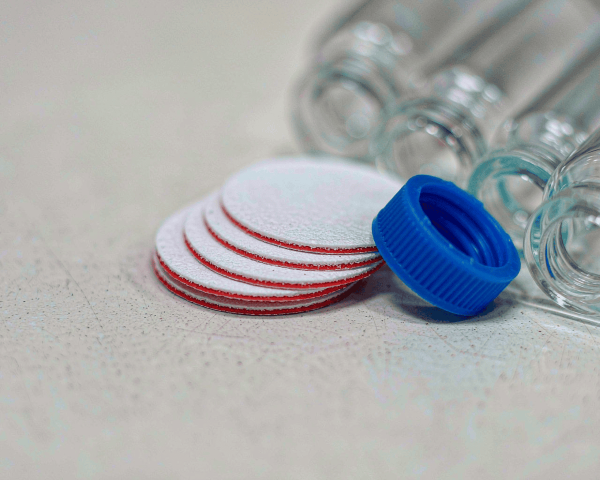
A septum is the elastic disc that seals the vial opening while letting the needle pass through. In a 9 mm screw cap, that disc is a composite: a thin PTFE layer on the sample side for chemical resistance, bonded to a thicker silicone layer that does the actual sealing and resealing.
When suppliers list “1.0 mm” for a septum, that’s the total thickness of the composite. Thermo Scientific’s 9 mm HPLC and GC septa, for example, are specified at 1.0 mm thickness with 45 Shore A hardness. That 1.0 mm figure is the de facto standard for 9 mm screw-cap autosampler vials, the kind used across Agilent, Waters, Shimadzu, and Thermo autosamplers.
Thickness matters because a septum has two jobs that pull in opposite directions. It must open cleanly for the needle, and it must close tightly afterward. Thickness is the dial that balances those two demands.
Thin Septa: Easy Penetration, Faster Wear
The strongest argument for a thin septum is needle compatibility. Autosampler needles are thin (often 22 to 26 gauge), and some are fragile. Pushing a fine needle through a thick, stiff septum risks bending the needle, especially if the needle lands slightly off-center.
That’s why Thermo notes that its soft, thin silicone/PTFE septa are great for thin, fragile needles. Less material means less resistance, a smoother puncture, and less lateral stress on the needle tip.
The cost shows up over time. A thin septum has less material to close the puncture channel, so it reseals less aggressively. After repeated injections, the hole stays more open, and you start losing sample to evaporation, particularly with volatile solvents or long autosampler queues. Thin septa also wear out faster, which is why high-throughput labs replace them more often. If your method re-pierces the same vial multiple times, thin is not your friend.
Thicker Septa: Better Resealing, Higher Insertion Force
Flip the trade-off around and you get the reason thicker septa exist: they seal better and last longer. More silicone means the puncture channel closes more completely, which slows evaporation, keeps air out, and lets one cap survive more injections.
The catch is mechanical. A thicker, stiffer septum demands more force from the needle, and more force means a higher chance of coring: the needle slicing out a little plug of septum material that falls into the sample or blocks the needle. Coring is the classic failure you’ll find in my septum coring explainer, and thickness is one of its root causes: thick + hard + blunt needle = coring.
Thicker septa also punish needle misalignment. If your autosampler needle is slightly bent or the vial isn’t seated squarely, a thick septum turns a small misalignment into a bent needle or a missed injection.
Where Thicker Septa Earn Their Keep
If thin septa suit delicate autosampler work, who needs thick ones? Three groups:
Headspace and GC work. Headspace vials hold samples at elevated temperatures, and the septum must hold pressure while the needle samples the gas phase. Septa for this duty run noticeably thicker than autosampler septa so they reseal against pressure and heat. I covered the full selection logic in my how to pick the right septum for headspace guide.
For GC, the story changes. GC inlet septa are in a different league (several millimeters thick) because they’re pierced hundreds of times at high temperature and must reseal every time. Restek’s septa literature is a good reminder that all septa fail if mishandled: overtightening, for example, shortens septum life by increasing coring and splitting regardless of thickness.
Long storage or repeated sampling. If a vial sits for days or gets pierced multiple times in one sequence, the extra resealing power of a thicker septum protects your sample from evaporation between injections.
One more point about the thick end of the market: manufacturers design around the thickness limits rather than ignoring them. Premium septa lines use features like a CenterGuide design to minimize coring. It’s a guide that helps the needle land in a consistent spot so a thicker, longer-lasting septum doesn’t punish your needle. If you need both longevity and clean punctures, look for those engineering features rather than just buying the thickest disc you can find.
Pre-Slit Septa: Thickness Without the Force
There’s a clever way around the thickness trade-off, and it’s why pre-slit septa exist. A pre-slit septum has a small cut through the silicone layer, so the needle follows an existing path instead of forcing one. You get the resealing of a thicker septum with the low insertion force of a thin one.
Pre-slit septa are the sensible choice for autosamplers that re-pierce vials and for fine-needle systems where coring risk is high. The one trade-off: the slit is a tiny permanent channel, so a pre-slit septum is marginally less evaporation-proof than a solid one. For short queues that’s irrelevant; for week-long storage of volatile samples, solid is safer.
How Often Do Septa Actually Need Replacing?
Thickness also sets expectations for lifetime, and most labs replace septa far too late, usually after the leak or evaporation problem appears. A good rule is to track injections per cap: thin 1.0 mm septa in busy autosamplers typically start degrading well before they look damaged. My how often should you replace your septa guide gives you the practical replacement signals: visible punctures, leaks, carryover, and pressure issues.
How to Choose Thickness for Your Autosampler
Here’s the decision process I use when a lab asks which septum they should run:
1. Know your needle. Fine or fragile needle → thin (1.0 mm) or pre-slit. Heavy-duty needle → you have more freedom. 2. Count punctures per vial. One injection per vial → thin is fine. Multiple injections → thicker or pre-slit. 3. Check your solvent. Volatile solvents and long queues → favor resealing (thicker or pre-slit). 4. Watch for coring. If you see coring or needle bends, step down in thickness or switch to pre-slit before blaming the needle. 5. Match material to solvent first. Thickness only matters if the material is right. My PTFE vs silicone vs PTFE/silicone guide covers that layer of the decision.
One more thing: hardness interacts with thickness. A thick but soft septum penetrates more easily than a thin but hard one, so never spec thickness in isolation. Shore hardness and thickness together determine the force your needle feels.
Conclusion
Septum thickness is a balancing act between two things you can’t have at maximum at the same time: effortless needle penetration and bulletproof resealing. For most HPLC autosampler work, the 1.0 mm standard exists for a reason; it punctures cleanly with fine needles and seals well enough for routine runs. Reach for thicker or pre-slit septa when you re-pierce vials, store samples longer, work with volatiles, or move into headspace and GC, where pressure and heat demand more from the seal. Watch your coring rate and evaporation as your feedback loop: if you see either, thickness is the first dial to turn. Start with septum coring and how to stop it if your needles are already carving plugs out of your caps.
Frequently Asked Questions
What is the standard thickness of an HPLC vial septum?
Most 9 mm screw-cap autosampler septa are 1.0 mm thick with roughly 45 Shore A hardness. Headspace and GC septa are typically thicker because they must reseal under heat and pressure.
Do thicker septa cause more coring?
Yes, all else being equal. A thicker, stiffer septum requires more needle force, which increases the chance the needle slices out a plug of material. Pre-slit septa reduce that force even at greater thicknesses.
Are pre-slit septa better than solid septa?
For autosamplers that pierce each vial multiple times, pre-slit septa are usually better because the needle follows an existing path with less force and less coring. For long-term storage of volatile samples, solid septa seal more completely.
How many injections can a septum handle?
It depends on thickness, hardness, needle gauge, and alignment. Thin 1.0 mm septa in busy autosamplers wear faster than thicker ones. Track visible punctures, leaks, and evaporation rather than relying on a fixed number.
Does septum thickness affect needle bending?
It can. Thin, soft septa are recommended for thin, fragile needles because they offer less resistance. Thick, hard septa combined with a slightly misaligned needle increase the risk of bending.