
Two analysts can filter the “same” sample and get different results. One pre-wets the membrane and tosses the first five drops; the other pushes everything through dry at full thumb pressure. Both feel certain they did it right. Nothing in their training says otherwise, because nothing was written down.
That gap is what a sample filtration SOP closes. It’s one of the cheapest documents a lab can write and one of the most ignored.
Quick Answer
A sample filtration SOP is a short controlled document that fixes how filtration happens in your lab: which filter (membrane, pore size, diameter), how it’s conditioned, how much filtrate is discarded, what technique and pressure to use, what QC checks apply, and what gets recorded. Its job is to make filtration a non-variable.
Why Filtration Needs an SOP at All
Filtration looks too simple to document. That’s exactly why it drifts.
The filters themselves are validated consumables, but the act of using them isn’t. Discard volume changes the extractable background. Pressure changes the chance of breakthrough. A dry membrane binds protein differently than a wet one. Field science figured this out long ago: the USGS standardizes surface and groundwater filtration through 0.45 µm filters with defined rinsing and processing steps precisely because uncontrolled filtration biased decades of trace-metal data. Your samples aren’t river water, but the principle transfers: if the step changes the answer, the step belongs in a controlled document.
There’s a compliance angle too. Auditors love asking why two results differ, and “different analyst” is not an answer anyone enjoys giving.
The Eight Things a Filtration SOP Must Fix
Borrowing structure from EPA’s SESD groundwater sampling procedure and standard SOP practice, a usable filtration SOP covers eight points. Keep each one short; the document should fit on two pages.
1. 1. Scope Which methods, matrices, and sample types does it cover? A filtration SOP for serum extracts is not the SOP for mobile phase. Name the methods explicitly so nobody applies the wrong version.
2. 2. Filter specification Membrane chemistry, pore size, diameter, and housing, stated as a minimum requirement rather than a catalog number where possible. If the method needs sterile or low-extractable filters, say so here. My syringe filter selection guide explains which chemistry matches which matrix.
3. 3. Conditioning Whether to pre-wet, and with what. For aqueous samples with mixed-ester or nylon membranes, a few drops of filtrate through first is standard. Some membranes (PTFE, hydrophobic) need wetting with an organic phase first.
4. 4. Discard volume The first portion of filtrate carries the highest extractable load and the hold-up of the housing. Fix the discard explicitly, typically the first several drops or a stated fraction of a milliliter. If you’ve never calculated hold-up against your sample volume, the hold-up volume guide shows why 1 mL samples and 25 mm filters don’t mix.
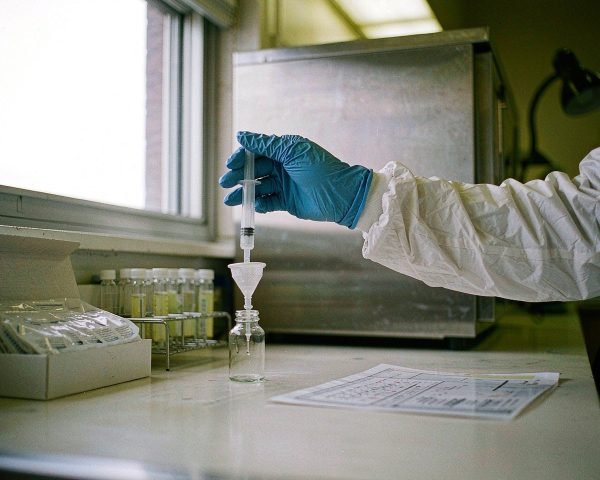
5. 5. Technique Steady, moderate pressure; never force a clogging filter. Forcing raises breakthrough risk, which quietly re-adds the particles you were filtering out. The SOP should say what to do when flow stops: change the filter, don’t escalate the pressure.
6. 6. Acceptance criteria Filtrate must be visually clear, of sufficient volume, and collected into an appropriate container. If a filtrate comes back cloudy, the run stops and the failure gets documented rather than injected anyway.
7. 7. QC At minimum: a filtration blank (solvent through a fresh filter, injected or checked) at a defined frequency, and a rule for filter lot changes. A new filter lot is a new raw material; treat it like one and the filter lot qualification stays boring instead of becoming a fire drill. Frequency matters too: a filtration blank on every batch catches a bad lot on day one, while a monthly blank catches nothing until you’ve shipped three weeks of questionable data.
8. 8. Records Filter type, lot number, expiry, and analyst, recorded where the data lives. When an investigation points at filtration, “we used the usual ones” is indefensible; a lot number closes the question in a minute.
Where Labs Get It Wrong
The SOP exists on paper and the bench ignores it. The failure modes repeat across labs: nobody discards the first drops because “it wastes sample,” expired filters stay in the drawer because nobody checks, one filter gets reused for a second sample “since it’s barely clogged,” and pressure rises until something gives. Each habit is small. Together they’re why filtration keeps showing up in root-cause meetings.
Write the technique section the way a new hire would read it, not the way a veteran would skip it. State the syringe size, the pressure as a plain instruction (“press steadily; the plunger should move at about the speed of a slow pour”), and what to do with a partially used filter (discard it; a half-clogged filter sheds differently). One failure I still remember: a spec panel that drifted seasonally for two years. The cause turned out to be a summer intern who skipped the pre-wet because the laminated SOP card had been thrown away with the old bench mat. Two pages of documentation would have caught it on day one.
A One-Page Skeleton to Copy
If you’re starting from zero, draft these lines and you’re most of the way there: purpose and scope (which methods); filter spec (membrane, pore, diameter, minimum quality); conditioning steps; discard volume; technique and pressure guidance; acceptance criteria for the filtrate; QC frequency and filter lot rules; record fields (lot, expiry, analyst). Eight lines, each with a sentence or two under it, becomes a document your auditors will nod at and your analysts will actually open.
Rolling It Out Without Eye-Rolls
An SOP nobody follows is decoration. Lab Manager’s eight-step SOP development process emphasizes writing with the people who do the work, and that applies doubly here: have the bench analysts draft the technique section, then laminate the result and put it where filters are grabbed. Revisit it when a method, matrix, or filter supplier changes, and record the review date on the document. Training takes twenty minutes, and it removes filtration from the list of things that silently vary.
Conclusion
A sample filtration SOP is not bureaucracy; it’s the cheapest variance reduction available to a wet lab. Fix the filter spec, the conditioning, the discard volume, the technique, the acceptance criteria, the QC checks, and the records, and filtration stops being a hidden variable in every method you run. Write it with the analysts who’ll use it, keep it to two laminated pages, and review it whenever filters or methods change. Then re-run the triplicate check once a quarter, not because anything changed, but because drift loves a quarter without witnesses. The labs I’ve seen hold filtration variance near zero all share one habit: they treat the two-page document with the same seriousness as the method itself, and they hand it to every new analyst on day one. If you’re tightening up sample prep generally, the mobile phase filtration guide is the natural next document to standardize.
Frequently Asked Questions
What is the purpose of a filtration SOP?
It makes filtration identical across analysts, days, and lots. The SOP fixes filter choice, conditioning, discard volume, technique, and QC so the filtration step contributes no variability to your results.
How much filtrate should I discard before collecting?
Follow your method if it specifies; otherwise discarding the first few drops is the common minimum for extractable reduction, and low-volume samples may need a low-hold-up filter instead. The key is that the number is written down and applied the same way every time.
Does pore size need to be in the SOP?
Yes. Pore size (typically 0.22 µm for sterile or fine work, 0.45 µm for general clarification) changes both the filtrate and the effort required, and a documented value prevents well-meant substitutions.
How often should a filtration SOP be reviewed?
Whenever the method, matrix, or filter supplier changes, plus a scheduled review such as annually. Record the review date on the document so an auditor can see the SOP is alive.
Should filter lots be qualified?
For regulated or trace work, yes. Run your QC sample through the new lot against the old one and compare recovery and background before switching production samples over. It takes an hour and prevents lot-driven surprises.