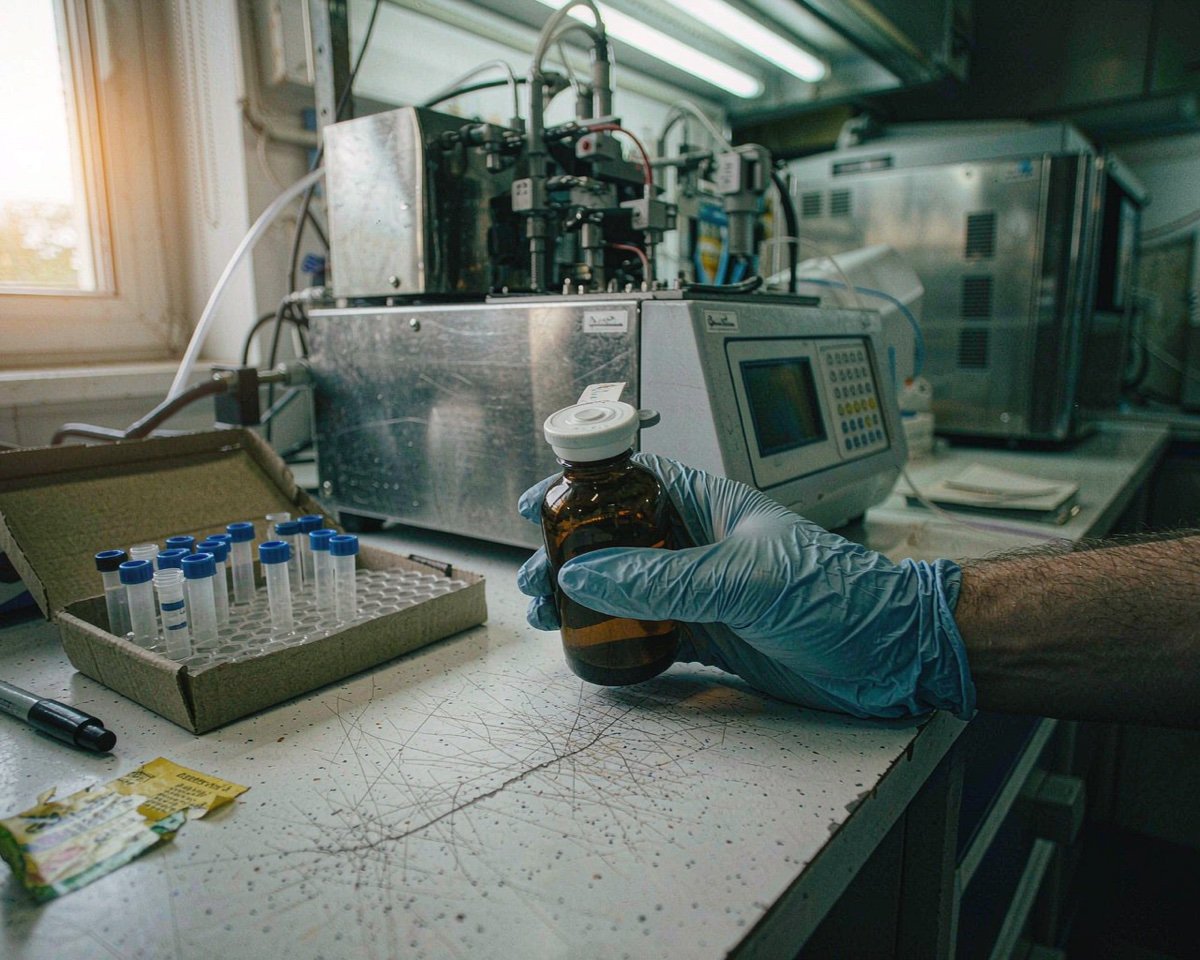
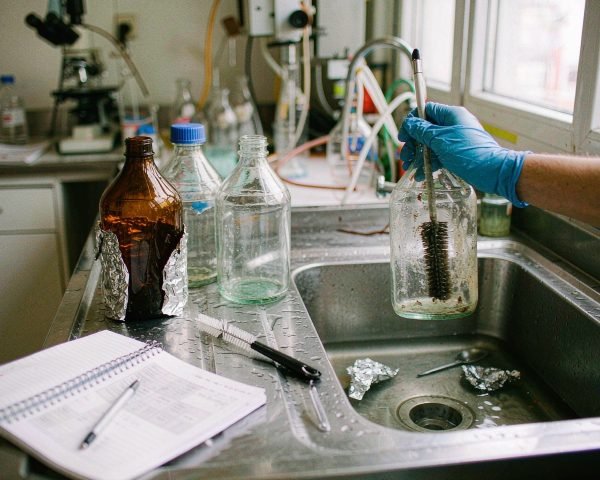

Somebody parks a 2 L mobile phase reservoir on the windowsill for a long weekend, and Monday morning it has a faint green film at the waterline. Algae in a solvent bottle sounds like a joke problem. It is not. It causes ghost peaks, clogged solvent frits, and pump seal wear, and it shows up most often in labs that do everything else right.
The Short Answer
Algae need light, water, and nutrients, and your aqueous mobile phase buffers supply all three. Block the light with amber glass or foil, prepare buffers fresh in small batches, never top off old solvent, and clean bottles on a schedule. Do those four things and algae stop being a problem in your lab.
Why It Happens in a Clean Lab
Algae are not a hygiene failure. They are opportunists. Three ingredients have to line up:
Light is the one people underestimate. A clear glass bottle sitting under a bench window or a fluorescent panel gets enough photons per day to sustain growth. Nothing else about the setup matters much if the bottle lives in the light.
Nutrients come from the buffer itself. Phosphate, acetate, and trace organics in aqueous mobile phase are a perfectly respectable growth medium at lab temperatures. A warm room turns that medium into an incubator.
A seed is the last ingredient, and it arrives via non-sterile water, a bottle that was rinsed with tap water, or airborne contamination. Once a seed lands in a sunlit buffer, growth is just a matter of days.
I watched this play out during my first year on a QC bench. Our aqueous reservoir lived three feet from a window, and we topped it off for two weeks straight instead of preparing fresh. The pump inlet frit slowly turned the color of matcha. Pressure climbed, retention times drifted, and a low-level ghost peak appeared right next to an impurity we monitored. The fix cost nothing: move the bottle, make fresh buffer daily. The investigation cost two days.
What Algae Actually Cost You
The green film is the visible part. The damage spreads through the whole flow path:
Solvent inlet frits clog first, and a partially clogged frit delivers inconsistent flow that looks exactly like a pump problem. Columns pick up biomass and lose efficiency. Detector baselines grow wobbly backgrounds that no one can trace to the standard solutions. And once biofilm establishes inside tubing, killing it takes more than a solvent change.
There is also a subtler cost. If algae or their metabolites appear as peaks, your impurity methods inherit a moving baseline. Peaks that come and go with bottle age are a classic sign, and chasing them wastes far more analyst time than prevention would.
I watched one lab burn three days on this exact loop. A purity method kept throwing a small peak at 6.2 minutes, but only on afternoon runs. The culprit turned out to be a water bottle on a sunny bench: photosynthesis in the reservoir ramped up with daylight, biomass shed into the line, and the peak rode the gradient right onto the chromatogram. The fix cost nothing. The three days did not come back.
The Prevention Routine That Works
Four habits, in order of impact:
Block the light first, because this single change does most of the work. Use amber glass bottles for aqueous solvents, or wrap clear bottles in foil, paying attention to the neck where light enters. A bottle in the dark cannot photosynthesize, full stop.
Prepare fresh and small. Buffers keep for days, not weeks, once they are aqueous and at room temperature. Make what you need for a day or two. If a bottle must sit over a weekend, refrigerate it or discard it.
Never top off. Pouring new buffer into a half-full reservoir inoculates the fresh batch with whatever is establishing in the old. Empty, clean, refill. Every time.
Clean bottles on rotation. A standing bottle-cleaning routine belongs in your lab’s weekly schedule, and it pairs naturally with the steps in our guide to cleaning and decontaminating reagent bottles.
Water quality matters as the starting point too. Labs that prepare mobile phase from purified water with a documented quality level, as outlined in the USP Purified Water monograph, start with a much smaller microbial load than labs using whatever came out of the nearest cartridge. There is published backing for how quickly surface-associated growth establishes once a nutrient-rich water line exists: reviews of biofilm growth in water systems describe the attachment-and-growth sequence in detail, and open-access work on controlling biofilms in water systems covers why disinfection alone rarely finishes the job.
If a Bottle Already Grew Something
Do not just rinse and refill. Biofilm clings to glass, and a spore population survives a water rinse easily. My routine for a contaminated bottle:
Empty it completely. Fill with a dilute laboratory detergent or a mild hypochlorite solution, let it stand for half an hour, then scrub with a long brush, paying attention to the shoulder and neck. Rinse three times with purified water. If the bottle is glass and the manufacturer allows it, a final sterilization cycle gives you a clean slate. Retire any bottle that still shows film after all that, because scratched or etched glass shelters biofilm you will never fully remove.
Then look upstream. If one reservoir grew algae, ask what made that bottle special. It is almost always light exposure or an old habit of topping off.
When It Is Bigger Than One Bottle
Algae in a bottle is annoying. Biofilm in a shared water purification system or in long runs of tubing is a facility problem, and it needs a different response: sanitize the water system per the manufacturer’s schedule, replace tubing that has visible growth, and consider whether your solvent preparation area needs to move out of the sunlight. The biology in a lab water line behaves the same way it does in any piped water system, which is why the biofilm control strategies from the research literature transfer so well to the prep room.
Conclusion
Algae in solvent reservoirs and media bottles is one of those problems that costs almost nothing to prevent and surprisingly much to ignore. Light, nutrients, and time are the whole equation, so break the chain wherever it is easiest: amber glass or foil over every aqueous bottle, fresh buffers in small batches, no topping off, and a weekly bottle-cleaning rotation. If you keep one habit from this article, keep the light off your bottles, because that alone stops most growth before it starts. For the broader purchasing view of the bottles themselves, our solvent reservoir buying guide will help you pick hardware that supports the routine. A clean baseline starts with a bottle you can see through, in a corner where the sun never lands.
Frequently Asked Questions
Can algae in mobile phase damage my HPLC column?
Yes, indirectly. Algae and biofilm shed particles that lodge in the solvent frit and at the column inlet, raising backpressure and degrading efficiency. Columns can sometimes be flushed back to health, but prevention is far cheaper than a column replacement.
Does refrigerating solvent bottles stop algae growth?
Cold temperatures slow growth dramatically but do not sterilize the contents. Refrigeration is a good holding strategy for buffers you will use within days. For anything stored longer, combine cold storage with amber glass and fresh preparation.
Is it safe to just filter algae out of a contaminated mobile phase?
Filtering removes the visible cells but not dissolved metabolites or the contamination now sitting in your reservoir and tubing. If a bottle has visible growth, discard the solvent, clean or replace the bottle, and flush or replace the inlet frit before preparing fresh mobile phase.
How often should I clean my solvent reservoir bottles?
A weekly rotation works for most labs with daily HPLC use: empty, wash, rinse, and dry one set of bottles while a clean set is in service. Labs running aqueous buffers in warm rooms should shorten that to every few days during summer months.