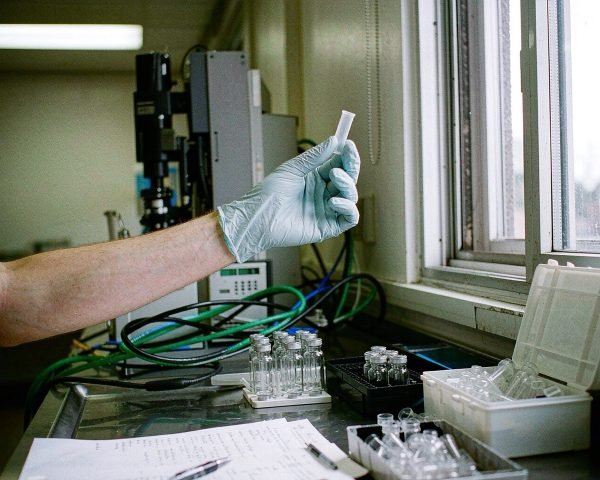

# Do Polypropylene Vials Leach? What the Data Shows
Last spring a customer asked me whether she could run her LC-MS standards in polypropylene vials instead of glass, because her peptide peaks were vanishing on the glass wall. Good question, and the honest answer has two halves. I have seen PP vials save assays and I have seen them wreck a baseline.
Polypropylene vials do leach under specific conditions: neat DMSO or DMF, elevated temperature, long storage, and gamma sterilization all pull measurable additives out of PP. For aqueous and ionic samples, PP is usually the cleaner choice. Worry when you run trace LC-MS in strong organics.
The details matter, though, so let’s look at what the published data actually says.
What the Data Actually Shows
The most cited study here is a one-page paper in Science that changed how a lot of labs think about plastic. A team at the University of Alberta found that disposable plasticware released bioactive contaminants into buffer, DMSO, and methanol. Two of them, the slip agent oleamide and a quaternary ammonium biocide, inhibited monoamine oxidase B at micromolar concentrations. The team only tracked this down because their enzyme assays kept misbehaving for no obvious reason.
That was 2008. The earlier warning came from Innsbruck in 1993. Researchers extracted Falcon polypropylene tubes and pulled out about 12 µg of Tinuvin 770, a light stabilizer, per tube. That compound blocked L-type calcium channels with an IC50 of 3.6 µM, which is genuinely potent according to the PNAS paper. Nobody in that lab had ordered a calcium channel blocker. The plastic shipped one anyway.
So yes: the leaching is real, it is measurable, and the migrants can be biologically or chromatographically active. The fair question is how much, and under which conditions.
What Actually Migrates Out of PP
Polypropylene is mostly pure hydrocarbon, but the additives package is where the trouble lives. Extraction studies on PP labware keep finding the same cast of characters:
• Antioxidants, mainly Irgafos 168 and Irganox 1010, plus the oxidized degradant of Irgafos 168
• Slip agents and mold-release amides, such as erucamide and oleamide
• Residual oligomers, which show up as branched alkane humps in GC-MS
• Nucleating agents like DMDBS in some molded plates
None of these are monsters. All of them can show up as ghost peaks in a sensitive method, and at trace MS levels, that is the whole game.
What Drives Leaching
Solvent strength
This is the big one. Water barely touches PP. Strong organic solvents are another story. A vendor technical note on PP vials used with DMSO puts it plainly: DMSO does not react with polypropylene, but the more concentrated it is, the more it extracts trace residues, and neat DMSO carries the highest risk. DMF and THF behave similarly. I run a solvent blank in a fresh PP vial before any neat-organic LC-MS method, and I’d suggest you do the same once per lot.
Heat and time
In one published extraction study, PP caps soaked at 40 °C for seven days released Irgafos 168 and Irganox 1010 into 60% isopropanol, while erucamide appeared in every solvent tested per Pharmaceutical Technology. Your autosampler tray at room temperature is far milder than that. But a vial that sits in a warm tray over a weekend, holding a neat organic diluent, is drifting toward the aggressive end of the curve.
Gamma sterilization
Gamma irradiation breaks polymer chains and additives alike. In a Japanese food-contact study, gamma-irradiated polypropylene generated dose-dependent amounts of acetic acid and acetone, plus other volatiles that were absent before treatment, and its Irgafos 168 content dropped faster than that of other plastics the study reports. If your PP vials arrive gamma-sterilized, that is worth knowing before you chase a mystery peak in an ion-exclusion method.
When PP Vials Are the Right Call
Here’s where the risk actually flips. Glass carries silanol groups that adsorb basic compounds and metal cations, which is why peptides and proteins so often vanish on a glass wall. Polypropylene has no silanols, so for bioanalytical work and anything trace-metal sensitive, PP often gives you better recovery. For ion chromatography, PP vials are the standard pick, since borosilicate leaches sodium, borate, and silicate straight into your anion blank.
This is not a small effect. I once re-ran a cation method after switching from glass to PP vials and the sodium blank fell by an order of magnitude. Procurement teams should still check that any PP vial used in regulated work has been tested against USP <661.1> for plastic materials of construction, which sets limits on extractable metals and antioxidant content for polypropylene.
How to Keep Leachables Off Your Baseline
If you only change one habit this month, make it this: inject a blank from the actual vial, in the actual solvent, before you commit a sequence.
Beyond that, the playbook is short. Dilute your DMSO stocks to 50% or less with aqueous when the method allows. Don’t fill PP vials days before the run; fill the morning of. Keep trays away from heat sources and out of direct sun. And buy PP vials specified for LC-MS rather than generic centrifuge-tube-grade plastic, because resin formulation varies more between suppliers than most people assume. For guidance on holding times, our post on how long samples can stay in a vial pairs well with this one.
Conclusion
So do polypropylene vials leach? Yes, measurably, but the dose makes the problem. Aqueous buffers and diluted samples in PP are about as inert as labware gets, and for ion chromatography and protein work, PP beats glass on every blank I have run. The genuine risk zone is narrow: neat or high-percentage DMSO or DMF, warmth, long holds, and freshly gamma-irradiated plastic. Stay outside that zone, or validate inside it with a vial blank, and PP vials will quietly do their job. My default: PP for anything ionic or biological, glass for routine reverse-phase in neat organics. If your concern about contamination extends to the filtration step too, read our guide to syringe filter extractables and leachables next, and compare materials in our glass vs plastic vials explainer.
Frequently Asked Questions
Are polypropylene vials safe for HPLC mobile phases?
Yes, for aqueous and buffered mobile phases PP is chemically forgiving. Avoid holding neat strong organics such as DMSO or DMF in PP for extended periods, because those solvents extract additives.
Which solvents attack polypropylene the most?
Strong solvating organics top the list: neat DMSO and DMF are the usual suspects, with THF and concentrated isopropanol close behind. Heat and long contact time multiply the effect, so a diluted, cold, short hold is the low-risk case.
Do PP vials cause ghost peaks in LC-MS?
They can, usually from additives like Irgafos 168 or erucamide migrating into the sample. A blank injection from the same vial and solvent will reveal whether the source is the vial.
Are polypropylene vials autoclavable and does autoclaving cause leaching?
Most PP labware survives 121 °C autoclaving, which is why it is common for media and bio workflows. Repeated autoclave cycles can accelerate additive degradation, so for trace analysis use vials that are verified for your sterilization route.