
Walk into any lab and you’ll find two boxes of syringe filters that look nearly identical — except one says “sterile” and costs noticeably more. When you’re prepping samples for HPLC, do you really need the sterile ones?
Here’s the honest answer: sterile syringe filters matter only when the filtrate itself needs to be free of microorganisms — think cell culture media, buffers for biology, and anything that will be injected into a living system. For routine HPLC and LC-MS sample prep, non-sterile filters do the same particulate-removal job at a lower price.
The decision isn’t about filter quality. It’s about whether your downstream application can tolerate microbes. Let me break down what “sterile” actually means, when it’s mandatory, and when you’re wasting money on it.
What “Sterile” Actually Means for a Syringe Filter
A sterile syringe filter is a filter that’s been validated to remove microorganisms from the liquid passing through it. That validation is a lot more specific than you might think.
Sterile filtration uses membrane filters with a pore size of 0.2 or 0.22 µm — small enough to physically retain bacteria. According to Sartorius’s guide to sterile filtration, a sterilizing-grade filter must withstand a bacterial challenge that retains a minimum of 10⁷ colony-forming units per cm² of *Brevundimonas diminuta*, the industry-standard test organism. That’s the difference between a “0.22 µm filter” and a genuinely sterile filter: the rating is a retention guarantee, not just a pore size.
You can see that validation standard in practice on commercial filters. Merck Millipore’s Durapore cartridge filter data sheet documents quantitative retention of a 10⁷ CFU/cm² *Brevundimonas diminuta* challenge per ASTM F838 methodology, and filter makers such as Meissner certify their 0.2 µm PTFE membranes as meeting the FDA definition of a liquid-rated sterilizing grade filter on the same basis.
There’s one more detail worth knowing. Microporous membranes rated at 0.2 and 0.22 µm are both defined by the FDA as sterilizing filters in its aseptic processing guidance when they meet that retention requirement, so you can treat the two ratings as equivalent for sterile work.
When You Must Use Sterile Filters
Some applications simply cannot tolerate microbes, and this is where sterile filters are non-negotiable:
- Cell culture and biology work. If you’re filtering media, buffers, or additives that will feed living cells, any contaminating bacterium will outcompete your culture and ruin the experiment.
- Pharmaceutical and microbiology testing. Samples destined for sterile products, injections, or microbial analysis need the filtrate to be sterile by definition.
- Anything labeled for medical use. Filters used in drug preparation or patient-facing workflows must meet sterilizing-grade standards.
In these cases, buy sterile filters that are individually packaged — the packaging preserves sterility until the moment of use, and each unit carries an expiration date.
When Non-Sterile Filters Are the Right Call
Here’s the part that saves labs real money: most analytical sample prep does not need sterile filters.
If your workflow is filtering a protein sample before injection, clarifying a reaction mixture, or removing particulates from your mobile phase, the goal is particle removal, not sterility. A non-sterile 0.45 µm or 0.22 µm filter does that job just as effectively — and the filtrate goes into an HPLC system anyway, where the column and detector don’t care about bacteria.
Non-sterile filters are also the smarter choice when you’re filtering aggressive solvents. Hydrophobic PTFE filters, which are common for organic samples, are often sold non-sterile because sterile versions add cost without benefit for analytical use. My syringe filter pore size guide covers the 0.22 vs 0.45 decision if that’s the part you’re weighing.
Can You Sterilize a Non-Sterile Filter Yourself?
Sometimes, yes — but only if the filter’s materials allow it, and you should follow the manufacturer’s instructions rather than assuming.
Sartorius notes that some non-sterile syringe filters can be autoclaved or sterilized with ethylene oxide, depending on the membrane and housing material — their NY, SRP, and PES types can be autoclaved, while others are restricted to EO or gamma irradiation. Sterile products, by contrast, cannot be re-sterilized.
Before you go down this route, think about the total cost. Autoclaving a filter adds a step, risks damaging the membrane, and gives you no certificate of sterility. For critical work, a factory-sterilized, individually packaged filter is usually the safer and sometimes cheaper path than in-house sterilization.
The Cost and Packaging Difference
The price gap between sterile and non-sterile filters comes from the manufacturing and packaging, not the membrane itself:
- Sterile filters are gamma-irradiated or otherwise sterilized, individually packaged, labeled with expiration dates, and batch-tested for microbial retention. That process costs money.
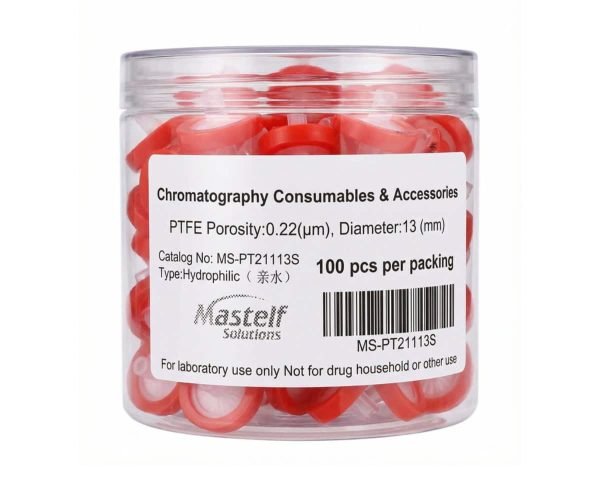
- Non-sterile filters ship in bulk packs of 50 or 100, skipping the individual packaging and sterilization steps. They’re cheaper per unit and take up less shelf space.
If you’re buying hundreds of filters a month for routine HPLC prep, the savings add up fast. That’s not a reason to buy sterile when you don’t need them — it’s a reason to match the grade to the application, exactly the way you’d match membrane chemistry. The complete syringe filter buyer’s guide walks through the full set of choices if you’re setting up a purchasing standard.
A Simple Decision Checklist
Next time you’re at the supply cabinet, run through this:
- Will the filtrate contact living cells or be administered? → Sterile, individually packaged.
- Is this routine analytical prep (HPLC, LC-MS, GC)? → Non-sterile is fine.
- Are you filtering an aggressive organic solvent? → Match the membrane (often PTFE) and check whether a sterile version even exists for it.
- Do you need a certificate or batch traceability? → Sterile, documented.
- Is the sample valuable and low-volume? → Use a low-binding membrane; sterility is a separate axis.
One more angle: if you’re working in biology but your samples sit in vials rather than filters, the same sterile-vs-clean logic applies to the container. My article on sterile HPLC vials explains when sterilized vials matter and when dust-free clean vials are enough.
Conclusion
Sterile and non-sterile syringe filters differ in one thing only: whether the filtrate must be free of viable microorganisms. For cell culture, microbiology, and pharmaceutical-critical work, buy sterile filters with individual packaging and trust their bacterial-retention validation. For the vast majority of analytical sample prep — clarifying samples, removing particulates, prepping for HPLC or LC-MS — a non-sterile filter delivers identical performance at a lower cost. The cheapest mistake is paying the sterile premium on every box; the costlier one is using non-sterile filters where sterility is actually required. Match the grade to the application, confirm the 0.2/0.22 µm retention rating when sterility matters, and you’ll never over- or under-buy again. And when you’re choosing the filter itself, start with my how to choose a syringe filter guide to get the size and membrane right.
Frequently Asked Questions
Can I autoclave a non-sterile syringe filter?
Some non-sterile syringe filters can be autoclaved or sterilized with ethylene oxide, depending on the membrane and housing materials. Always check the manufacturer’s instructions — some filter types allow autoclaving, while others must use EO or gamma irradiation, and sterile products should never be re-sterilized.
Are 0.22 µm filters always sterile?
No. A 0.22 µm pore size alone doesn’t make a filter sterile. Sterilizing-grade filters must also pass a bacterial retention test — retaining at least 10⁷ CFU/cm² of *Brevundimonas diminuta* — and be manufactured and packaged to maintain sterility. A non-sterile 0.22 µm filter removes particles but isn’t validated as a sterilizing filter.
Do I need a sterile syringe filter for HPLC?
Usually not. Routine HPLC sample prep aims to remove particulates that could clog the column or interfere with the detector, not to achieve sterility. Non-sterile filters handle that job effectively, so you can save the sterile-grade filters for biology and pharmaceutical-critical applications.
What’s the difference between 0.2 and 0.22 µm for sterile filtration?
Nothing meaningful for sterile work. The FDA defines both 0.2 and 0.22 µm rated membranes as sterilizing filters when they meet the same bacterial retention requirement, so you can treat the two ratings as equivalent for sterile filtration.
Why are sterile syringe filters more expensive?
The premium pays for gamma irradiation or other sterilization, individual packaging, expiration dating, and batch microbial-retention testing. Non-sterile filters skip those steps and ship in bulk packs, which is why they cost less per unit.