
Why Bother With This Math
A friend who runs a three-instrument QC lab called me last October, mid-panic. The HPLC wasn’t broken. There was simply no box of 9 mm caps left in the building, and the replacement quote was sitting unread in someone’s inbox. Two days of sequencing lost over a $90 item.
That call convinced me to write down the numbers I usually keep in my head. Below is one full year of consumption for a small lab running three instruments, worked out from injection counts rather than last year’s invoice plus ten percent. If you want a lab consumables budget you can actually defend in a meeting, this is the shape of it. The folks at Lab Manager make the same argument from the management side: knowing your burn rates is what turns budgeting from guesswork into planning. Every cost figure below is a rough list-price band, because street prices vary wildly by region and contract.
The Lab We’re Budgeting For
Assumptions matter more than the totals, so here they are. Two analysts, 230 working days a year. One HPLC running 40 injections a day. One GC doing about 20 injections a day, mostly headspace volatile work. One ICP-OES handling 10 runs a day for trace metals.
Your lab will differ. Maybe you run weekends, or your method needs six replicates per sample, or your LC-MS column is so expensive you baby it. Redo the arithmetic with your own counts and the structure still holds. The point is the method, not my exact numbers.
Vials First, Because Everything Starts There
The core multiplication is simple:
40 injections/day × 230 working days = 9,200 injections a year on the HPLC.
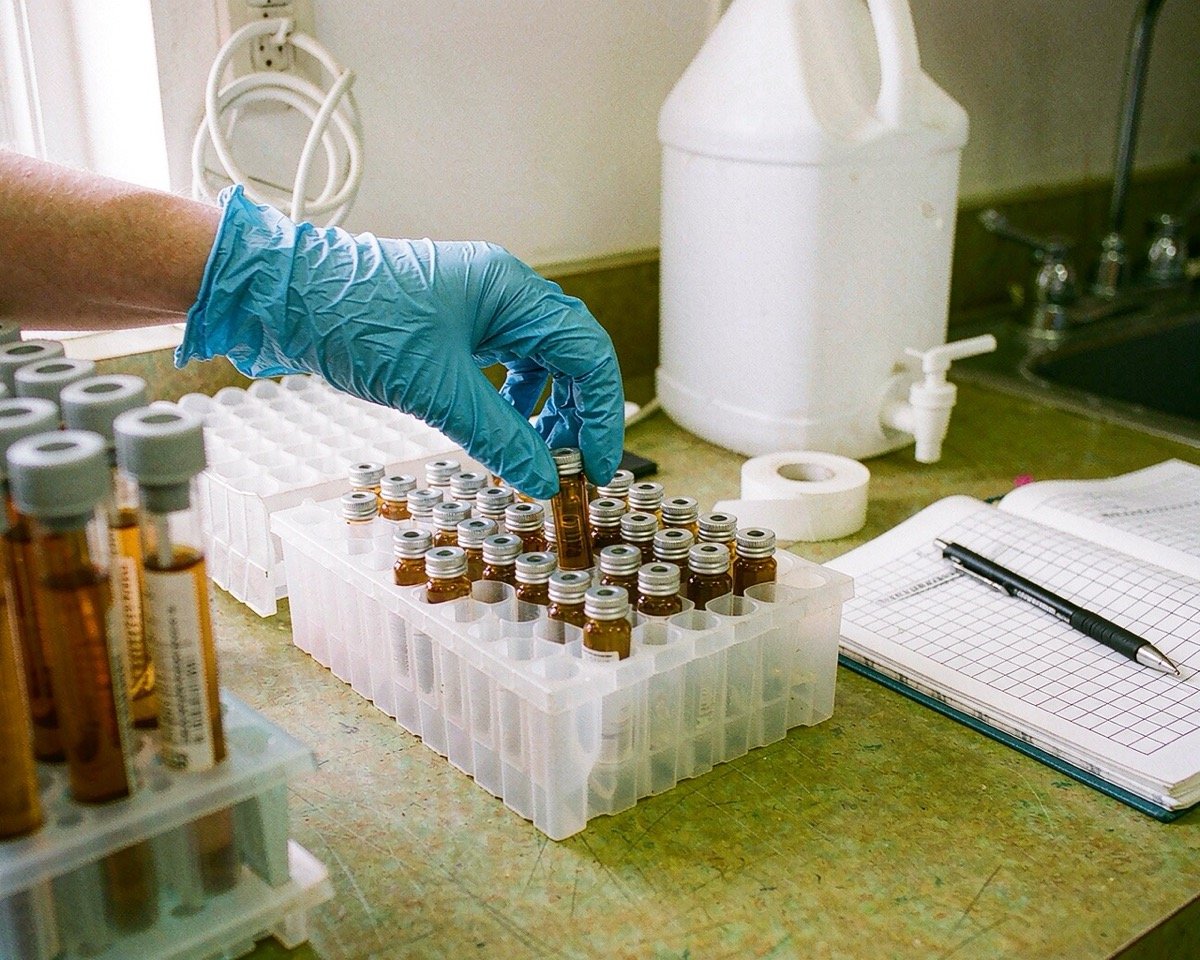
Don’t budget for 9,200 vials, though. Standards, blanks, QC checkpoints, and re-runs reliably add 10 to 15 percent on a normal method, so I plan for about 10,500 vials a year. Caps with pre-assembled septa come along with them, which is how most labs should buy anyway.
So how many packs is that? About 105 packs of 100. Branded certified vial and cap kits sit between $120 and $200 per 100-pack at list; compatible kits from direct manufacturers run $15 to $30 for the same 2 mL borosilicate format. You can see the gap yourself by comparing certified vial and cap kits on Fisher Scientific against any direct-from-manufacturer quote. Over a year, that one line item swings from roughly $1,600 to $20,000 depending on where you buy. Same glass, same 9 mm threads, wildly different invoice. If you want a second benchmark, the Agilent 2 mL screw vial range prices out the premium end of the same format.
The GC adds its own line: 20 injections a day becomes about 5,300 headspace vials and crimp caps after the re-run allowance. Call it $900 to $4,000 a year depending on brand and whether you buy 10 mL or 20 mL. Two smaller notes while we’re on vials. If your samples sit below the needle’s reach, vial inserts change the count slightly, since inserts get replaced or reused on their own schedule. And storage vials for retained extracts are a separate drawer with a separate count, usually another 10 to 20 percent on top of the injection math. When I sanity-check my own vial math mid-year, I go back to the piece I wrote on how many HPLC vials a lab actually consumes every month.
Septa, Liners, and the GC Inlet Nobody Budgets
The line item labs forget is the inlet, because it’s filed under maintenance rather than supplies. GC inlet septa take a puncture every injection and should be changed every 50 to 100 injections before they leak or shed particles into the liner. At 4,600 GC injections a year, that’s 45 to 90 septa, so two or three 50-packs.
Inlet liners last longer, roughly 150 to 200 injections in clean work, which works out to 15 to 30 liners a year. Deactivated liners run $35 to $90 each at list, so the annual hit lands somewhere between $800 and $2,500. Labs that skip liner changes until peak shape collapses are gambling a multi-day batch on a $60 part.
On the LC side, wear concentrates in the autosampler instead. Budget one or two injection syringes and one rotor seal a year; that’s usually a $300 to $700 quote arriving at the worst possible moment. The Agilent 2 mL screw vial range I linked above matters here too, because a poorly seated cap sheds septa fragments that accelerate needle and seat wear.
Syringe Filters: The Sneaky Budget Line
Filters behave differently from vials because you don’t need one per injection. A dilute-and-shoot method with clean standards might touch a filter a dozen times a day. A dissolution lab filtering every tube will burn through hundreds.
For this model lab I assume about half a filter per sample across the prep work, so 5,000 to 6,000 filters a year, mostly 13 mm PTFE and nylon at 0.22 µm. That’s 50 to 60 boxes of 100. Branded filters run $90 to $150 a box; compatible equivalents land closer to $20 to $40. Thermo Fisher’s syringe filter selection guide is the reference I hand people before they commit to a cheaper box, since membrane choice matters more than brand.
One warning from personal scarring. I once approved a switch to an unvetted cheap filter to save about $1,800 a year. It leached enough UV-active extractable to produce mystery peaks in a gradient method, and we spent two weeks and far more than $1,800 hunting them. Validate one lot against your old filter before you switch. Two days of testing beats two weeks of ghost-chasing.
Bottles, Solvent, and Guard Columns
Reagent and mobile phase bottles are the rare good news. Buy borosilicate GL45 bottles once and they last for years; plan to replace four to six a year for breakage and worn threads, maybe $100 to $300 annually. Keep them capped and out of the light and they’ll outlast half the instrument fleet.
Mobile phase solvents are chemicals rather than consumables, but I’d still sketch the number in the same spreadsheet. An HPLC at 0.5 to 1 mL/min burns roughly 50 to 100 liters of solvent a year across aqueous and organic phases, and HPLC-grade acetonitrile runs $150 to $250 per 4 L bottle at list. That’s a $2,000 to $5,000 line that procurement may file elsewhere but that your budget absolutely feels.
Guard columns are cheap insurance for expensive columns. Swap a cartridge every 500 to 1,000 injections and you spend $300 to $1,200 a year protecting an analytical column that costs $800 to $1,500 to replace. Restek’s guide to choosing the right LC guard column covers matching the cartridge to your column, and their write-up on diagnosing high back pressure explains what happens when nobody changes the guard on time.
The Small Stuff That Quietly Adds Up
Individually, none of these lines is scary. Together they’re a car payment.
Pipette tips: two analysts doing daily prep empty three or four racks a week, which is 150 to 200 racks a year and $1,500 to $6,000 at list, more if you insist on filtered tips for LC-MS work. Nitrile gloves run 45 to 55 boxes a year, $350 to $800. Waste containers, 8 to 12 twenty-liter carboys, another $200 to $500.
The ICP has its own appetite. Sample cups go by the thousand, plus a nebulizer and torch components on a wear schedule, so budget $800 to $2,000 a year for that instrument’s plastics and glassware. In my experience this is the instrument where labs guess low most often, because the cups look trivial until the autosampler stops mid-sequence.
The Whole Year in One Table
Here’s the model lab’s year, with every assumption stated so you can swap in your own.
| Item | Usage assumption | Annual quantity | Rough annual cost (list-price band) |
|---|---|---|---|
| 2 mL screw vials + pre-assembled caps (HPLC) | 9,200 injections + 12% re-runs | ~10,500 (105 packs of 100) | $1,600 – $20,000 |
| 20 mL headspace vials + crimp caps (GC) | 4,600 injections + 15% re-runs | ~5,300 (53 packs of 100) | $900 – $4,000 |
| GC inlet septa | change every 50–100 injections | 45 – 90 septa | $60 – $180 |
| GC inlet liners | change every 150–200 injections | 15 – 30 liners | $800 – $2,500 |
| Syringe filters, 0.22 µm | ~0.5 filter per sample | 5,000 – 6,000 (50–60 boxes) | $1,200 – $7,000 |
| Guard cartridges / in-line frits | swap every 500–1,000 injections | 4 – 8 cartridges | $300 – $1,200 |
| Autosampler syringe + rotor seal | scheduled PM | 1–2 syringes, 1 seal | $300 – $700 |
| ICP sample cups + torch components | 10 runs/day | ~2,500 cups, 2–3 torch sets | $800 – $2,000 |
| Pipette tips (racked) | 3–4 racks/week, two analysts | 150 – 200 racks | $1,500 – $6,000 |
| Nitrile gloves | ~4 boxes/month, two analysts | 45 – 55 boxes | $350 – $800 |
| Solvent waste containers | 20 L carboys | 8 – 12 | $200 – $500 |
| Reagent / mobile phase bottles (GL45) | replaced on breakage and wear | 4 – 6 bottles | $100 – $300 |
| HPLC-grade acetonitrile | 50–100 L total mobile phase | 13 – 25 × 4 L bottles | $2,000 – $5,000 |
Add it up and the spread is enormous: roughly $10,000 a year for a compatible-first lab buying direct, versus about $50,000 for a lab that buys premium certified vials and filters at full list. The workload is identical. The brand decision, not the injection count, is what moves the number.
How to Adapt the Model to Your Lab
Swap the ICP for an LC-MS and the structure holds, but two lines shift. MS-grade consumables cost a premium over standard HPLC grade, sometimes double, and source cleanliness matters more, so labs running MS tend to use more filters per sample, not fewer. Expect the filter line to grow by a third and the vial line to pick up an MS-certified surcharge.
Weekend shifts change everything by roughly 20 percent, in the wrong direction. Five-day math on a six-day lab undercounts every single line, and it undercounts the consumables nobody thinks about on Saturdays: waste containers fill faster, gloves run out faster, and the person reordering is not always watching the stock.
Replicate-heavy methods deserve their own flag. If your QC method runs six preparations per sample, your filter count per injection jumps from half to six, and suddenly filters rival vials as the biggest line in the budget. I’ve seen that exact surprise in a dissolution lab: the vial drawer looked healthy while the filter shelf vanished twice a month.
The honest version of this model takes about an hour to build from your own chromatography logs. Pull last quarter’s injection counts, divide by the days the instruments actually ran, and multiply forward.
Par Levels and Reorder Points
A budget tells you how much to spend. Par levels and reorder points tell you when.
A par level is the quantity you keep on the shelf, typically two to three months of consumption. A reorder point is the level that triggers a purchase, calculated from supplier lead time plus a safety buffer. For the model lab, 10,500 vials a year means a par level around 2,500 and a reorder point near 1,000, which gives a five-to-six-week cushion over a two-to-three-week lead time. Filters deplete slower but clog faster in dirty matrices, so I keep their buffer generous.
Write the reorder points on the cabinet door if you have to. The 13 mm filter box on the second shelf of my old lab somehow emptied every third Wednesday, and we never did fix it until the count went on the shelf edge in marker. If counting stock by hand sounds grim, watch for the signs you need to reorder before the drawer is empty.
One more wrinkle: minimum order quantities. Most vial and filter manufacturers sell in case quantities, not single boxes, so your reorder point needs to clear the MOQ hurdle. If the math says order at 1,000 vials but the MOQ is a case of 3,000, your real par level just became 3,000 whether you planned for it or not. Lead times matter too; imported consumables on sea freight can sit in transit for six weeks, which quietly doubles the buffer you need.
Where Labs Over-Buy and Under-Buy
Over-buying concentrates in three places. Gloves, because a sale is tempting and they never expire. Bottles and racks, because they last for years. And anything somebody ordered “just in case” back in 2021 that is still stacking up.
Under-buying is costlier. Septa and inlet liners get skipped because they sit in the maintenance line. Guard cartridges get stretched two swaps past their point to save $80, which is how people lose $1,200 analytical columns. Re-run allowances get left out of the vial math entirely, which is why the drawer that should last three months dies in eleven weeks.
The fix costs nothing. Lock the quantities first using your injection counts, then shop the price separately. Quantity is chemistry; price is procurement.
Shelf life is the quiet tiebreaker. Vials, caps, and filters don’t expire in any way that stops them working, but sterile items, pre-slit septa, and anything with an adhesive or a membrane can degrade in storage. Bulk-buying gloves is safe. Bulk-buying two years of pre-slit caps is how a bargain becomes bin liner.
Conclusion
None of this math is complicated, yet almost nobody runs it before the budget meeting, which is exactly why consumables lines swing so wildly from one year to the next. Count your injections, add a re-run allowance, price the list honestly, and set par levels so the drawer never empties mid-sequence. Do that once and you’ll hold a number you can adjust in ten minutes whenever utilization changes. My rule after years of watching labs get this wrong: the lab that knows its annual vial count spends less than the lab that negotiates harder, because the first lab knows exactly what it’s negotiating for. If you’re building this model from scratch, the startup lab consumables budget guide walks through the same logic for a brand-new lab, and the consumables buying calendar tells you which months to place each order.
Frequently Asked Questions
How many vials does a small lab use per year?
For a single HPLC running 40 injections a day over 230 working days, plan for about 10,500 vials once you include standards and re-runs. Add each instrument’s own count on top; a GC running at half that rate needs roughly 5,300 headspace vials more.
What percentage of a lab budget goes to consumables?
Most small analytical labs land between 5 and 15 percent of total operating budget, after staff and equipment costs. The share climbs quickly when the lab buys premium branded consumables at full list price.
How far ahead should I order HPLC consumables?
Work backwards from supplier lead time and add a two-to-four-week safety buffer. For imported compatible consumables shipping by sea, I’d order three months before you expect to need them.
Can I use compatible vials instead of OEM ones?
If the thread size, glass quality, and dimensions match your autosampler’s specification, yes, and the savings are substantial. Validate a single lot on your own method before switching, then reorder with confidence.
What’s the difference between a par level and a reorder point?
The par level is what you keep on the shelf, usually two to three months of usage. The reorder point is the lower threshold that triggers a new purchase, based on lead time plus a safety buffer.