
# What Are Vortex Mixers and Which Consumables Do They Need?
The first time I used a vortex mixer, I thought it was the simplest instrument in the lab. Press a tube down, feel the buzz, done. Then a hinged cap flew off at full speed and I spent ten minutes wiping sample off the bench. The machine is simple. Everything around it is not.
A vortex mixer mixes small liquid samples by spinning a padded cup in a tight orbit, so the liquid whirlpools inside the tube. All it asks of your consumables is tubes, vials, and caps that survive that motion without cracking, foaming, or leaking.
If you set up, stock, or run a lab, the details below will save you cracked tubes, foamed protein, and rerun assays. I’ve split them into how the machine works, which vessels fit, and the consumables that actually change your results.
What a Vortex Mixer Actually Does
A vortex mixer drives its head in a circular orbit, usually 3 to 6 mm across. When you press a tube against the pad, that orbital motion transfers to the liquid and throws it into a whirlpool. The whirlpool pulls everything in the tube through the center, which is why a few seconds of vortexing can resuspend a pellet that would take minutes of flicking with your finger.
Most benchtop models run between roughly 200 and 3,000 rpm, and some analog units reach 3,200 rpm at the top end. Entry-level machines are analog: turn a dial, press the tube down, and the cup spins only while you hold it. That “touch mode” is exactly what you want for a single 1.5 mL tube. Digital models add a timer and a speed readout, which matters when a protocol says “vortex at 2,000 rpm for 30 seconds” and you need the same conditions every run.
The mixing force is real. An open-access study on chip-based sample prep describes vortexing as a standard method for manual sample preparation, strong enough to disrupt cell membranes and lyse cells for DNA extraction in about 25 to 30 seconds. If it can break open cells, it can do a lot of other things to your sample too. The same logic explains why vortexing shows up everywhere from resuspending magnetic beads to homogenizing tissue, a topic we cover in our guide to sample homogenization consumables.
Which Tubes and Vials Fit on the Pad
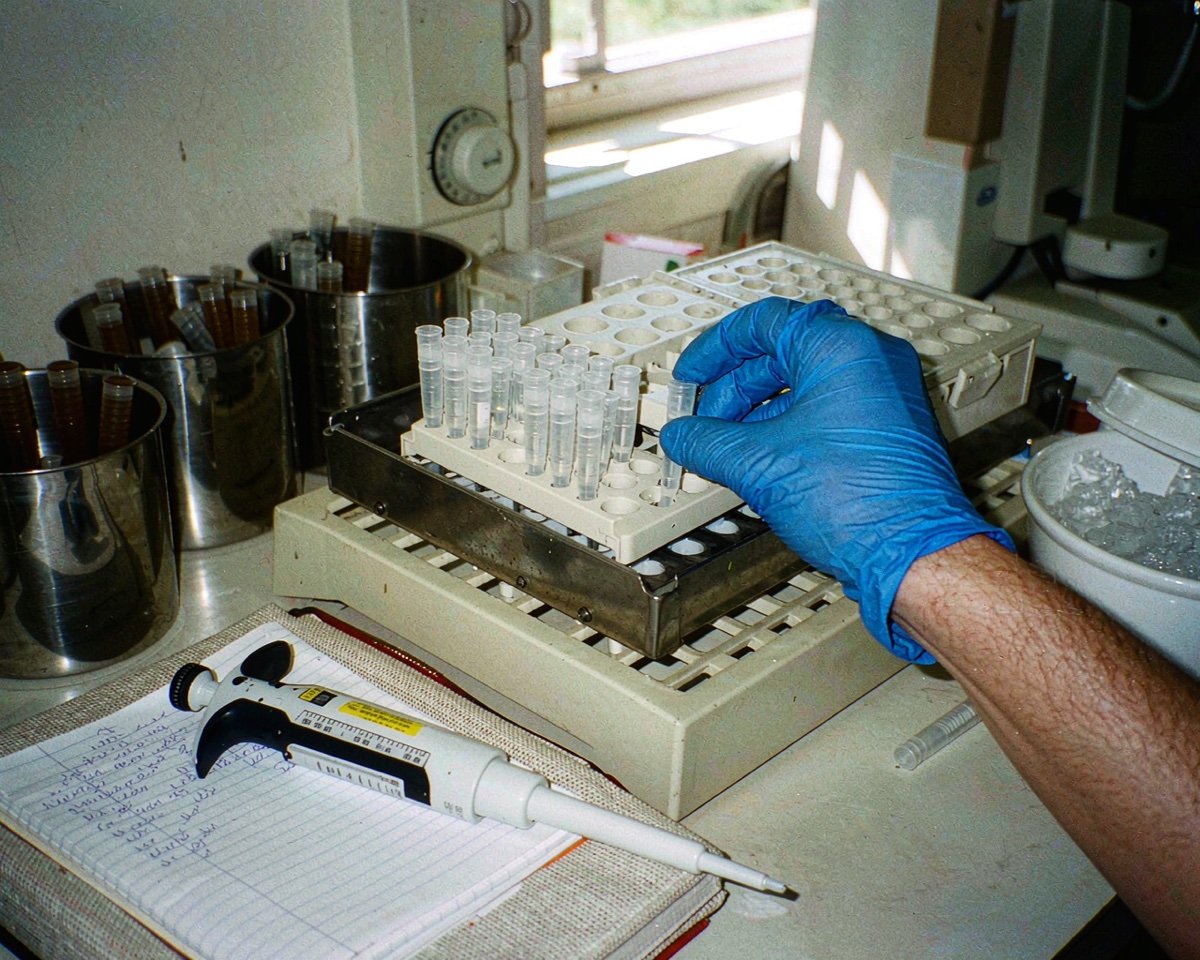
Microcentrifuge tubes are the natural fit. A 1.5 or 2 mL polypropylene tube pressed at a slight angle against the pad vortexes cleanly, and 0.5 mL tubes work the same way. Conical-bottom 15 mL and 50 mL centrifuge tubes also work, though most people hold them by hand in touch mode rather than trust a small pad to balance them. Round-bottom test tubes need a holder or rack, because a bare pad lets them wander.
HPLC vials are a special case. A 2 mL glass vial with its cap screwed on tight can be vortexed, and it works well for short mixing of standards. Leave some headspace, though. A vial filled to the shoulder has no room for the liquid to circulate, so the vortex never forms and the cap takes the beating instead. The conical inserts used for low-volume injections should stay out of this entirely; they are made for autosamplers, not agitation.
There is a practical ceiling on vessel size. The operating manual for a classic Thermo Fisher Maxi-Mix unit puts it at roughly 100 mL, and notes that the real limit depends on vessel shape, liquid viscosity, and how full it is.
The Consumables That Make or Break the Step
Tube and Cap Quality
Polypropylene is the standard tube material for vortexing because it flexes under stress instead of shattering, which is why suppliers build their sample collection tubes around it in conical and round-bottom formats. Quality matters more than people expect. A well-made 1.5 mL tube survives years of high-speed mixing; a brittle or thin-walled one can crack along the seam, especially near freezing temperatures when the plastic gets stiff. Thin-walled PCR tubes crack fastest of all, so if a protocol says “vortex gently,” take it literally.
Caps are where things go wrong. Hinged snap caps can pop open under vibration, and I learned this the expensive way: once, a snap cap let go during a 30-second mix and half a rack of pooled serum samples was compromised. Screw caps with a soft liner or O-ring hold far better, particularly with solvent or anything volatile. If the tube ships with a cheap cap and the sample matters, it is worth paying for the upgrade.
Foaming and Protein Samples
Proteins, detergents, and surfactant-heavy buffers foam when beaten with air, and a vortex mixer is a small whisk. Foam looks harmless but it denatures proteins at the air-liquid boundary and traps sample in bubbles that cling to the cap. You lose material, and your measured concentration drifts low.
If your sample foams, drop the speed and use short bursts of two or three seconds rather than one long mix. Where foam still builds, skip the vortex and swirl or rock the sample instead. Protein work also tends to include a precipitation or cleanup step afterward, and choosing the right consumables for that stage is its own topic (https://www.mastelf.com/what-consumables-does-protein-precipitation-need/).
Evaporation and Headspace
Vortexing is brief, but the friction and repeated whipping add a little heat and a lot of air-liquid contact. Over a long mix, volatile solvents and low-boiling analytes can measurably lose volume, and concentrated standards can drift from their labeled values. Keep mixes short, caps tight, and tubes no more than about two-thirds full so the liquid has room to move without pressing on the closure. Headspace discipline matters at every filling step, not only on the mixer, which we cover in detail in how to fill a vial without introducing bubbles.
Splashes and Cross-Contamination
An open tube on a running pad spits. Droplets land on the pad, and the pad remembers them, because foam absorbs liquid and the next tube pressed into that spot picks up traces of the last one. For anything trace-level, cap every tube before it touches the mixer and wipe the pad between sample groups. Cross-contamination rarely announces itself; it shows up later as replicate values that disagree for no obvious reason. We keep a list of the usual suspects in nine ways samples get contaminated before injection.
Speed and Time: What the Numbers Mean
For resuspending a soft pellet or mixing a buffer, 1,000 to 2,000 rpm for 5 to 15 seconds is usually plenty. Hard-packed pellets, bead-beating style extraction, and cell lysis need full speed, and 30 seconds is a common target in published workflows. When a protocol gives you a speed and a time, a digital mixer with a timer pays for itself, because “vortex briefly” means different things to different hands.
The accessory sets the ceiling. On Thermo Fisher’s platform system, individual tube holders carry their own speed ratings, and they vary: a holder for 10 mm tubes is rated to 2,000 rpm while one for narrow 4 mm tubes tops out near 900 rpm. Exceed the rating and the tube walks off the cup, which is the splash problem again with extra steps. Multi-tube heads that hold up to 50 samples, like those in Thermo Fisher’s vortex mixer lineup, exist for high-throughput work, and they are the right tool when every tube gets identical treatment.
When NOT to Vortex
Some samples pay a price for the orbit. Primary mammalian cells and shear-sensitive cultures can rupture, so gentle rocking or flicking is safer. Long genomic DNA fragments shear into shorter pieces under violent mixing, which quietly ruins downstream long-read or high-molecular-weight work. Volatile organic solvents in loosely capped vials are a fire-and-evaporation risk in one package. And anything that foams, as above, usually gets worse the harder you mix. A sample prep guide from Restek makes a broader point worth borrowing: the best prep step is the least one that still gets the job done.
Cleaning and Accessories
The foam pad, sometimes called a pop-off cushion pad, is a consumable in its own right. It absorbs shock, grips the tube, and absorbs every spill you don’t wipe off. When it hardens, tears, or smells like last month’s buffer, peel it off and press on a new one; most are self-adhesive replacements that take ten seconds to swap. Between swaps, wipe the pad and housing with 70% ethanol and let them dry.
A few accessories expand what the mixer can do. Flat foam pads take beakers and flasks. Tube racks and multi-tube heads keep batches upright and identical. Microplate trays let some models mix 96-well plates at reduced speed. None of it is exotic, but matching the accessory to the vessel, and the speed rating to the accessory, prevents most of the failures people blame on the instrument itself.
Conclusion
A vortex mixer is a five-second machine that quietly depends on a whole chain of consumables. The tube has to flex without cracking, the cap has to stay shut, the pad has to grip and stay clean, and the sample itself has to tolerate being beaten with air. When any one of those parts is wrong, the failure shows up as foam, splash, drift, or a rerun, and none of them look like a consumable problem at first.
So stock for the motion, not just for the volume: decent polypropylene tubes with real screw caps, spare pop-off pads within reach, and racks that match the vessels you actually use. It costs little up front and saves assays later. If you are auditing the rest of your prep bench, our guide to sample homogenization consumables is a good next stop, along with the contamination checklist for everything that happens after the mixing stops.
Frequently Asked Questions
Can I vortex a glass HPLC vial?
Yes, if the cap is on tight and the vial is no more than about two-thirds full. Short mixes of standards work fine; for conical inserts or volatile solvents, swirl gently instead.
Why does my sample foam when I vortex it?
Proteins and surfactants stabilize air bubbles, so whipping the liquid builds foam that denatures protein and traps sample. Lower the speed, use short bursts, or switch to swirling or rocking.
How long should I vortex a sample?
For simple mixing, 5 to 15 seconds at 1,000 to 2,000 rpm is usually enough. Cell lysis and hard pellets typically need full speed for around 30 seconds.
Is vortexing bad for DNA?
Long genomic DNA can shear under violent mixing, which hurts high-molecular-weight applications. Plasmids and short fragments tolerate it well; for intact gDNA, use gentle inversion or rocking instead.
What is a pop-off pad on a vortex mixer?
It is the soft foam cushion on the mixer head that grips the tube and absorbs vibration. It wears out and absorbs spills, so replace it when it hardens or tears and wipe it down with 70% ethanol between spills.