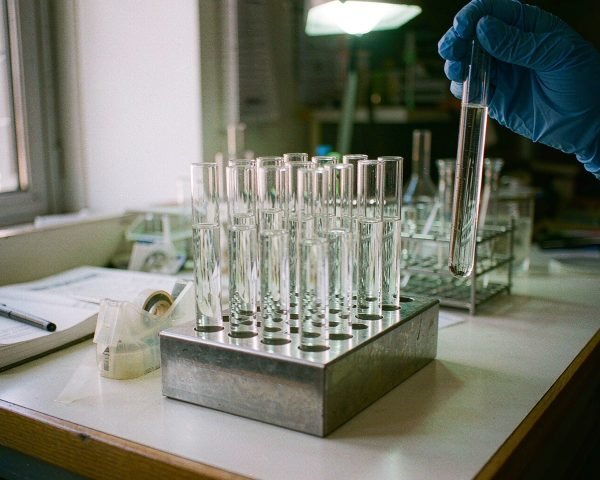

# What Are Test Tubes and How Should Labs Choose Them?
Most of us held a test tube before we ever held a pipette. That familiarity hides a real buying decision, though. Pick the wrong material or size and you get cracked glassware, failed runs, and samples you have to collect twice.
What Are Test Tubes?
Test tubes are slim cylindrical vessels with a closed, rounded end, made from borosilicate glass or plastic, used to hold, mix, heat, and observe small sample volumes. Common sizes hold anywhere from about 1 mL to 50 mL.
Read on for the material trade-offs, the size and rim details that matter on a working bench, and the checks I run before any tube order ships.
Why the Material Decision Comes First
Borosilicate glass is the default for good reason. DURAN borosilicate 3.3, the reference formulation for lab glassware, expands at just 3.3 × 10⁻⁶ K⁻¹ between 20 and 300 °C, so a tube can move from autoclave to bench without cracking (Schott DURAN datasheet). The same glass rates Class HGB 1 for hydrolytic resistance and Class S 1 for acid resistance, and it meets USP, EP, and JP Type 1 requirements for pharmaceutical containers.
Soda-lime glass costs less and works fine for disposable, low-stress jobs. It tolerates sudden temperature swings badly, though. If a method involves a flame, a hot plate, or repeated autoclaving, I would not risk it. Our Type 1 borosilicate vs soda-lime guide walks through the full comparison.
I once watched an entire rack of soda-lime tubes crack in an 80 °C water bath because someone restocked the shelf with a cheaper brand. The bath sounded like ice dropping into a glass. We lost an afternoon and, worse, about half the samples in the run.
Polypropylene (PP) tubes win when breakage risk or centrifugation dominates. Corning’s Falcon 14 mL round-bottom PP tubes are rated to 3,000 × g and ship sterile, RNase- and DNase-free (Falcon PP test tubes). Thermo Fisher’s Nalgene PPCO conical tubes reach 6,000 × g and survive repeated 121 °C autoclave cycles (Nalgene PPCO tubes, Nalgene labware guidelines). PP also shrugs off most acids, bases, and salts that would slowly etch glass over months.
So which should you buy? Glass still wins on optical clarity, solvent resistance, and direct heating. Plastic wins on safety, cost per tube, and single-use workflows. Match the material to the harshest step in your method, not the mildest one.
Size, Wall, and Rim: The Details That Matter
Tube sizes follow a diameter × length convention, so a 13 × 100 mm tube is 13 mm across and 100 mm tall, holding roughly 9 mL. Common bench sizes run from 10 × 75 mm (about 4 mL) up to 18 × 180 mm (32 mL). Wall thickness on quality tubes sits between 0.8 and 1.2 mm; thicker walls resist chipping but heat more slowly.
Rim style sounds trivial until it isn’t. A beaded (rolled) rim gives you a smoother pour and a seat for rubber stoppers. A straight, fire-polished rim suits open racks and plastic caps. If your workflow uses stoppered reactions, buy beaded rims only, or you will be fighting split stoppers at 6 pm.
Round bottom or flat? Round bottoms suit heating and swirl-mixing, and they rinse clean without residue pooling in corners. Flat-bottom tubes stand upright on the bench without a rack, which is handy for quick pH checks. The same trade-off applies when you are choosing beakers, by the way.
One detail buyers miss: nominal capacity runs to the brim. If your protocol needs 8 mL of sample plus headspace for mixing, a 9 mL tube is tight. Leave about 20% headroom or plan on splash-over the first time someone vortexes.
Matching the Tube to the Job
| Application | Default choice | Why |
|---|---|---|
| Heating, digestions, small reactions | Borosilicate, round bottom, beaded rim | Thermal shock resistance, direct heating |
| Centrifugation of small volumes | PP tube with cap, RCF rated above your g-force | Glass can shatter at speed |
| Sterile sample collection | Individually wrapped sterile PP | Sealed until use, no washing step |
| Teaching labs | Soda-lime or PP, lowest cost | Breakage is guaranteed, budget for it |
| Long-term solvent storage | Borosilicate with a PTFE-lined cap | No leaching, no solvent permeation |
A quick note on ratings: RCF (relative centrifugal force) is the g-force a tube can survive, and it is only valid for the specific gravity your supplier states. Organic solvents at low temperature can drop that rating, so check the fine print before you spin anything volatile.
Reusing Tubes Without Ruining Data
Can you reuse glass test tubes? Yes, and most labs do. The two risks are residue and etching. A routine that works: a detergent soak, a thorough tap-water rinse, three rinses with deionized water, then an autoclave or drying-oven cycle if the work is sensitive. Skip the brush with metal tips; they score the inner wall.
Plastic is different. PP scratches easily, and scratches hold residue, pigments, and occasionally your last experiment’s pride. For anything trace-level or metal-sensitive, I treat plastic tubes as single-use and never look back.
Watch for cloudiness that washing does not remove. That is etching, and an etched tube holds samples, stains, and grudges. Retire it.
Buying Checks Before You Order
Run through this list and most tube problems never reach your bench:
1. Confirm the material specification. Borosilicate 3.3 should reference ISO 3585 or ASTM E438 Type 1 Class A.
2. Check wall thickness ranges, not just dimensions. Thin walls chip; uneven walls heat unevenly.
3. Match the RCF rating to your rotor’s maximum, with margin.
4. Look at packaging. Tubes rattling loose in a box arrive pre-chipped, and dust inside them costs you a rinse cycle per tube.
5. Ask for lot documentation if your lab runs audits or GLP work.
If you only stock one size, my vote is 13 × 100 mm borosilicate with a beaded rim. It fits standard racks, holds enough for most wet chemistry, and survives autoclaving. Everything else you can add as the methods demand it.
Conclusion
A test tube is a small decision that shows up in big ways: cracked racks, contaminated runs, samples collected twice. The fix is mostly thinking through your harshest step first. Borosilicate glass for heat and solvents, polypropylene for centrifugation and sterile collection, soda-lime only where breakage is cheaper than precision. Then get the details right: a size that leaves headspace, a rim that matches your caps, an RCF rating with margin. Do that and a tube order becomes boring, which is exactly what you want from consumables. When the tubes arrive, keep the bench organized with proper racks and trays so a cheaper brand never sneaks onto the wrong shelf again.
Frequently Asked Questions
Can test tubes go in the autoclave?
Borosilicate glass tubes and polypropylene tubes both handle 121 °C autoclave cycles. Soda-lime glass and polystyrene do not. Check the material spec before you load the chamber, because a failed tube in an autoclave makes a mess you will remember.
What is the difference between a test tube and a centrifuge tube?
Centrifuge tubes have conical or reinforced round bottoms, secure caps, and a published RCF rating. Test tubes are general-purpose vessels and usually carry no spin rating. If a sample is going into a rotor, use a tube designed for it.
Are graduation marks on test tubes accurate for measuring?
Treat printed graduations as approximate. For volumes that matter, use volumetric flasks, pipettes, or graduated cylinders, which are calibrated to a tolerance class. A tube’s marks are for quick estimates at the bench.
What size test tube fits a standard rack?
Racks are bored to specific diameters, commonly 13 mm, 16 mm, and 20 mm. A 13 × 100 mm tube fits a 13 mm bore; a 16 × 150 mm tube does not. Check the rack’s bore chart before ordering a new tube size.